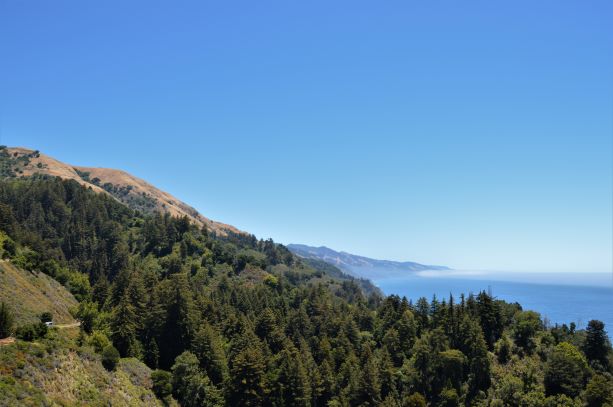
I drive south on HWY 1, the Pacific Coast Highway. There are delays caused by roadwork going through Carmel, but as I drive on towards Big Sur, the traffic thins out. A bank of fog floats in and out, flirting with the coast line. The sun is shining, and the sky and ocean are their own shades of blue. Cars are parked along the side of the road, surfers pulling on wetsuits, hauling surfboards down to the rolling waves.
The road winds, sometimes through stands of sequoias, sometimes along the edge of steep cliffs. I’m filled with eager anticipation as I near Nepenthe. The last time I was there was in the late ’80 with my beloved friend Jacquie. I don’t know if it was the hour of the day, or the day of the week, or the time of the year, but we were the only two people in the restaurant that day. Today, cars are parked along the side of the road near the entrance. I boldly enter the parking lot and get a parking place right away. I smile at my good fortune.
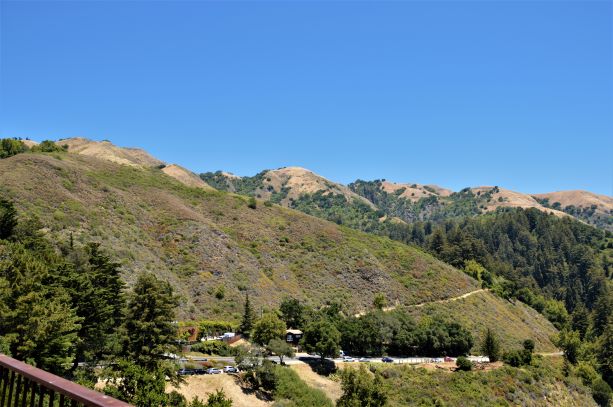
There are people everywhere. I climb the stairs to the restaurant, nestled in trees on one side, a breathtaking view of the ocean in front. The waiting area is filled, and there’s a long line outside the hostess’s podium. We are informed that the wait for a table is forty-five minutes. I decide to try my luck at the Kevah Café.
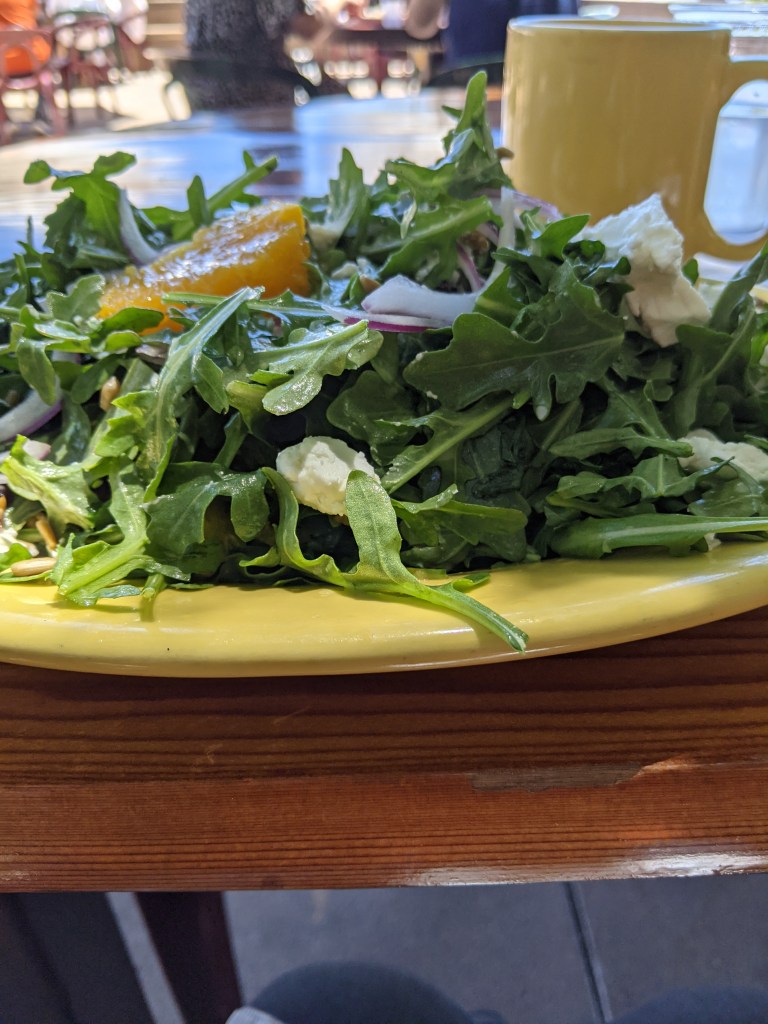
There’s is a line at the café as well, but not as long. I place my order and settle at a table in the shade to wait for the salad to be served. I write in my journal and watch a blue jay perch on a ledge, and then sweep across the patio, looking for scraps of food. The salad is served and I dig in. My taste buds are thrilled. The bitter, peppery taste of the arugula is offset by the sweetness of the orange supreme, the goat cheese and dried cherries are a tangy combination, and the shaved red onion and sunflower seeds add crunch, all are enrobed in a perfect citrus vinaigrette. I eat slowly and savor every bite.
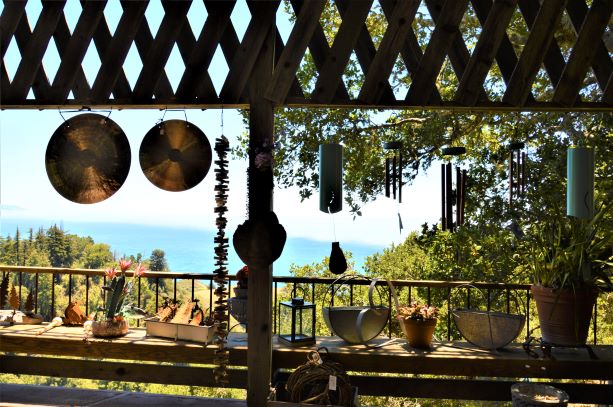
I wander down to the gift shop to buy postcards to send to my grandkids and end up on the back porch. It’s peaceful, the breeze playing in the windchimes. I stand at the rail and watch the ocean roll to the shore and remind myself that nepenthe means anything inducing a pleasurable sensation of forgetfulness.
I pull onto Hwy 1, behind a silver haired man in a blue Corvette convertible. I follow him down the winding road at a safe distance. I love the way Freedom handles the road, moving gracefully around the curves.
Foggy days have allowed the wildflowers to flourish. There are patches of bright California poppy, mustard, and lupine. Sometimes we drive through dense fog, and then blue skies, the fog lurking out at sea. After a while Mr. Blue Corvette pulls onto a view point and waves. I wave back and drive on.
For a long stretch, the road is steep and has more curves. I slow down, grateful that there is little traffic. The road lengthens and in the rearview mirror, I see Mr. Blue Corvette. We drive in tandem along the coast.
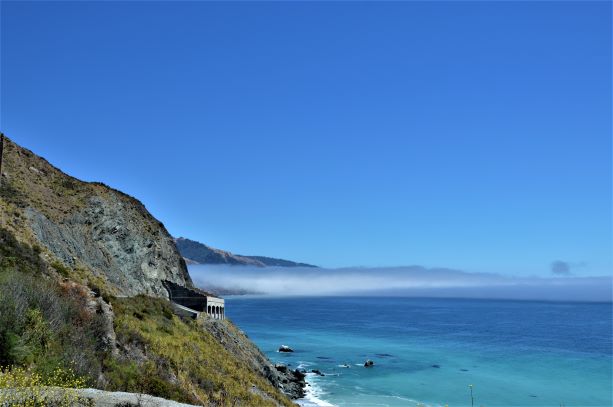
I come around a curve and the scene before me is captivating. The ocean is turquoise and violet, above it a puff of fog, and an architecturally interesting tunnel clinging to the hillside. I pull onto a view point to take a photo. Mr. Blue Corvette waves as he drives past.
Continuing on, the road becomes straighter. There is more traffic, and more homes and ranches. I drive through San Simeon, home of Hearst Castle. Cars leave the road to go to the beach, or the castle, and soon I am behind Mr. Blue Corvette. We drive through Cambria’s business section and then residential areas.
Mr. Blue Corvette turns right onto a residential street and waves. Waving farewell, I drive on towards the 101 to continue my journey.
Sometimes you need to look at where you’ve been to see where you’re going.
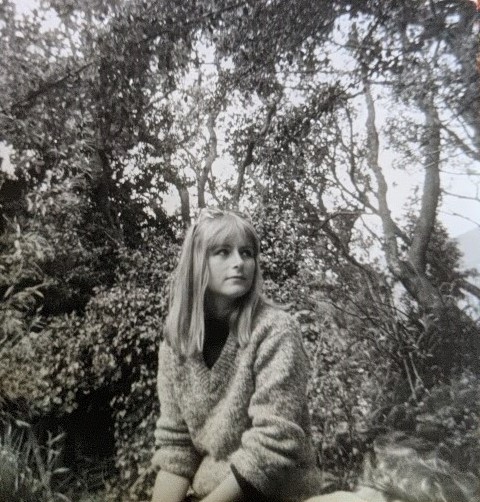
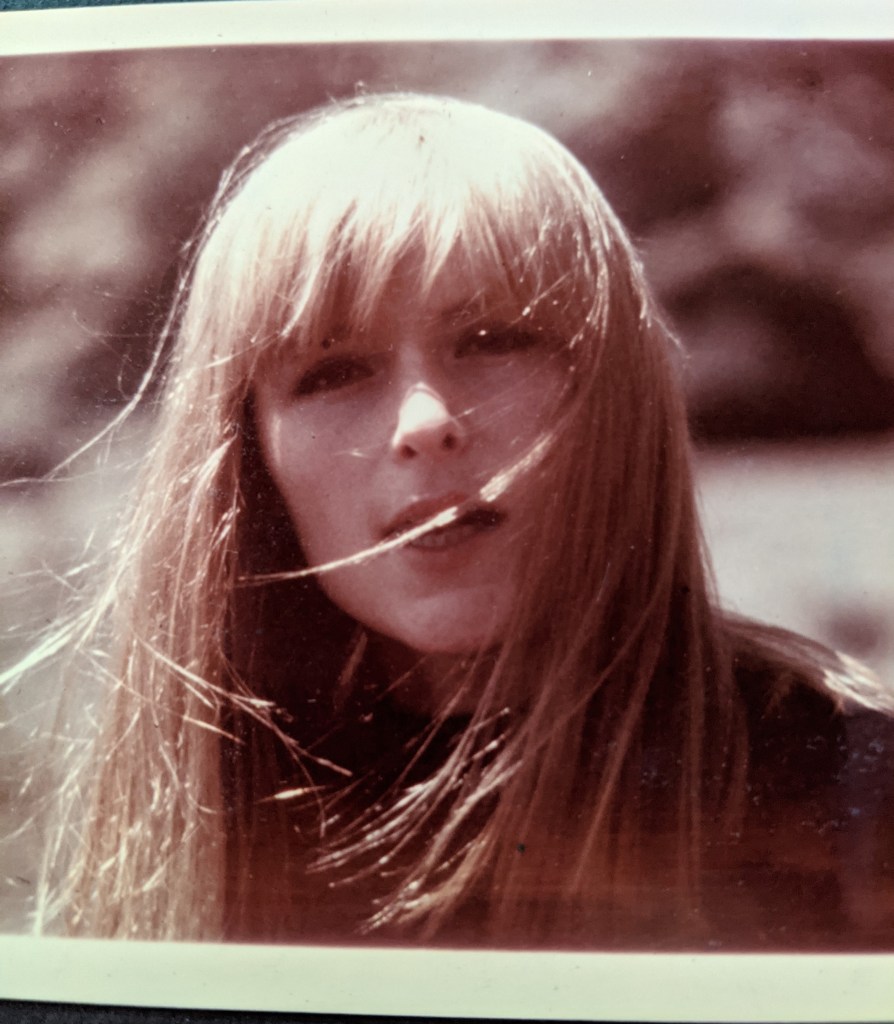
San Francisco was the beginning of my journey, all those years ago, when I left my parents’ home to become a TWA Hostess, a starry eyed girl filled with dreams, eager to experience everything life would show me. I came into my womanhood here, the yearning of my true self expressed and formed.
The path led me to the people who became lifelong friends. My first friend was Nancy. She was everything I wished I could be: tall, thin, blonde, blue-eyed, artist, Aquarian. When I admired her art, and said that I wished I was an artist, she assured me that I was. “Your life is your art,” she said.
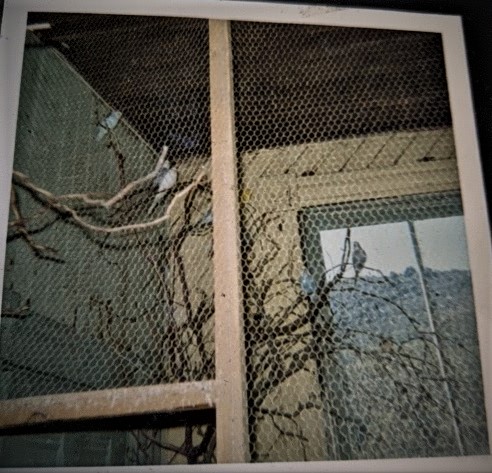
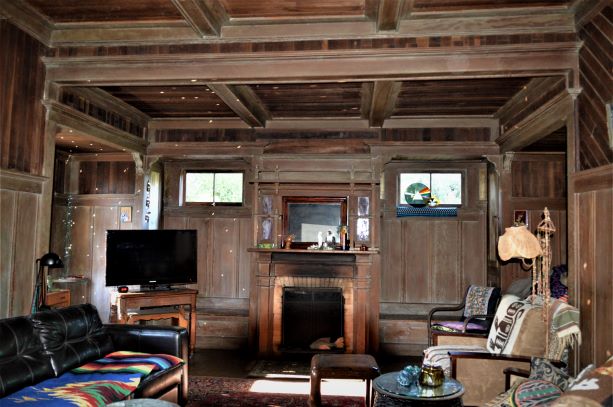
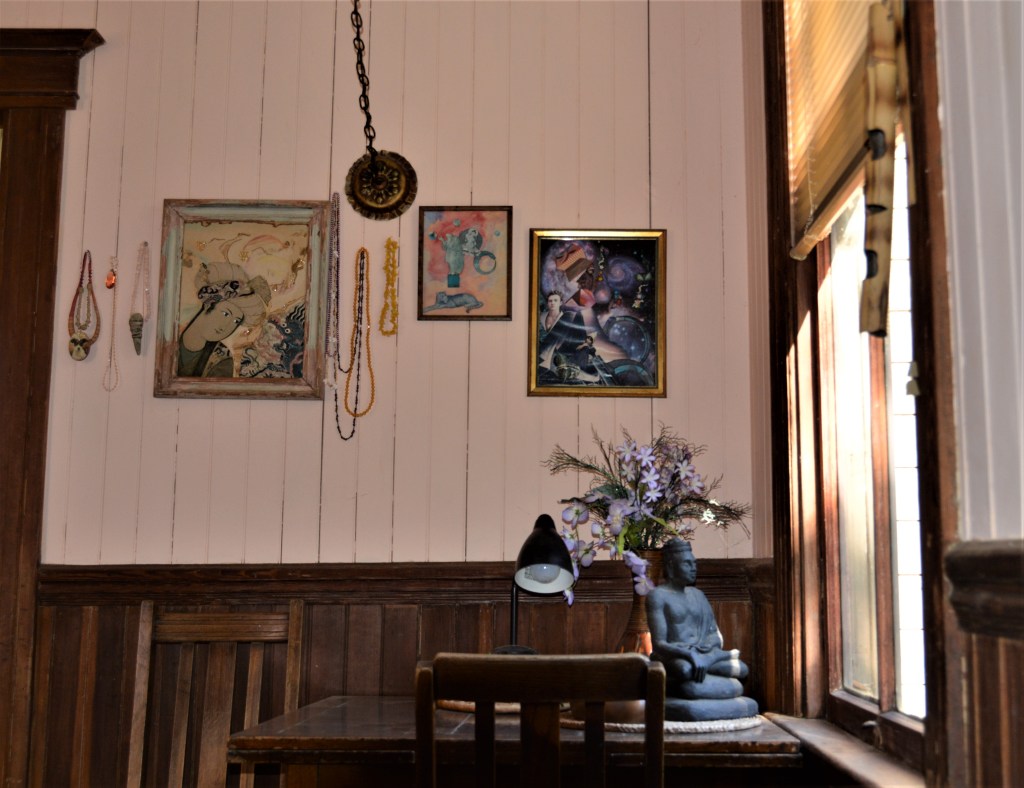
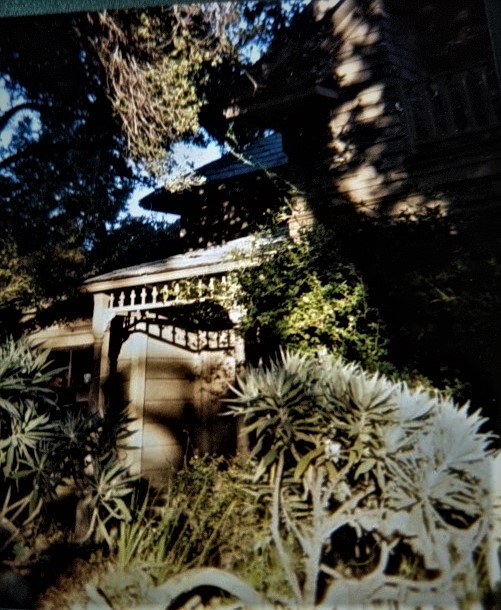
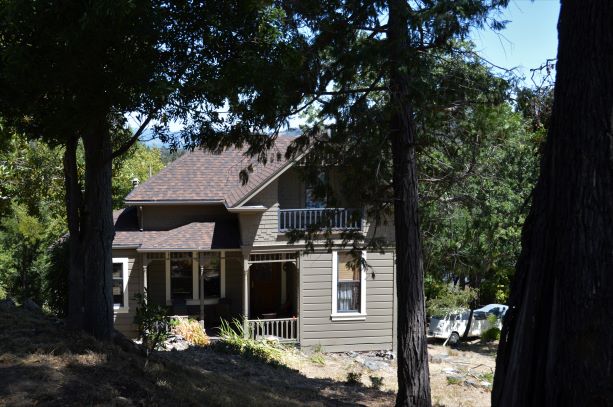
In 1965, she and her husband, Carlo, bought a beautiful, but rundown property in Larkspur. The previous owners had a pet store and kept their stock of birds in the redwood house built in 1900. They spent months cleaning it before moving in. The interior of the house is also redwood, and Nancy painted only the stairwell and one of the downstairs rooms. I remember helping paint it, each slat a different shade of lavender interspersed with pale yellow. Nancy’s art form is collage, and the house is decorated with her numerous pieces.
Carlo was a dentist and had an office in North Beach. After hours it was a gathering place for old Beats and the young Hip. Over the years, their home became a gathering place for intellectuals, writers, artists, and musicians. Carlo was a student of Hinduism, and Swamiji Satchitananda and Yogi Bhajan, were guests who stayed there to give series of lectures.
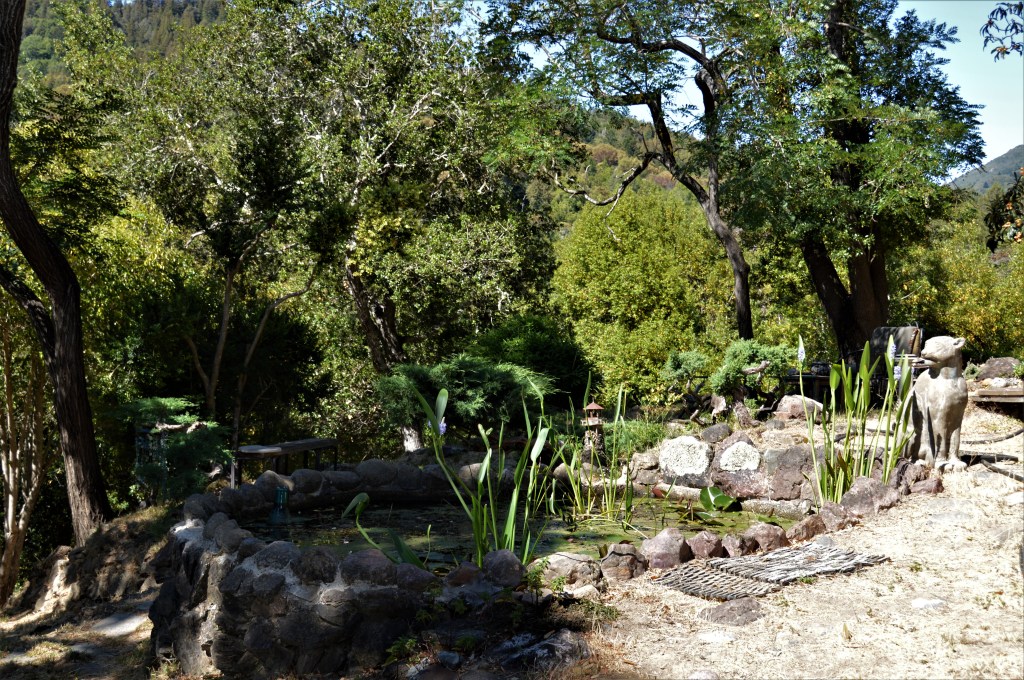
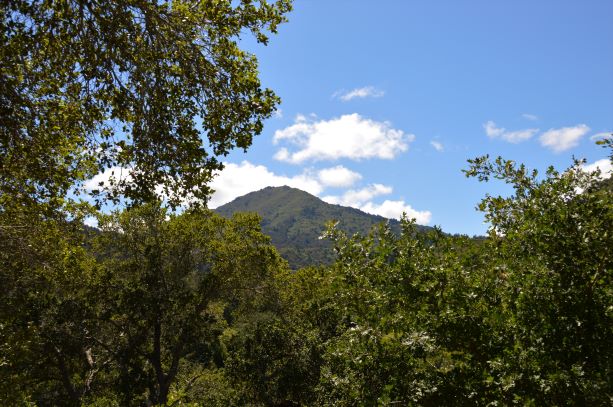
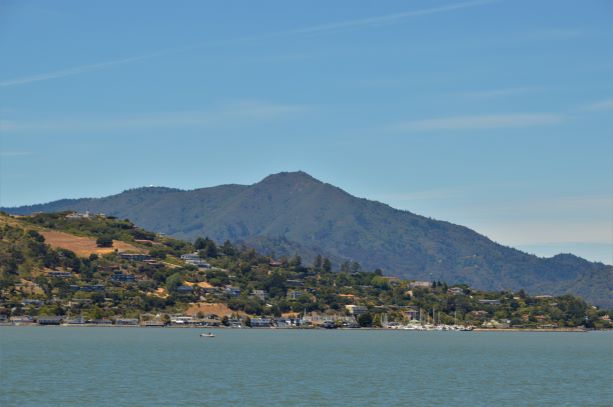
Nancy and Carlo groomed the hilly acre the house sits on into a lush oasis. Wisteria hung in cascades of purple and white from the retaining wall all along the driveway. Carlo used bamboo as natural screens to create areas to sit in quiet conversation, or contemplation, and hard labor to trim and clear overgrown shrubs to reveal the view of Mt. Tamalpais.
There is so much to learn when we are in our twenties, about life, about the world, about relationships. There were fun times going to concerts, seeing the great new artists of the times, learning how to care for our bodies and of those we loved with healthful food, consciousness expanding conversations over dinner, and creating art. There were concerns for the world: using our voices for peace rather than war, for Civil rights, the environment. At the heart of it was the relationships that tried and tempered us, learning what it means to be an individual in a changing society.
Nancy and I have been friends since those days. While I moved around, she remained in Larkspur, loving caretaker of the home and property that I think of as a monument to the ’60s. Though our life experiences have taken us in different directions, the bond of love and friendship has not diminished over the years.
Not long after I arrived in San Francisco, I met Bryan, a dentist in practice with Carlo. He lived in Mill Valley, and when we married, we bought a house there. Two years later we bought a fourteen acre holly and Christmas tree farm in Sebastopol. Our son, Luke, was born during the time we lived there.
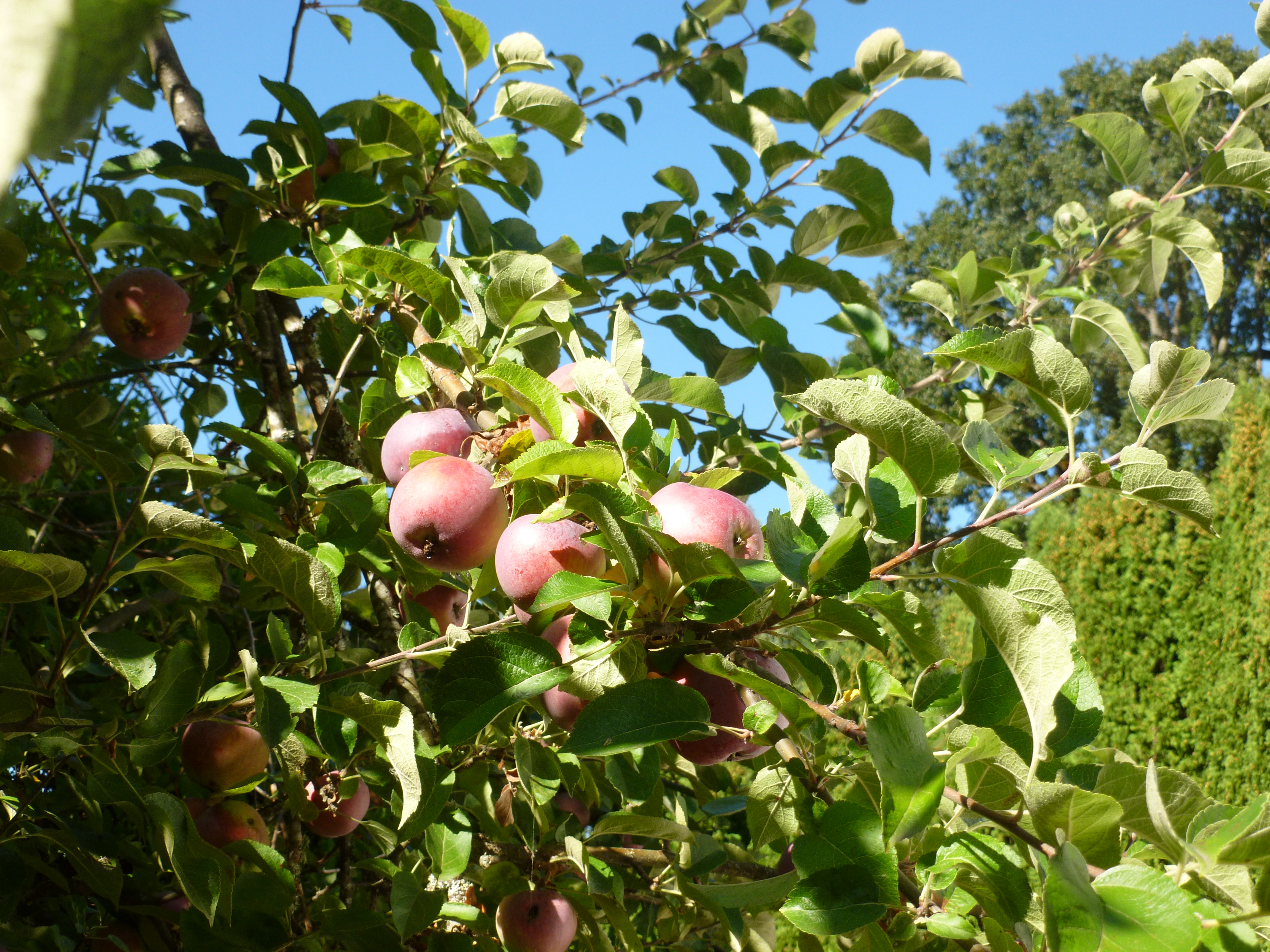
When we moved to Sebastopol it was a quiet agricultural community, its main crop Gravenstein apples, and its motto, “The apple capital of Northern California.” At the time, there was an influx of young people looking for alternative lifestyles, living off the land. We bought produce from farm stands, and staples from a co-op one of our neighbors started.
I learned to bake bread, and can the abundant produce from the garden. I planted my first organic garden shortly after Luke was born. One morning I heard planes flying nearby. Looking out the window I see crop dusters spraying the surrounding apple orchards. I was devastated, and realized that one’s garden is only as organic as the neighbors’ orchards.
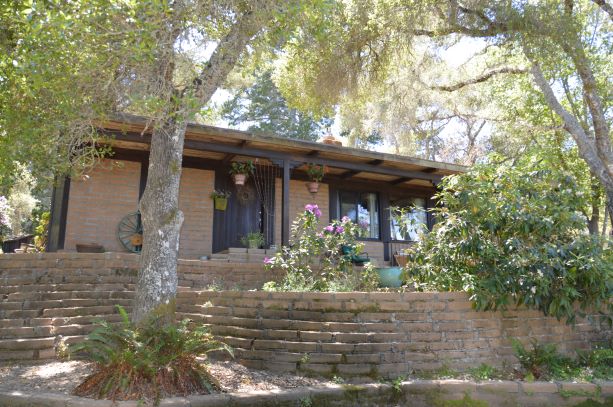
The house we lived in was yellow adobe brick. From the front terrace there was a sweeping view of the Napa Valley, all the way to Mt. St. Helena. The lower part of the property was planted in holly trees, and the driveway was lined with jasmine. I loved to walk down to the mailbox carrying my baby, breathing that delightful fragrance. Outside the kitchen window was a manzanita tree with its red, peeling bark and waxy flowers. To me it was heaven on earth and I loved my life.
I wanted to see Sebastopol and the homestead. I expected change, but not the kind I saw. The town was teeming with tourists. It has become a Disneylandish version of an old fashioned American town, nothing like the little farming community I knew. I took Bodega Hwy to find the road where I once lived. The farther I got from town, the more rural it became, but where were the apple trees? Many of the small farms were now planted in grape vines, the land leased to wineries.
The road I had lived on was unrecognizable. I drove up and down it several times looking for the house. It had been visible from the road, gently sloping up to a knoll. Now the holly trees are gone and the lower property is overgrown with tall pines and other trees. When I found the address marker, I took the narrow driveway up. There were people sitting on the terrace. I lowered the car window and said, “I’m sorry to intrude. I used to live here and I wanted to see the house.”
The woman was gracious and not only invited me to join them, she treated me like an honored guest. A sturdy brick house, it hadn’t changed much, except for the art studio that she’d added on, and the updated kitchen. We sat in the living room, she wanting to know all that I knew about the house, me feeling the life I lived here.
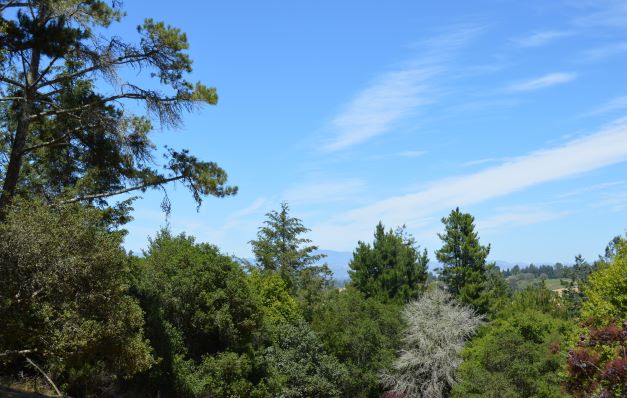
Besides the holly, the jasmine and manzanita are gone, and the view to Mt. St. Helena is blotted out by the tall trees.
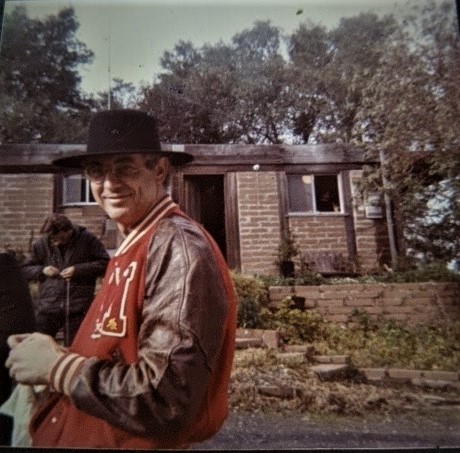
Bryan and our friend, Keely, December, 1969. They filled the van with holly trimmings and sold them at the florists’ market in San Francisco
Present day, only a glimpse of Mt. St. Helena in the distance.
The traffic was bumper to bumper down to Larkspur, my heart breaking by how much the countryside had changed. The road that once was flanked by open fields and rolling hills, was now lined with big box stores and shopping malls. I last visited Nancy twenty-one years ago. Larkspur had grown quite a bit then since I’d visited in the mid-’90s, but the growth and density now in Marin County shocked me.
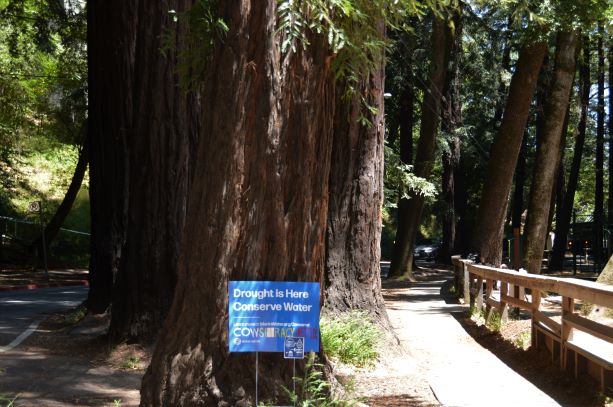
Drought and the threat of fire are palpable. Years ago, when the drought became serious, the electric company cut down the wisteria on Nancy’s property, the beautiful blossoms that once lined the path to the house, gone. Trees have been cut back or removed; the bamboo chopped down to the nubbins.
A teacher once said to me that all progress is change, but not all change is progress. I know we need housing and jobs, but it’s my opinion that unrestrained growth is a major contribution to the climate crisis we are experiencing.
I took the ferry from Larkspur Landing to San Francisco and walked from the terminal to North Beach. The area looked pretty much the same, even the building Carlo and Bryan’s office was in, but it was crowded. There was a live jazz concert in Washington Park, across from the Cathedral of Saints Peter and Paul. The Park was filled with people. Some sat talking in groups, some walked dogs, a group of young men tossed a football.
It was hot that day. I kept thinking of a quote by Mark Twain, “The coldest winter I ever spent was a summer in San Francisco.” I remember those cool, foggy summers, now a thing of the past.
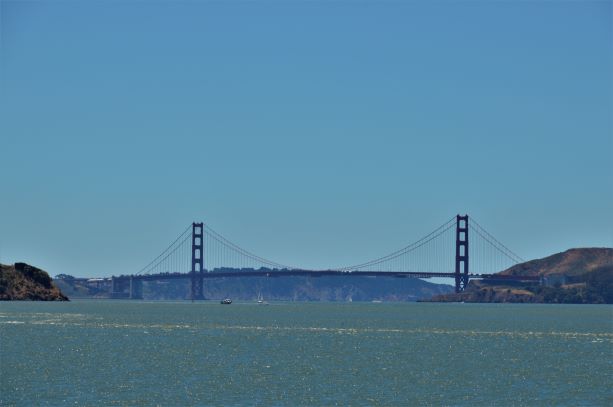
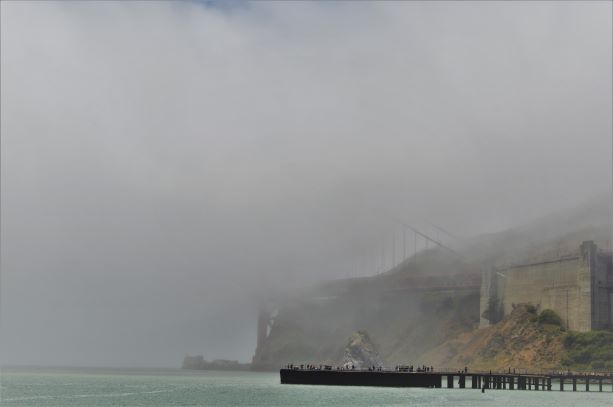
The morning I left Larkspur, it was already ninety degrees. I wanted to take a close up look of the Golden Gate Bridge before crossing it. When I arrived at Ft. Baker, at the base of the bridge, a thick plume of fog filled the mouth of the bay, shrouding most of the bridge. The sound of foghorns moaning filled the air. I’m happy to have spent five days with Nancy, and for the lessons learned in the years I lived in the Bay area. I remember a saying from the EST training I took in the ’70s, “I used to be different, and now I’m the same.”
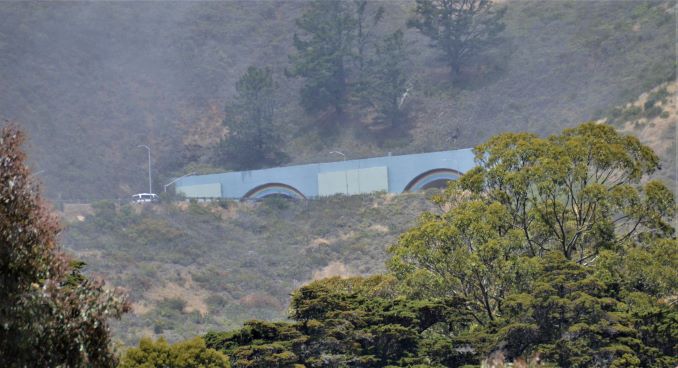
I drive past Vista Point and onto the bridge. In farewell, I glance in the rearview mirror at the Waldo Tunnel, the rainbow entrance to Marin county. Tucking my memories away in a special corner of my heart, I drive into the fog and the mysterious future.
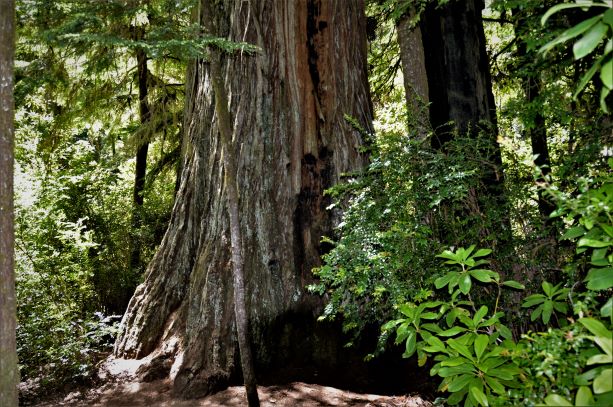
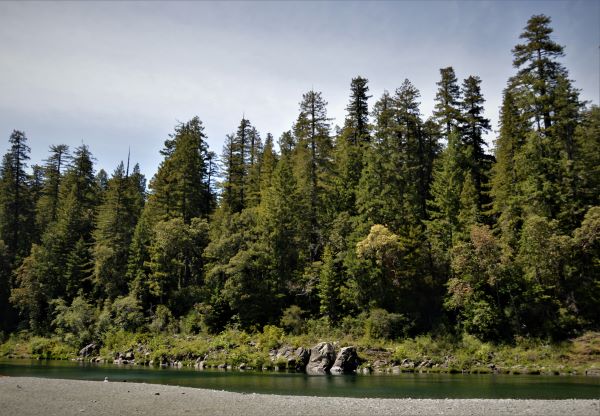
I took my time driving down HWY 101, stopping to spend time in Jedidiah Smith Redwoods State Park. There are ten thousand acres of primeval redwood groves that protect forty-five percent of California’s remaining old growth redwoods.
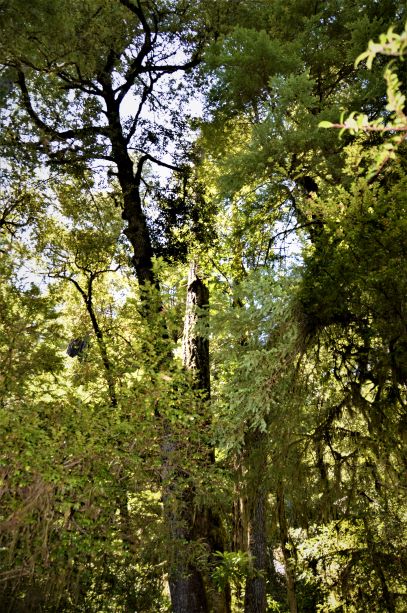
California’s coast redwoods live along the fog belt. They need the fog for their survival, and flourish at elevations below two thousand feet. Trees grow three hundred feet tall or more, with a base diameter around twenty feet. The oldest coast redwoods are about two thousand years old and show no signs of dying out. They resist insects, fire, and rot to a remarkable degree, and sprout back when cut or badly burned.
The Yurok, Hupa, Karuk, Chilula, and Tolowa people inhabited the area. Tolowa descendants are still present in Northern California, and many continue to practice their traditions. European settlers depleted natural resources, causing far-reaching environmental changes.
A cooperative was created in 1994 between Jedidiah Smith, Del Norte Coast, and Prairie Creek Redwoods State and National Parks to manage their combined 105,516 acres of old growth redwoods.
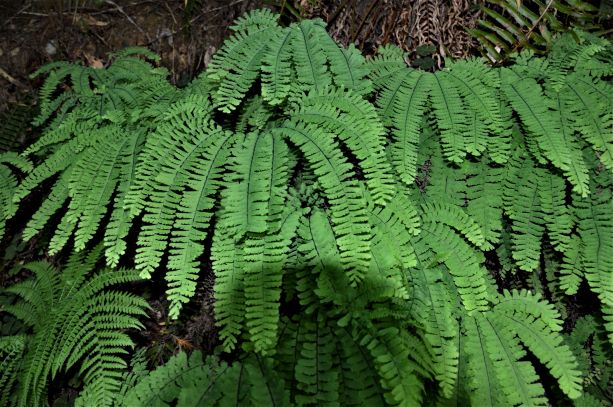
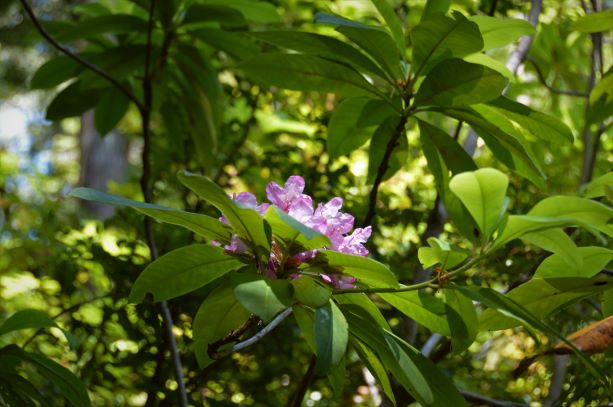
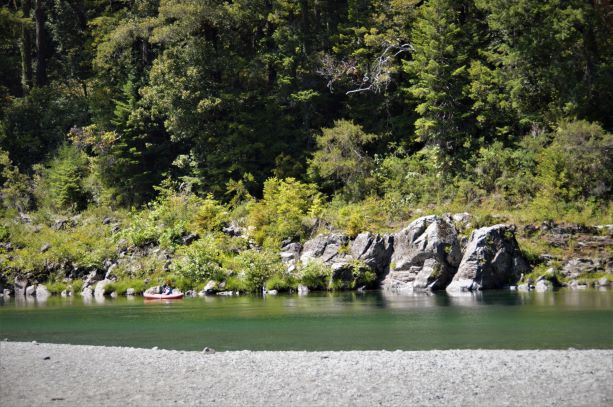
Hiking among the magnificent redwoods filled me with awe. The narrow trail winds up along the Smith River, rising from gently sloping to steep, with steps cut into the soil in some places to facilitate the climb. A wall of ferns feels silky. I’m surprised to see rhododendron in bloom along the path, as well as wild Douglas iris, and a variety of other flowering plants and berries. The new-grown tips of the redwood trees are soft and feathery.
The sun is hot, but there is a cool breeze that rustles in the trees. I don’t know how long I’ve walked, and I’m hot and thirsty. I see a tree stump and decide to sit, rest, and drink some water. I am deep enough into the woods that I no longer hear the whoosh of the cars rushing past on the road, only the birds singing songs different from ones I’m used to hearing, and the sound the wind makes as it teases the trees. I sing a song of made up words about how beautiful the trees and sky are, and how happy I feel.
“That’s nice.” I hear someone say. I’m startled. I thought I was alone.
“More please.” I look around and realize that what I thought was a tree, was actually an extraordinarily tall person, covered with shaggy hair. “I don’t normally talk to humans, but I don’t think you’d hurt me, and you’re happy.” His voice was soft, calm. “I come to look at the river. I can stand in the trees and most people don’t see me, although they look for me.” I noticed that he did blend in with the trees. It was his stillness.
“Be careful. You are vulnerable alone in the woods,” he said.
“From wild animals?”
“No, other humans.”
“Most people are nice.” I say, and then realize that as I’d be afraid of a bear, he was afraid of humans. “Has a human ever hurt you?”
“No, but I see what they do to other creatures and to each other.”
I sat quietly beside him, letting time pass, enjoying his presence.
“What you’re looking for, I think you’ve found it.” He sighed.
The wind sighed.
I sighed.
Rested, I hike down to the road and cross to the campground to enjoy the beach on the Smith River. There are a few kayakers on the river, and families sitting on the beach, children splashing in the water. I ponder whether the color of the water is teal or turquoise. A mother calls to her children. “C’mon, let’s go for a walk in the jungle.”
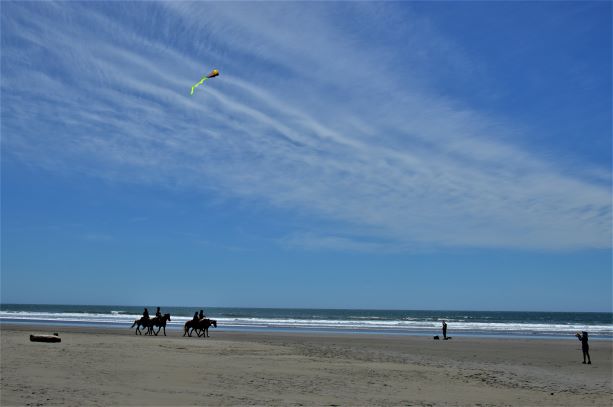
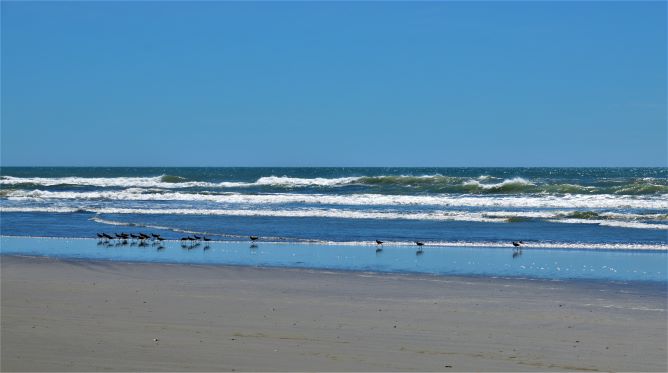
Driving along the coast I stop at Crescent Beach. I walk the length of the beach and watch families play, running in and out of the waves, flying kites. People ride horses. Sandpipers feast along the shore at the Good Eats Café. It’s cool and windy and I let my guard down as to how intense the sun can be. I return to the motel, windblown and sunburned.
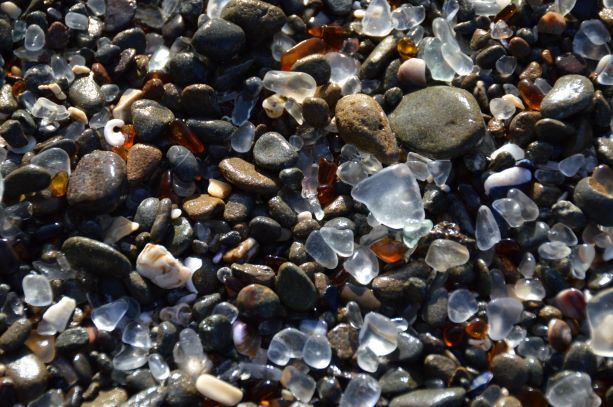
Glass Beach at Ft. Bragg, CA is a place I’ve wanted to see for many years. The beach, once knee deep in bits of sea tumbled glass, now has only remnants of the feature that draws people here. Yet, families come with thirty-two ounce drink cups to collect what remains.
Packing a home to move forces a person to face oneself.
A few years ago, Marie Kondo caused a sensation talking about decluttering, saying to discard an item if it doesn’t “spark joy.” Over the years I toyed with the idea of decluttering, but everything I saw and touched sparked joy.
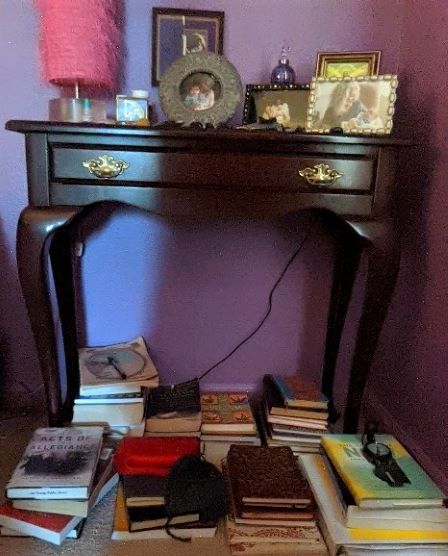
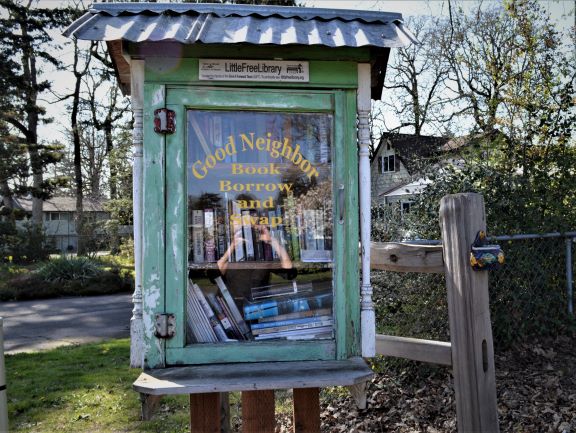
When I made the decision to sell the house, I promised myself to eliminate as much as possible. Room by room, I filled box after box. I recycled a large amount of paper that consisted of saved newspaper and magazine articles, recipes that sounded good but were never made, lists of things: to do, to read, to see, to write about. It was difficult eliminating books. I saved the ones I loved the best, and distributed the rest in little neighborhood libraries from which I’d borrowed books in the past.
I consigned some clothing and donated the rest. The clothes I wore to garden and clean the house that were worn to rags, were given to Ridwell, a recycling company. They take what other recyclers won’t and distribute them to innovative industries that make useful things, such as insulation from shredded old clothing. Still, I have a wardrobe filled with clothes I just can’t give away: winter coats, some rather fancy, dating back to the eighties. I have an ivory and gold brocade suit I bought in December, 1963. It’s gorgeous. I look at how tiny it is and remember that when I wore it, I thought I was fat.
There’s a box of shawls and scarves of all shapes and sizes: wool, silk, rayon, cotton, in various colors, some with bold prints. The first shawl I bought is crimson red, printed with bright flowers. It has a long fringe. It’s frayed in many places from the many years I wore it. When I could no longer wear it, I found other uses for it. It is carefully folded and placed with other treasures. It is too much a part of my life to give away.
Another box is filled with gloves. The gloves range from heavy duty winter gloves, to leather, velvet, wrist length, elbow length, and one pair of arm length black satin gloves that I wore with a strapless, purple satin dress. There are also a pair of white cotton gloves I bought for my granddaughter to wear when we went to see Broadway shows at Keller Auditorium.
I love gloves. They’ve been a part of my life as long as I can remember. I went to an all-girls parochial school, St. Angela Hall Academy for Young Ladies. As stated in the title, part of our education was to become ladies. Every Thursday we dressed with white bows in our hair and wore white gloves. We learned manners, how to introduce someone or a group of people, how to accept a dance when a gentleman asked. We also learned how to waltz. One week we danced the girl part, the next week the boy part.
In the fifth grade the school admitted one boy. His name was John. He was in my class. Every week the nuns would tell him who to ask for a dance, each dance with a different girl. He learned how to put his hand on our waists, arm’s distance. Every other week I had one dance with John. In class he sat one row up, one row over. Sometimes he’d turn and look at me. He’d pretend he didn’t see me looking at him, and I’d pretend I didn’t notice.
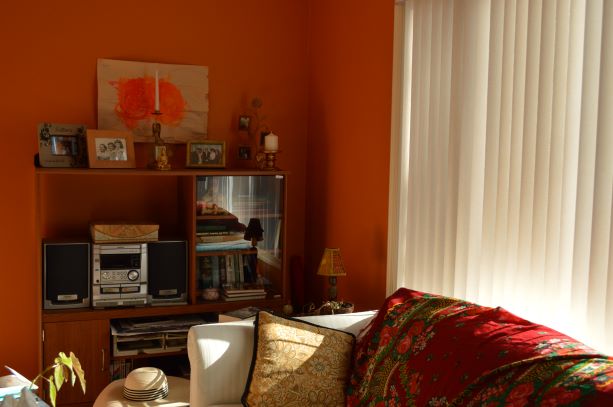
Today I took down the art from the walls. My art is eclectic, much of it from my creative friends: paintings, pen and ink drawings, and collages. There are pictures cut out of magazines and beautiful cards that I framed. One inspired a poem that I wrote for my granddaughter when she was four years old; card and poem are framed together. There is a painting of the moon hovering over a rocky shoreline that I bought at an art fair in Corte Madera, California nearly fifty years ago. It called to me from a distance, as if it was made for me.
There’s a beautifully framed poster of Georgia O’Keeffe’s White Calico Flower that I bought at the Los Angeles County Museum of Art after viewing a special Georgia O’Keeffe exhibit in March, 1989. It was a magical day. A brief, but intense, storm had blown through southern California leaving the skies so clear that they were ultra-blue. I’d never seen Los Angeles so lovely, nor have I since. The exhibit was breathtaking, and best of all, it was a day shared with my beloved friend, Jacquie. Whenever I look at that picture, a vivid memory returns of walking the darkened halls of LACMA, O’Keeffe’s lighted art, unique, stunning, and captivating, the astonishing color of the sky, and the warm friendship of an extraordinary person.
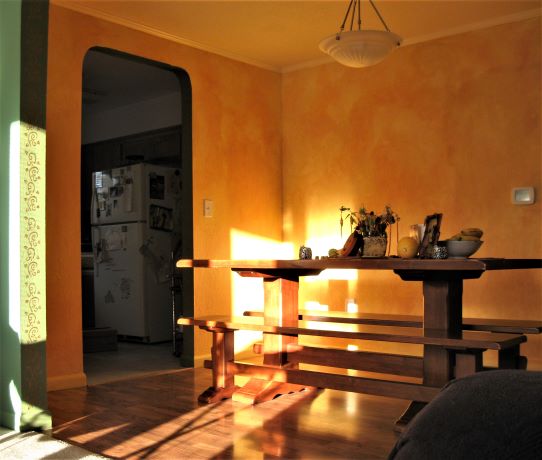
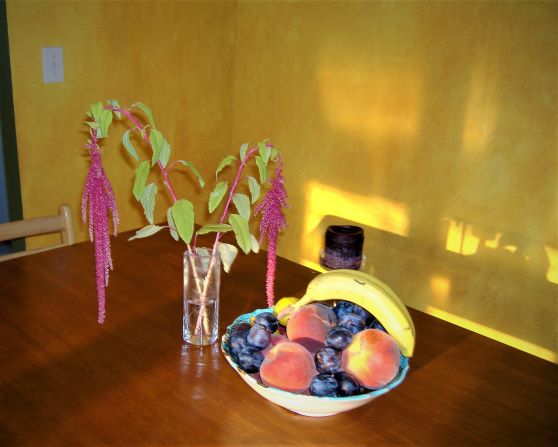
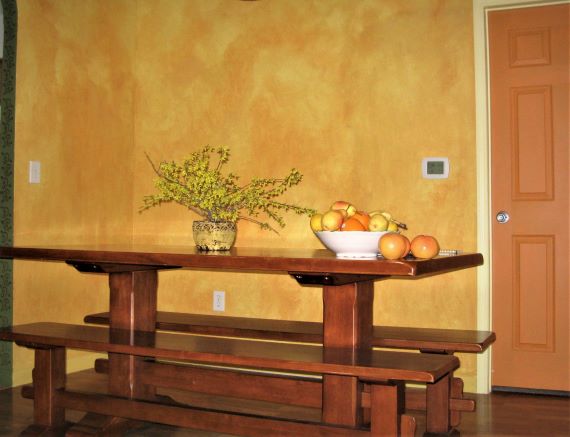
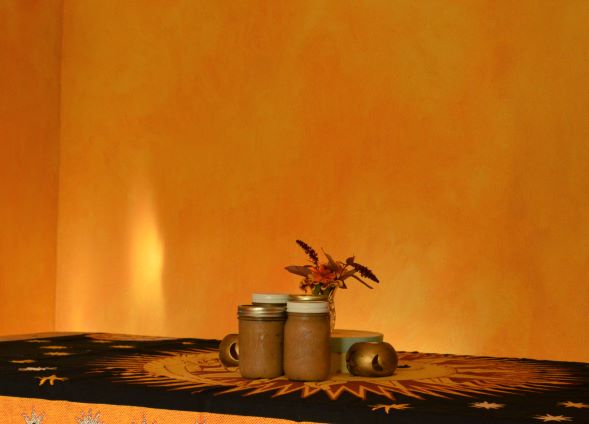
Everything has a memory, but some have no physical counterpart to pack away, such as the way the light fills the house. I faux painted the dining room with my dear friend, Shauna, layering and feathering paint of pale yellow with a light, then deeper orange. It was a day of joyful camaraderie. When the afternoon sun hangs low in the western sky in spring and autumn, it shines through the living room window and the dining room glows.
The early morning sun rising in the east touches the crystals hanging in the bathroom window, creating shards of rainbows that shine on my bedroom walls.
Some things not only represent memories, they contain energy. The last time my youngest grandchildren visited, they’d stand at the living room window to look out at the day, hands and faces pressed to the window. In the morning light, their little hand prints glow. It’s as if they are here with me.
I’ve given many tokens of parts of my life away, shared some with friends and family, and put the rest in storage. I tuck these memories in my heart and leave the house to a lovely young couple to create their own memories. In a few days I venture out on a loosely planned journey to meet whatever surprises life may have in store for me.
I hope you will follow this blog for the Free and Pure Adventures of the Write Mind of a Left Hander.
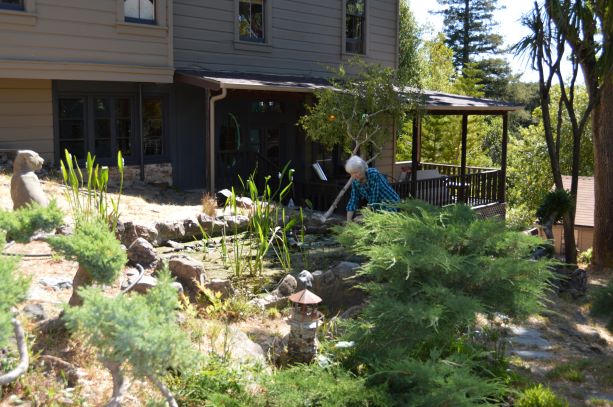
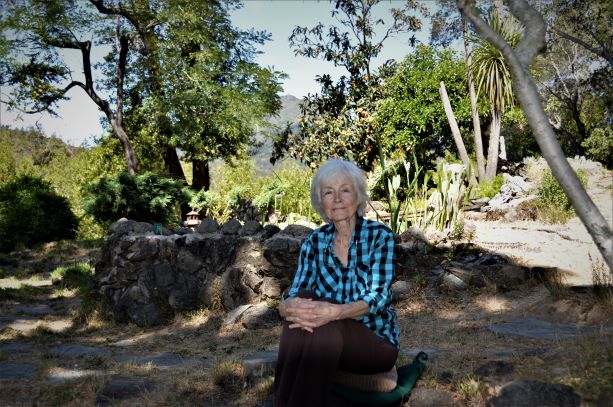
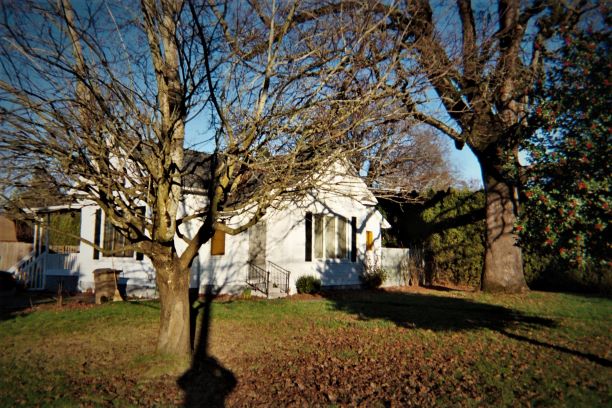
When I bought this quarter acre lot nearly seventeen years ago, I fell in love with the magnificent Oregon white oak, red leaf maple, and holly trees that command the front yard. The house just happened to come with them.
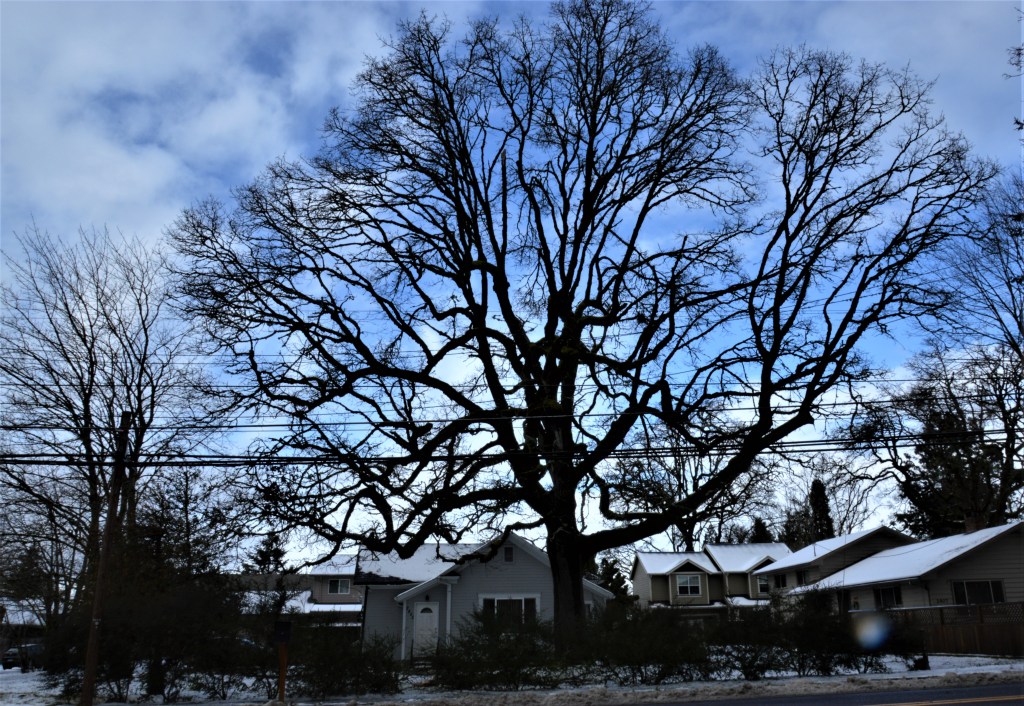
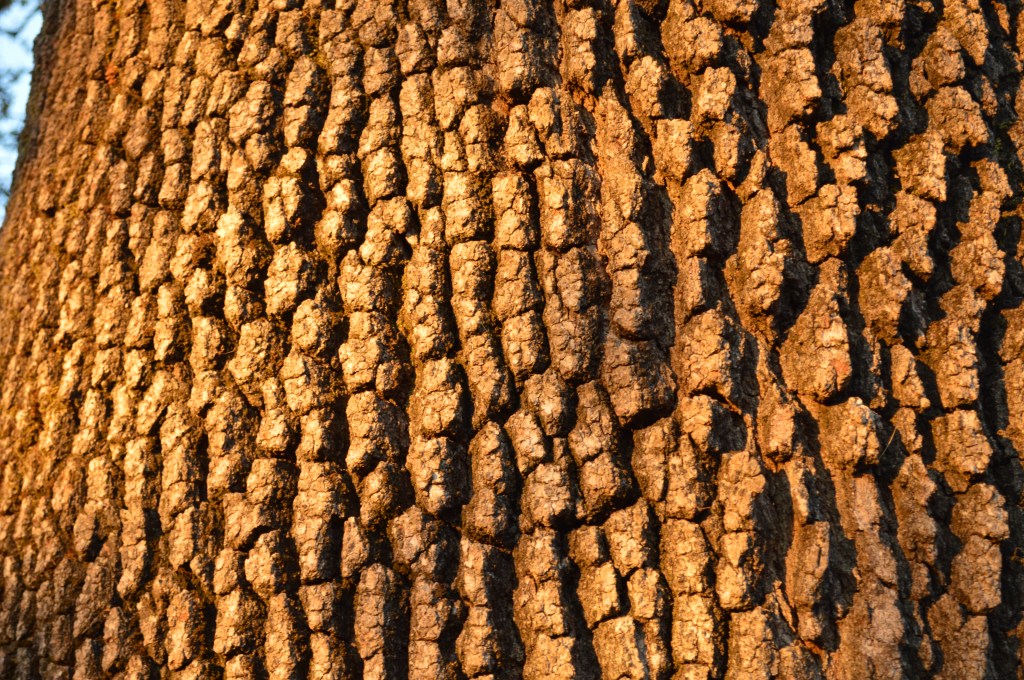
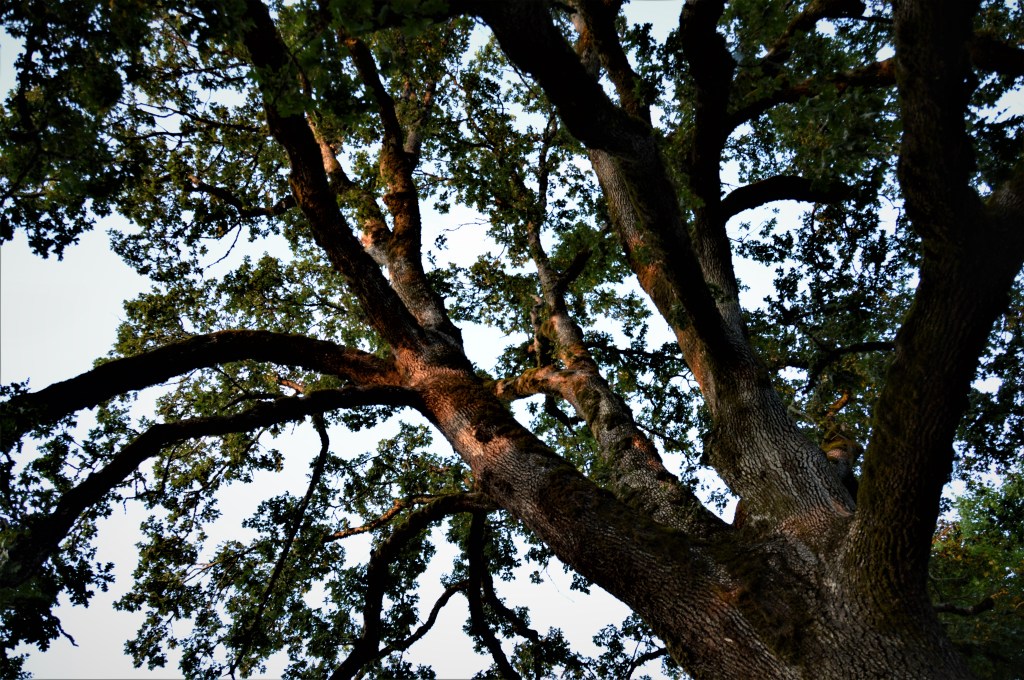
Over the years the trees have delighted me. I’ve been told that the oak tree is one of the three trees that Oak Grove was founded around. She is a majestic beauty. She has grown taller over the years, and her arms span the width of the property. People walk by and stop to admire her.
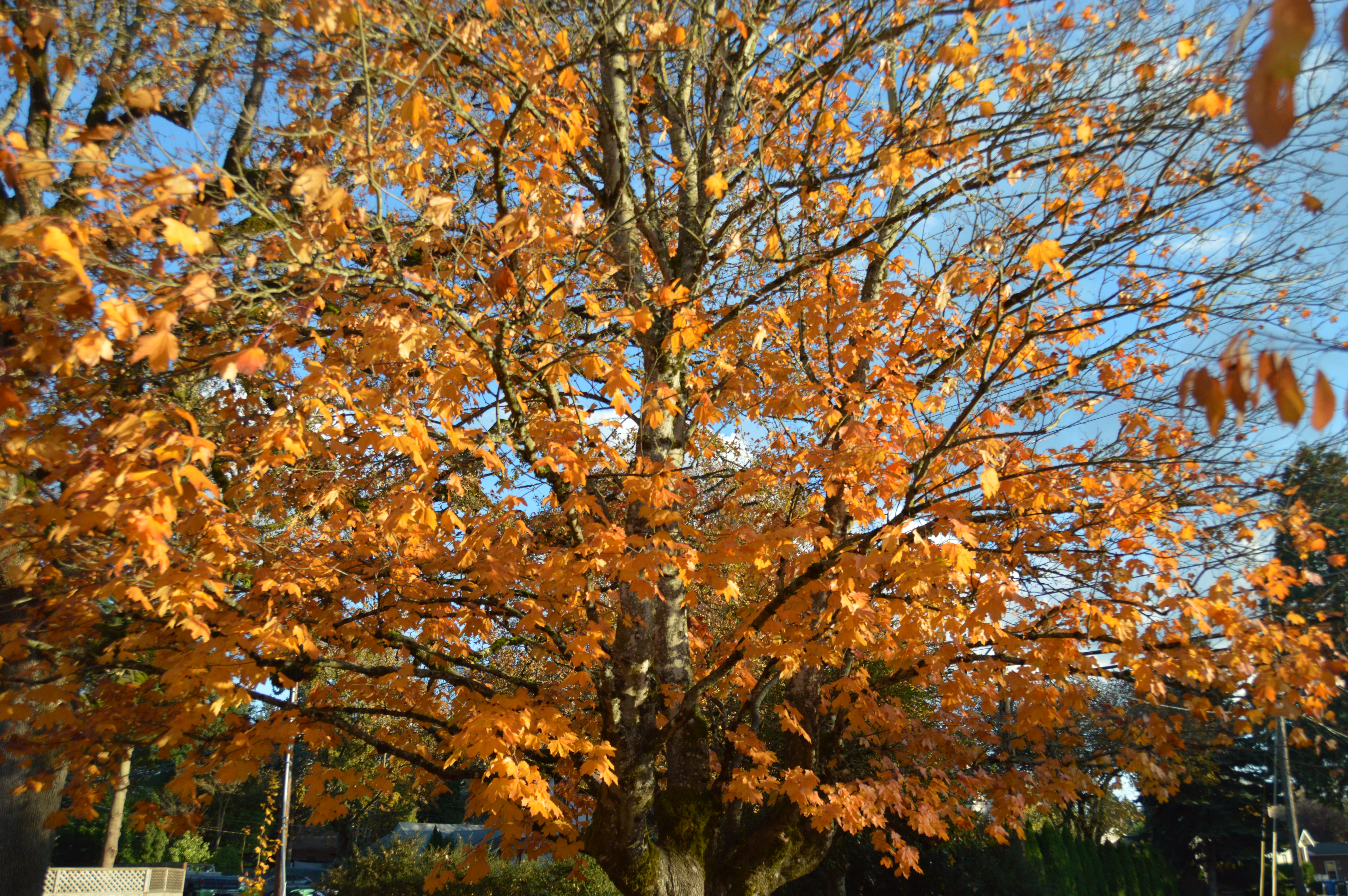
In the spring, the maple tree flowers before it leafs out. Those flowers become seeds called samaras, or ‘Polly noses’ as I knew them in my childhood. In the autumn, when the sun is at a low angle in the afternoon sky, the red leaves glow, and the tree looks like a controlled blaze. I have tried to capture that light on camera, but I don’t have the technical know-how. It’s a sight that is forever etched in my memory.
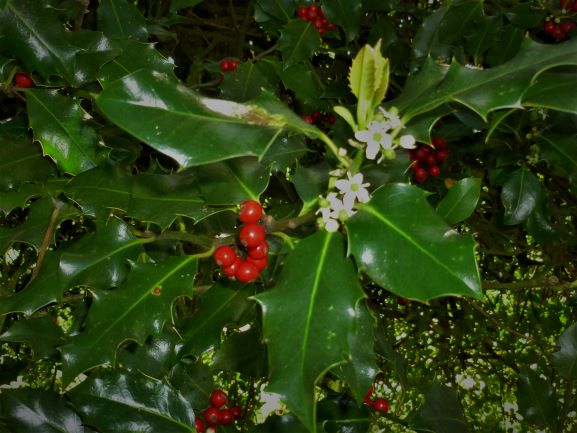
Branches from the holly, with its shiny leaves and brilliant red berries, have decorated my home for the holiday season every December.
I have found peace and joy tending to everything that lives on this little piece of land: the plant life, insects from bees to spiders, the birds who fill the air with their song, or who squabble over territory, and the squirrels, those thieving, but entertaining rodents.
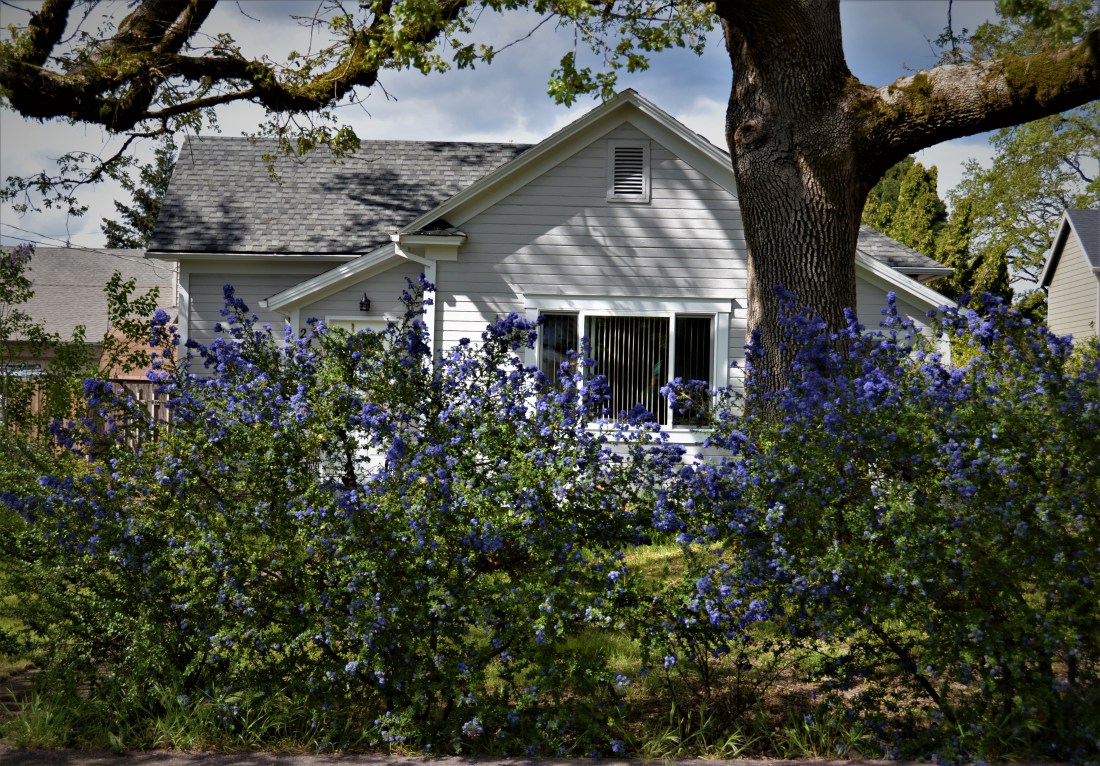
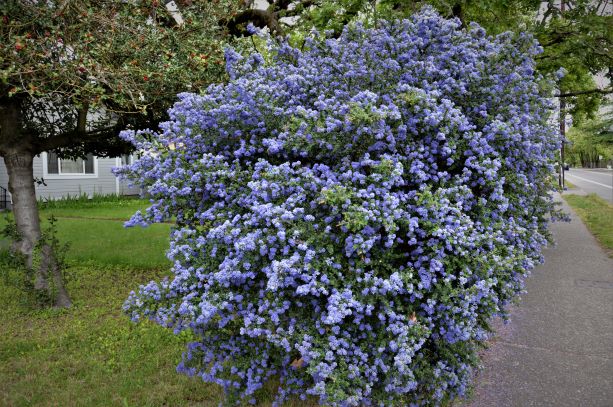
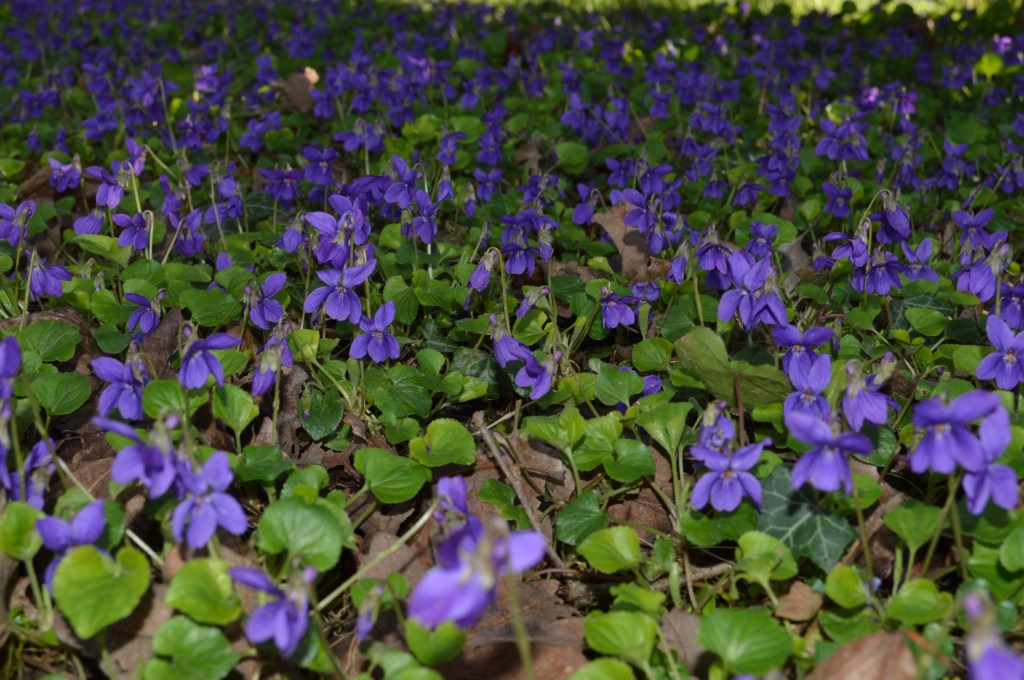
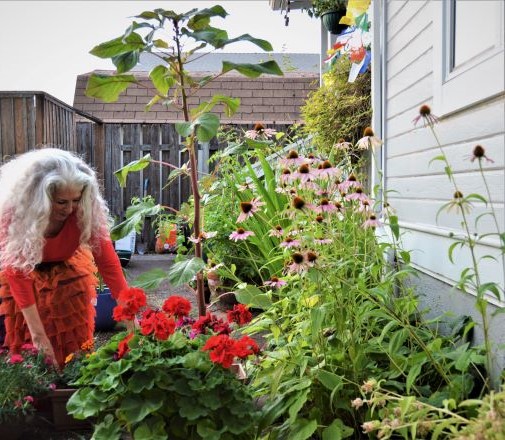
Over the years I have planted assorted bulbs, rose bushes, a lilac bush, a hedge of ceanothus, and all sorts of flowers. I allow whatever shows up to do its own thing. One year an Oregon wild Iris volunteered. Now there are nine plants. Its flower is a beautiful, but subtle, lavender and tan, and in the fall a pod bursts to reveal a cluster of orange berries. The bluebells are also volunteers, bunched in various parts of the lawn. There is a patch of violets that circle the holly tree.
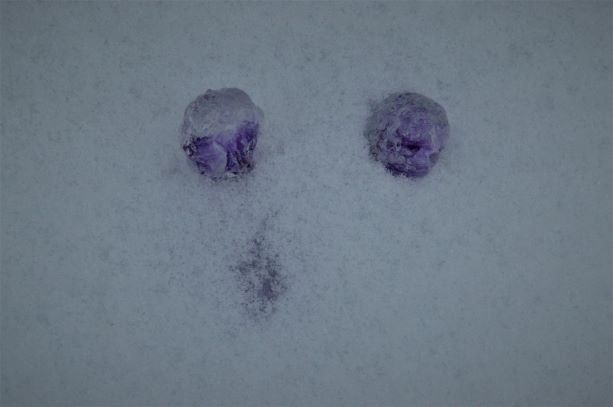
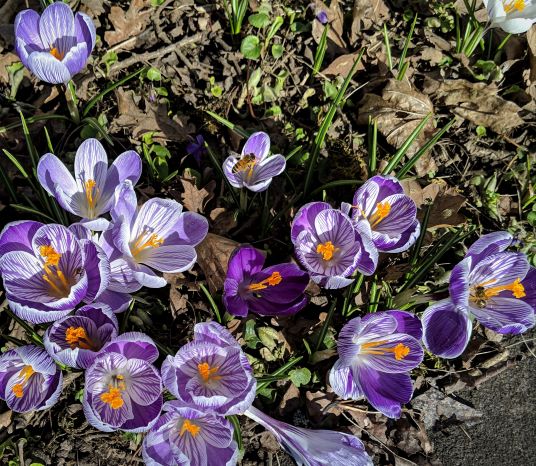
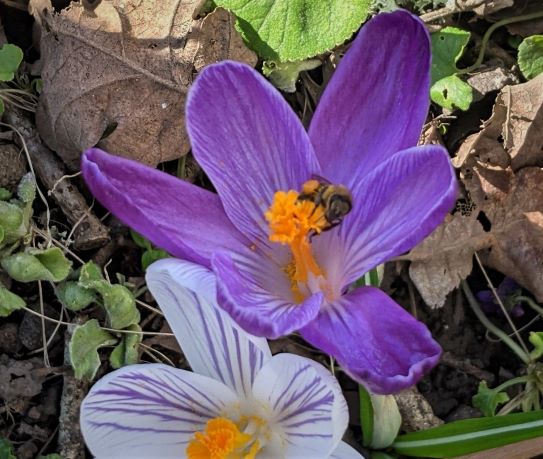
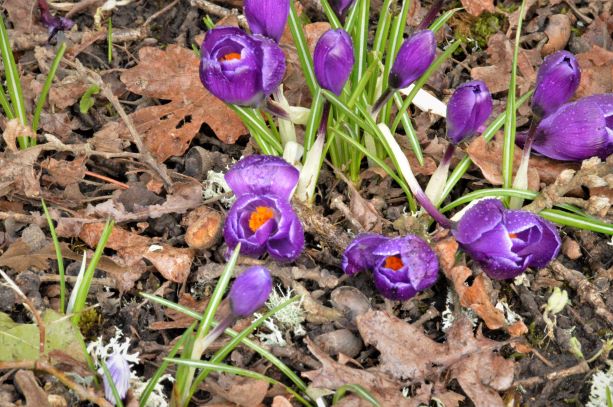
Every February I look forward to seeing the crocus push their way up through the hard, cold earth, promising that spring is near. I have seen them covered in snow, and this year, frozen like popsicles in the ice storm, but after the thaw, they continued to bloom, hosting bees hungry for nectar. Hugging the earth, crocuses are tiny and look delicate, but they are hardy, enduring in harsh conditions, sharing their cheer through it all. I learned a lot about living from the crocus.
Plants that weren’t gifts from the birds, or squirrels hiding their winter hoard, were gifts from friends thinning out their gardens, or found in curbside free boxes. I see how much they have spread across the yard, fighting the invasive ivy for space. In spring it looks like a woodland glen.
Many of the plants are fragrant. On sunny afternoons in early spring, the air is perfumed by violets. I sing to them, “Sweet violets, sweeter than all the roses, covered all over from head to toe, covered all over with sweet violets.” They smile shyly from their verdant leaves.
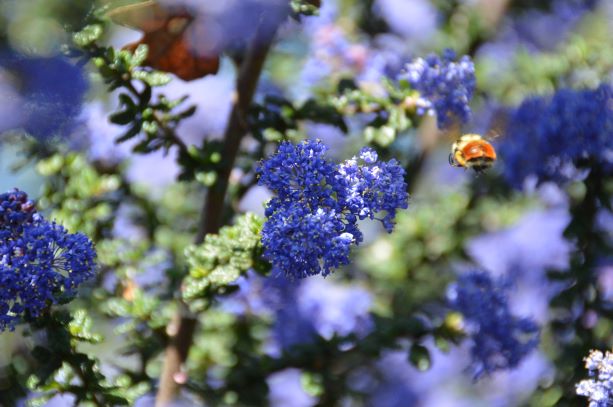
I planted the hedge of ceanothus because they are drought tolerant. They are wild lilac and are more fragrant than the lilac bush. The bees love their electric blue blossoms.
A lot of life has happened in this homestead: family dinners, cake on the porch with friends, watching sunrises, sunsets, the moon go through her phases, and other celestial events. I completed the novel I worked on for over twenty years here.
It’s been an emotional experience preparing and packing the house for sale. It’s astounding what one accumulates in seventeen years’ time, not to mention everything else carried along in a lifetime. I decided to make a clean sweep of it and get rid of as much as possible, except for a few pieces of furniture and kitchen items, but then there are books, letters, journals, photos, art, clothing… I am sentimental and have difficulty giving away anything that was a gift. I’m letting go of a lot more than things.
Along with the trees and plants, I’ve grown living here. I lived my childhood in Brooklyn, my adolescence in Hicksville, my young womanhood in San Francisco, and the prime of my life in Santa Barbara. Here I grew into maturity, learning how to become an elder of society. There are lessons in every stage of life, but I’ve always felt that although we grow older, being old is a matter of attitude.
I’d been dreaming of making a change for quite some time. Last summer my friend, Alice, sent me a link to Mary Chapin Carpenter’s song, Late for Your Life. The words struck a chord with me, “But the question begs why would you wait and be late for your life…” We were still in the midst of Covid19, and cases were escalating. When it was announced that vaccines had been approved, I promised myself that as soon as I was vaccinated, I would do what I dreamed of.
Once the house sells, I’m taking Freedom for a ride down the west coast, stopping to spend time in nature’s beauty spots, visiting longtime friends, and looking for that next place to call home.
I will admit that sometimes I think this is crazy. I love this spot on the map. I love the trees and plants, and all the creatures that live here. I love my house. It’s comfortable, maybe too comfortable, making me feel stagnant. When I think of jumping off into a future with no clear plan, I remind myself of a quote by Georgia O’Keefe, “I’ve always been absolutely terrified every single moment of my life, and I’ve never let it stop me from doing a single thing I wanted to do.”
Mid-December I wrote a blog for the new year titled The Year of Living Fully, a reflection of my optimism for the year ahead. Disturbing news events made me pause for a more appropriate moment to publish it. I waited for the news to settle, but then another troubling event happened. This went on for two months.
The last round of staggering news began when a dramatic spike in temperatures above the North Pole caused a polar vortex to descend upon a large portion of the United States. It affected Texas most dramatically, but here in Oregon’s Willamette Valley, we experienced our share of problems.
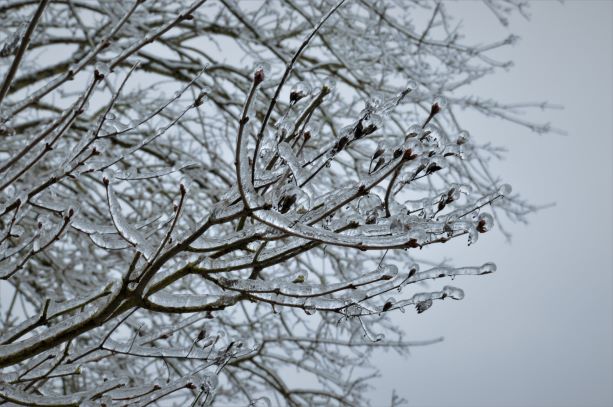
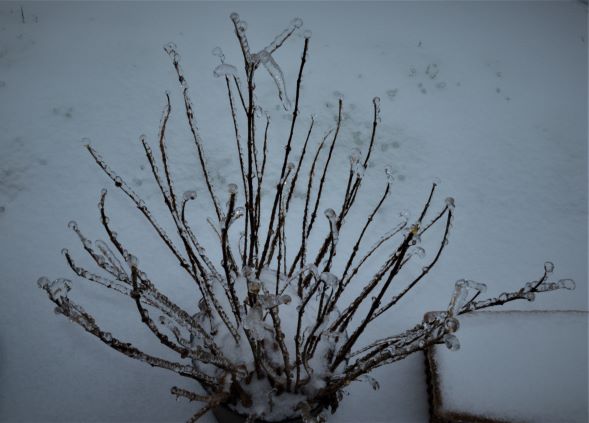
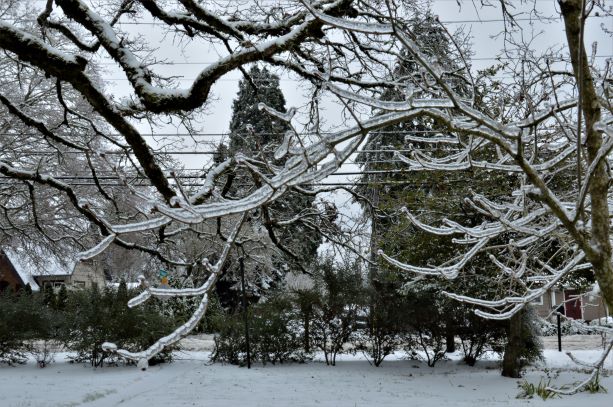
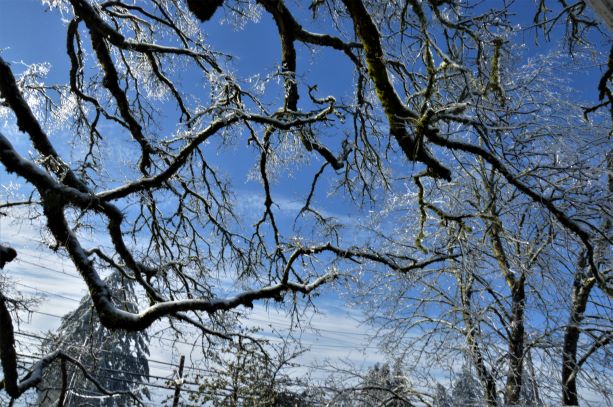
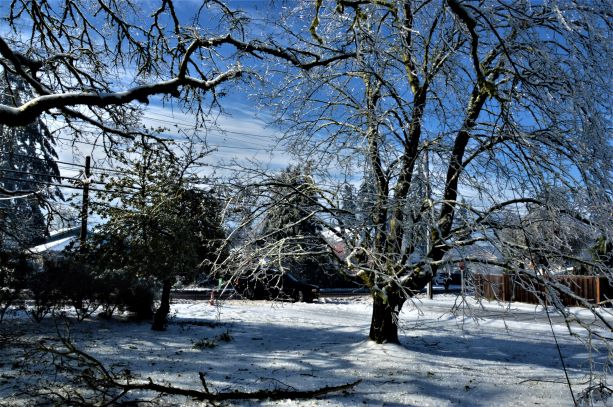
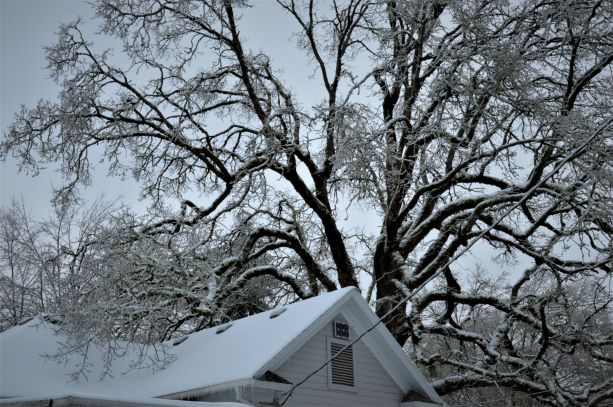
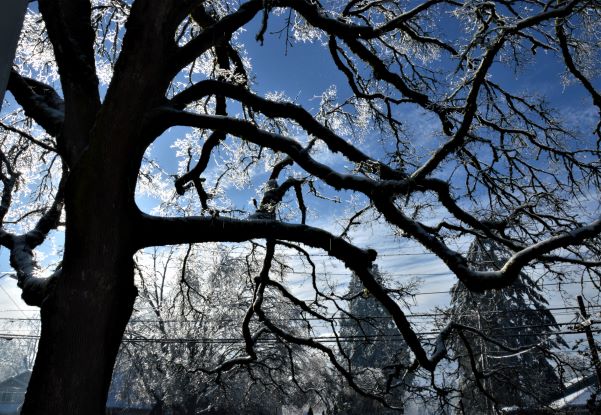
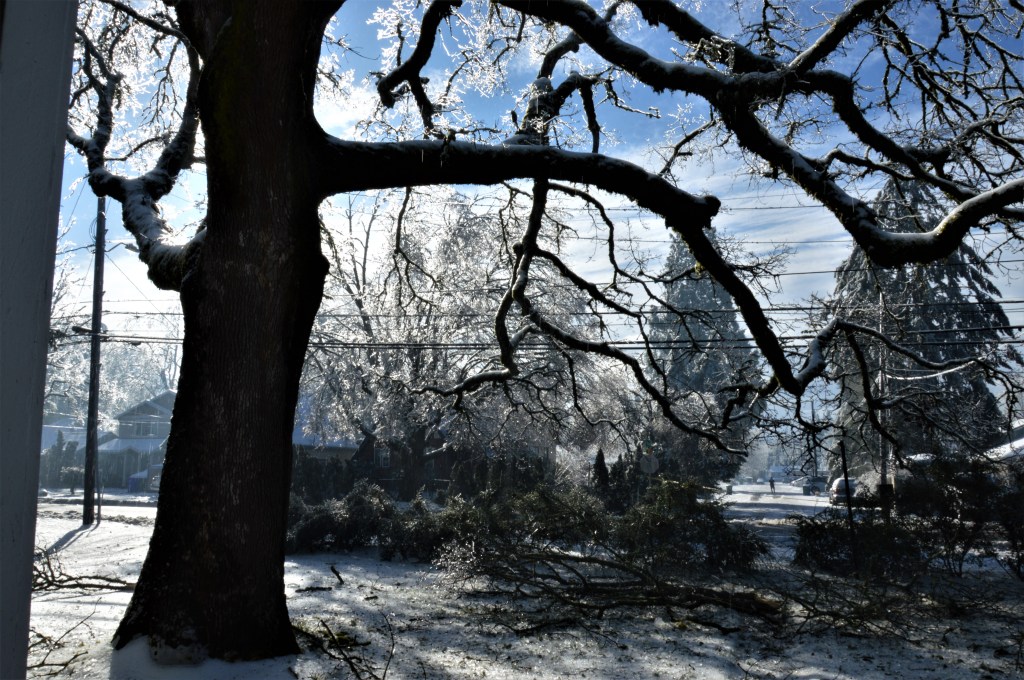
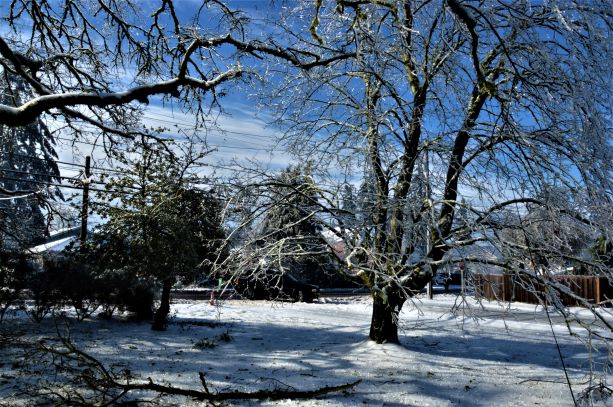
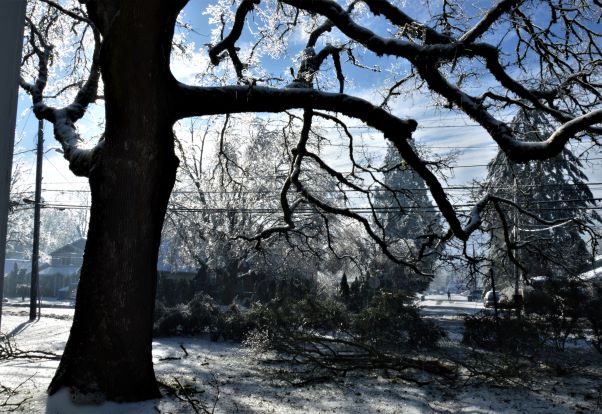
A combination of rain, snow, and plummeting temperatures, cloaked everything with a thick layer of ice. When the temperatures rose, the ice crackled and popped in strange atonal music as it shattered and fell to the ground. It was other-worldly beautiful, but it was a terrible beauty.
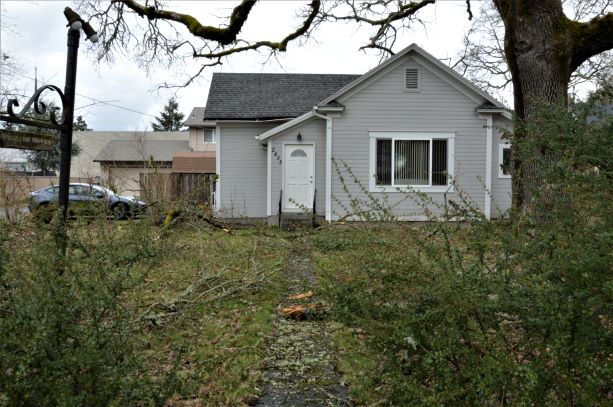
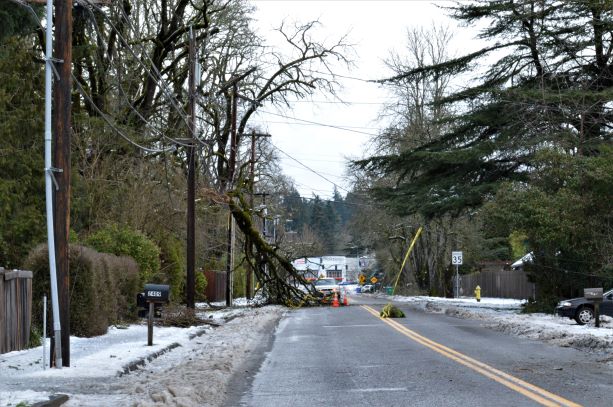
The weight of the ice on trees caused branches and limbs to fall; some trees split in half. It was unnerving, hearing them fall to the ground around my house, around the neighborhood, downing power lines.
The streets were littered with branches, limbs, and tree trunks. I was impressed with the organization and team effort that it took to restore power. First, PGE workers walked every street noting downed lines. Early the next morning, crews were out with chainsaws and chippers to clear the streets. Once the streets were cleared, the linesmen went to work.
My neighborhood was without electricity for four days. Some surrounding areas were without for ten days. My heartfelt gratitude to all of the hardworking people, some coming from other states, who restored power as quickly and efficiently as possible under arduous conditions.
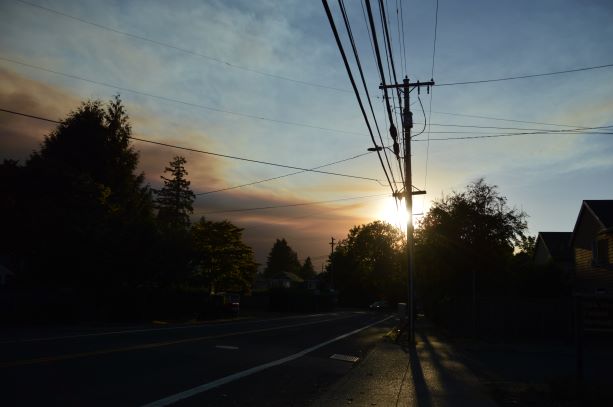
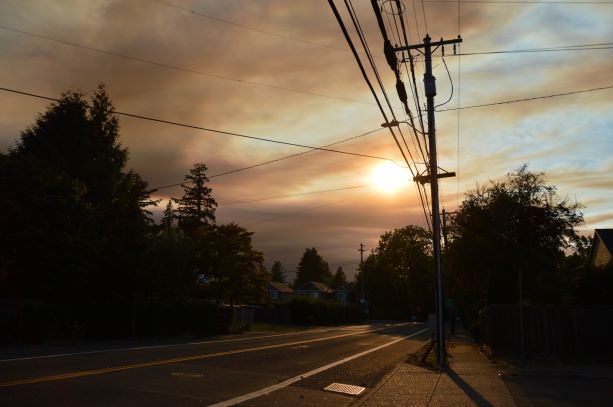
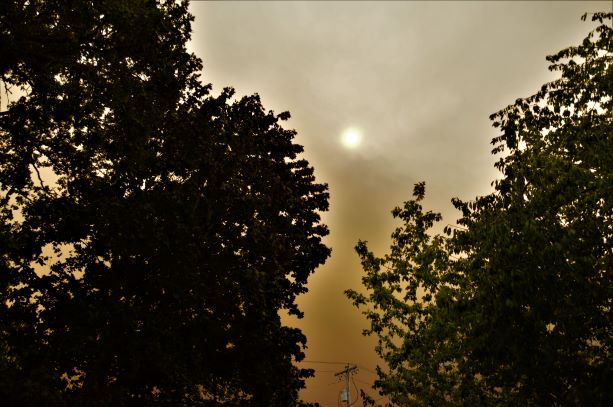
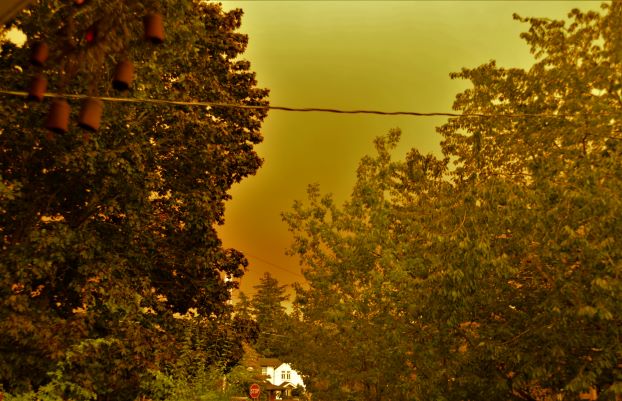
This is the second natural disaster I’ve witnessed in five months. The first was last September when there were numerous fires all along the west coast. Fires swept through Oregon on fierce winds. They reached Clackamas County, within seventeen miles of my home, and the air was so noxious that I didn’t leave the house for ten days.
While I was inconvenienced, I am grateful that I did not experience loss. I am deeply saddened for the lives lost, for those who lost their homes, for the wildlife that perished, and for all the trees and vegetation lost in both the fire and ice storms, and I’m profoundly concerned for the condition of our Mother, Earth.
After all the intense weather that we’ve experienced in recent years, floods spawned by the increased volume of rain from hurricanes and other intense storms, or out of control wildfires caused by extreme drought, and periods of abnormally high and low temperatures, it blows my mind that there are people who still do not believe that what is happening is not normal, and not a cyclical thing that Nature does, but is caused by how we live on this planet and use Earth’s resources. These climatic events are growing in magnitude and occurrence, and will continue to do so unless we take bold action.
Bold, as in being audacious, daring, unflinching, and forward thinking. It means letting go of doing things the way we’ve always done them. We are too comfortable with the familiar. Worse, we are indoctrinated by the companies we work for, or that service us, telling us that if we dare to try something different, we will lose our jobs, our security, our comfort. I can tell you that living in the midst of a wildfire is not comfortable or secure, nor is living in freezing temperatures without electricity to warm our homes and cook our food.
We are living in startling times, but we can look at it as a time to use our creativity for the highest good, to find new opportunities to live not the same lives, but better quality lives, giving up our dependence on what is killing is.
After both the fire and the ice storms, I was struck by the resilience of Nature. She came back in all of her glory. If we don’t change, we will die, but Nature will continue.
What can we do? We must give up our dependence on fossil fuels. The next vehicle you buy, make it an electric vehicle. I am grateful to have a Tesla Model 3 that I call Freedom. During the ice storm, I spent hours in Freedom to keep warm. I was able to safely drive through ice and snow banks to an EV charging station to charge her, my phone, and computer.
Secretary of Transportation, Pete Buttigieg, plans to increase EV charging stations all across the U. S. to facilitate the growth in use of electric vehicles. This will upgrade our infrastructure as well as create jobs.
We need to support the Green New Deal and use of sustainable energy. There have been significant advances in solar technology. If all new homes, and homes needing to re-roof, used solar tiles to generate household energy, and send excess energy to the grid, we could avoid devastating situations created by the recent ice storm, while decreasing our carbon output.
We need to stop using chemicals in our homes, gardens, and farms. They are making us ill, and killing the bees, insects, and birds that pollinate the food we eat. Chemicals are killing our rivers, oceans, coral reefs, and marine life. They are killing our eco-system. Permaculture is the answer.
We need to support businesses that create a circular economy, that drastically reduce waste by continually using and re-using already existing materials and resources. There is a new business here in the Northwest called Ridwell. Every two weeks they pick up your discarded items: clothing, plastics, batteries, and light bulbs. Clothing that is still usable is donated to charities. Items that are not useable become rugs, or home insulation. They recycle Amazon’s plastic shipping bags. Batteries are recycled so that harmful chemicals do not go into landfills and leach into our ground water. The same with lightbulbs.
If you are concerned about the batteries for electric vehicles, advances are being made to recycle and reuse the components that make them, and to make them longer lasting.
We need to reforest over-logged lands. Trees are the lungs of the world. They absorb carbon and create oxygen. Let’s start planting sustainable hemp farms for paper and clothing.
There is so much we can do to make the world a better place for everyone, to create jobs and a healthy economy, and to heal Mother Earth, our home. Do you have a good idea? Do it!
When I started this blog, I looked forward to 2021 with enthusiastic anticipation. I am still optimistic that things will get better this year, just not as quickly as I’d hoped. We all need to participate in making positive changes. Let’s get vaccinated and keep wearing a mask until Covid19 is vanquished, do whatever we can in our daily lives to live gently on the earth, and support businesses that work towards creating a healthy planet.
Let’s make this the year of Living Fully and Boldly!
After reading Rachel Carson’s epic book, Silent Spring in the early 1960s, I became concerned about the environment and the negative impact that human activity has on our home, Mother Earth. I looked for ways to do my part to walk lightly upon the Earth.
It started with the way I ate. From Zen Macrobiotics I learned to eat what is seasonal and local. From Diet for a Small Planet, I learned food combinations for high protein, meatless meals. I planted an organic garden and was awestruck by Earth’s abundance. I learned how to can and preserve food with that bounty.
I’ve lived on our Earth for a while and have seen the myriad changes she’s gone through during my life’s journey. Most of my years have been lived on the west coast. I’ve seen the weather patterns change, creating the drought that is growing more severe in California, and extending to the Pacific Northwest, where I now live.
In my lifetime I’ve witnessed hurricanes and tornadoes, floods, large fires, and intense earthquakes, but possibly the most disconcerting event I’ve lived through was this past September when there were fires all along the west coast from California to Washington state, as well as a number of other western states. The smoke from these fires travelled half way around the world. Greta Thunberg says we must act as if our house is on fire. Because it is.
Always, I ask myself, what more can I do? I don’t buy what I don’t need. I recycle, repurpose, reuse. During the many months of lockdown and isolation, I realized that participation is part of the game of life, and once we are able to be with one another again, we will find new ways to live on the Earth. Our lives will be different than before, and I believe better days are ahead.
I am heartened by President Biden’s commitment to the climate crisis in ways that heal the environment, the economy, and humanity. His nomination of Pete Buttigieg as Secretary of Transportation shows actions that will be taken to solve this problem. As a presidential candidate, Pete Buttigieg had an infrastructure plan that prioritized improving and modernizing the country’s rundown infrastructure. It included adding thousands EV charging stations along our highways to aid the transition to electric vehicles.
Five Christmases ago, my sons made it possible for me to own a Nissan Leaf. I have loved that car. It’s wonderful to drive, there are no additional maintenance costs, and I felt good about having diminished my carbon footprint. There was one major drawback: range. Other than around the town activities, I was limited as to where I could go, unless I took public transportation.
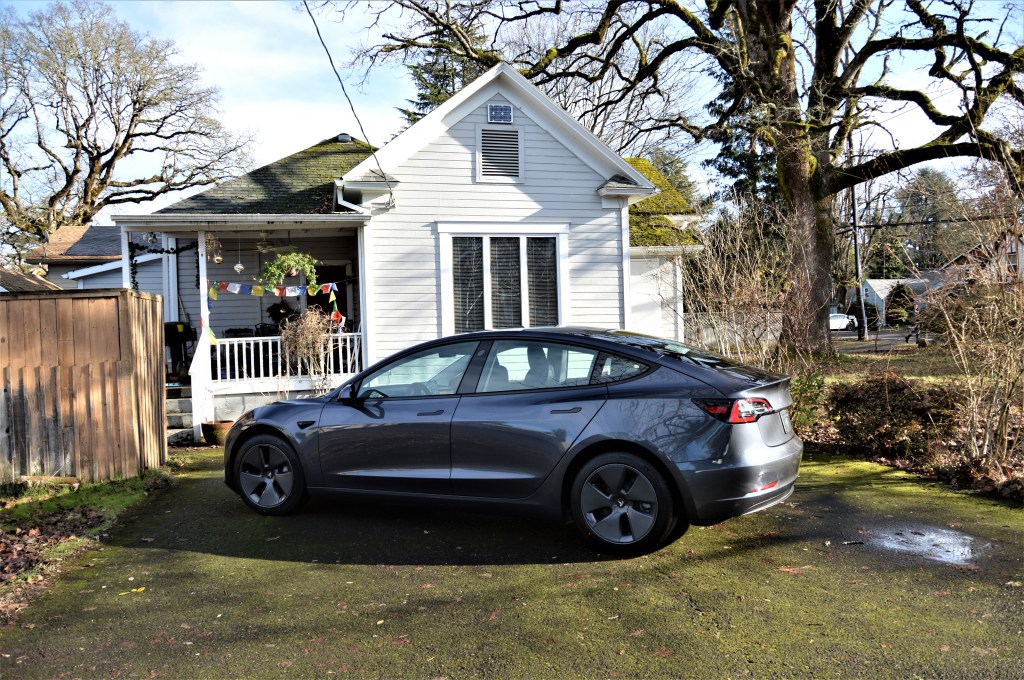
This Christmas, thanks to a great trade in on the Leaf, the Oregon state rebate, and a most generous gift from my son, Paul, I am now the proud owner of this beautiful Tesla Model 3. I call her Freedom.
About five years ago, Paul became interested in Tesla and Elon Musk. He talked about it so much that I started to pay attention to all news stories about the business and the person. The corporate mission is, “To accelerate the world’s transition to sustainable energy.”
Tesla is more than an automobile manufacturer; it is an energy company. They make solar roofs that are not clunky panels, but aesthetic roofing tiles. This will make home energy more efficient and sustainable. Tesla is working on high-speed transportation with the Hyperloop. They are working on electric ships. SpaceX, another of Elon Musk’s projects, has perfected the re-entry and landing of rockets so that they may be reused. With this success comes plans for electric planes with vertical lift offs and landings.
Needless to say, I am a fan. Please watch for future blogs with more news about Tesla, and my travels in Freedom.
“I want you act as you would in a crisis. I want you to act as if our house is on fire. Because it is.” Greta Thunberg, January 25, 2019
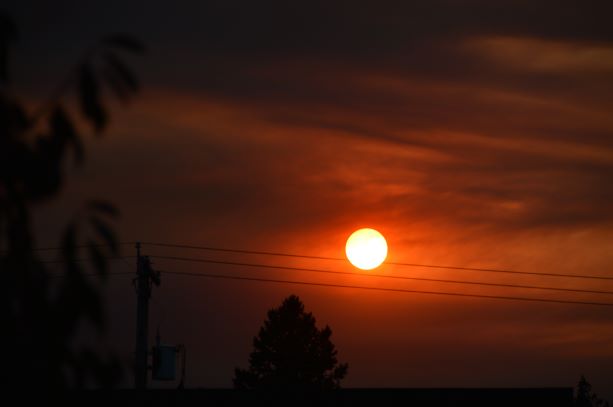
Our house is on fire. Nine western states in the United States have major fires. Millions of acres have burned or are ablaze along the entire west coast. Everyone who lives here is feeling the effects, if not directly from the fires, then by eerie, smoke filled skies. The devastation is real to personal property, health, the loss of flora, fauna, and human life.
And the Amazon is still burning.
Beginning in September 2019, Australia was on fire for 210 days.
There have been hurricanes, cyclones, monsoons, and other storms that have displaced millions of people across the globe by flooding, landslides, mudslides, and dam collapses.
On July 1st it was 90° in Siberia; On August 17th it was 130° in Death Valley, California
There has been a plague of locusts that have devastated large swathes of Africa, Asia, and the Middle East.
And let us not forget Covid19…
Has Mother Nature gotten our attention yet? She is suffering at our hands by our over consumption of fossil fuels and things, most of which we don’t need. It’s time that we come together as brethren of humanity, to stop fighting over our differences and see what unites us, to live on this blessed, vivifying planet and work to stop the degradation of Earth, our home. It is going to take serious commitment to turn things around. We need to start now.
Oh Mother, Your wondrous forests burn.
Once verdant countrysides are now parched; no rain falls to slake their thirst.
Arctic ice melts and polar bears starve on drifting floes.
Hurricanes and monsoons inundate, too much water there, not enough here,
Heat everywhere, hotter and hotter.
Oh Mother, I feel your pain.
You choke on our garbage.
You are poisoned with chemicals to kill unwanted plants and insects.
Fishes wash up on your shores, drowned in seas strangled with algae.
Oh Mother, I feel your pain.
You are burdened under the proliferation of humanity
Greedily depleting the natural resources you give so generously,
Raiding your vast wilderness for homes with groomed gardens,
Becoming irate when coyote or bear or deer seek food or water from their once wild habitat.
Oh Mother, I am in pain.
My eyes burn from the smoke filled air,
My veins run with tears
As I watch the blood red sun set in a grey sky,
And the hazy moon wander across the starless night.
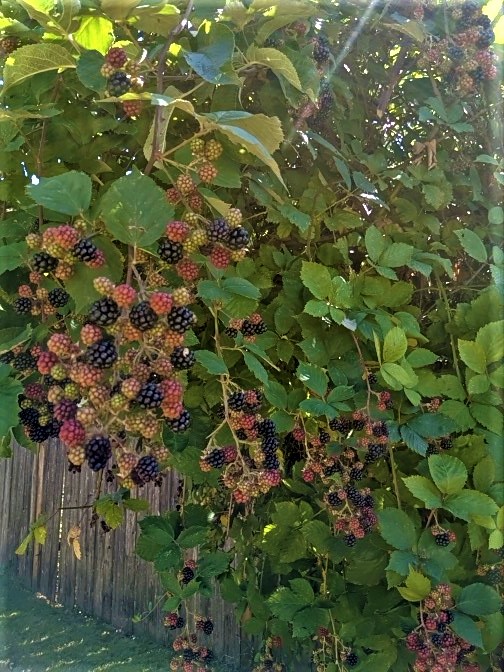
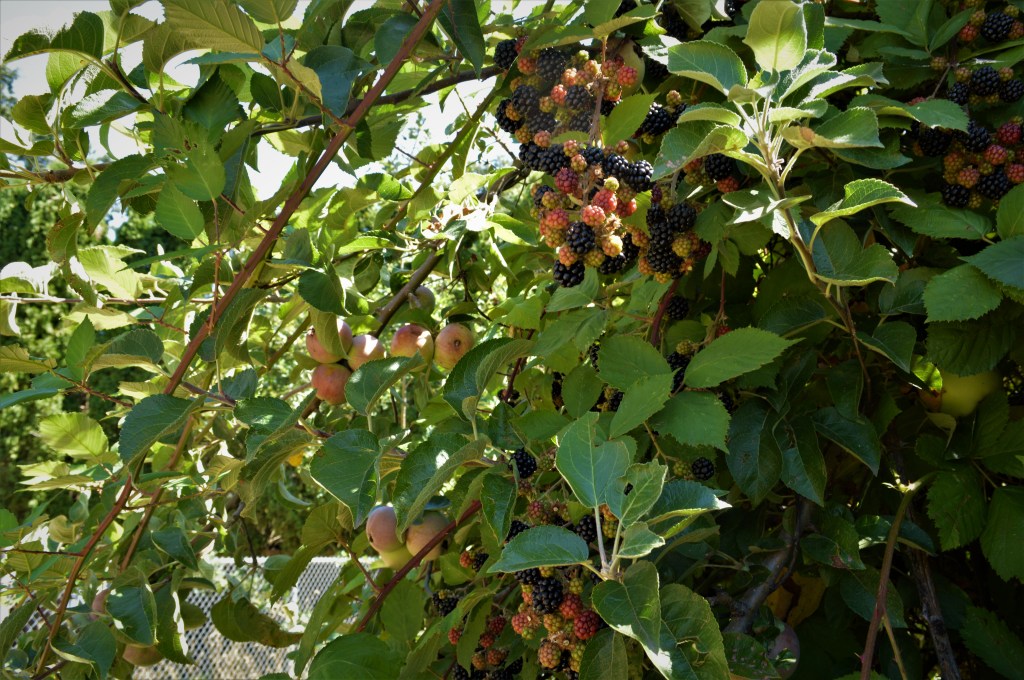
The neighbors yard is overgrown with blackberry brambles. They throw their tentacles, hung with clusters of voluptuous berries, juicy and sweet, over my fence. I stand in the morning sun and pick and eat as many as I want, until my fingers are purple and my arms are scratched from brushing against the thorny vines. It’s like being in love with the wrong person, going back, over and again for the sweetness, left bruised and torn.
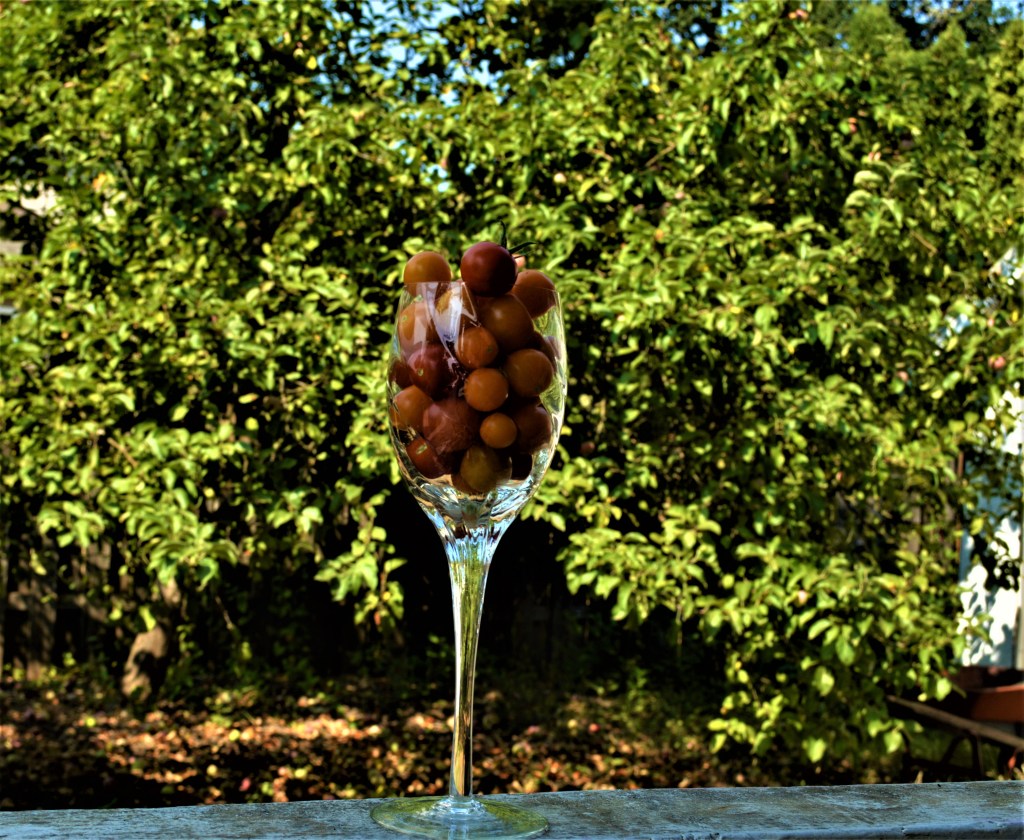
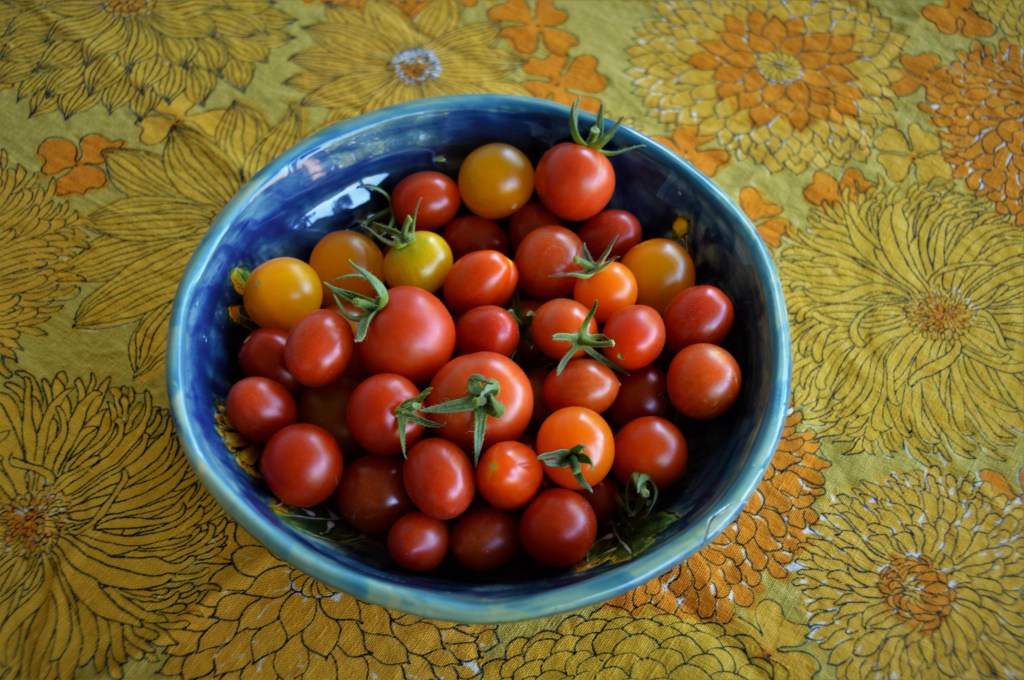
Tomato plants, heavy with fruit ripen one at a time
Then by the handful, and then fill a bowl
Now to make tomato salad to be eaten with a loaf of bread
Or sauteed with garlic in olive oil and tossed with pasta and basil
Stressed from too much heat and not enough rain
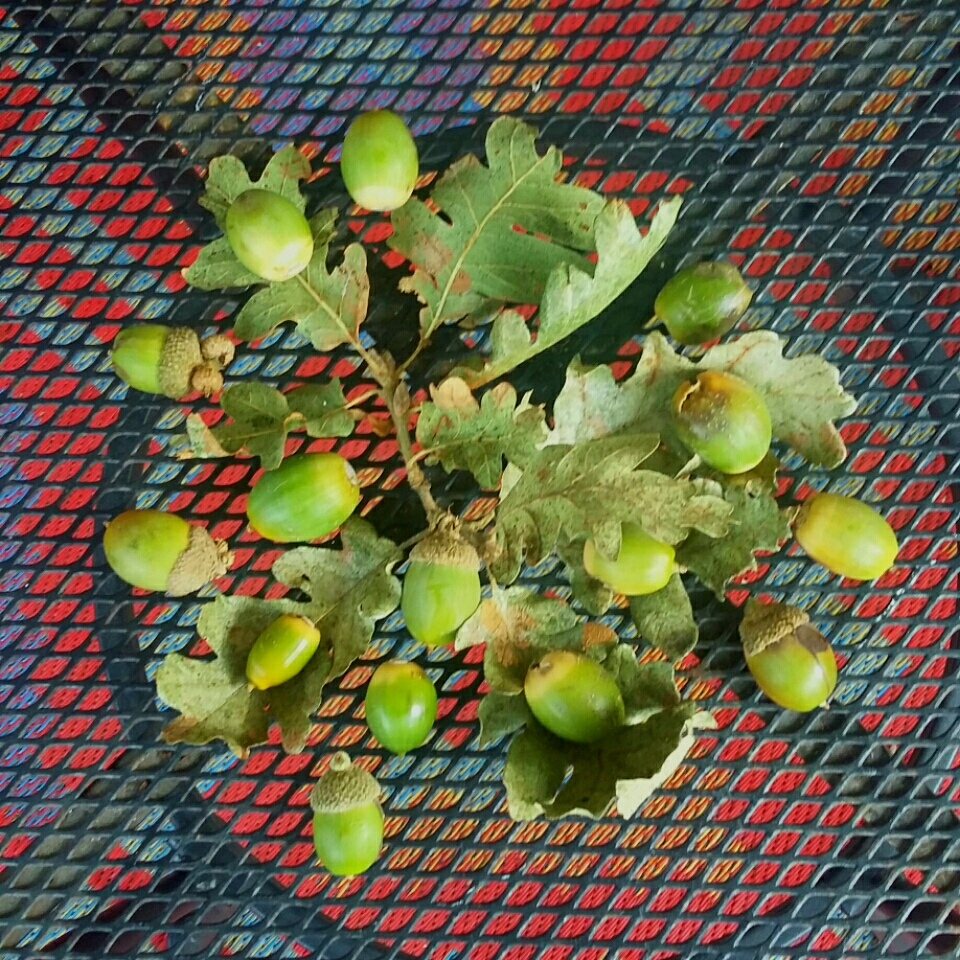
The magnificent white oak drops green acorns
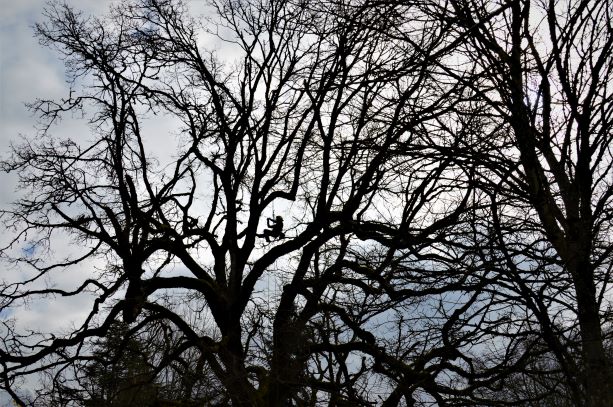
Give it water for fifteen minutes twice a week, Dr. Tree says
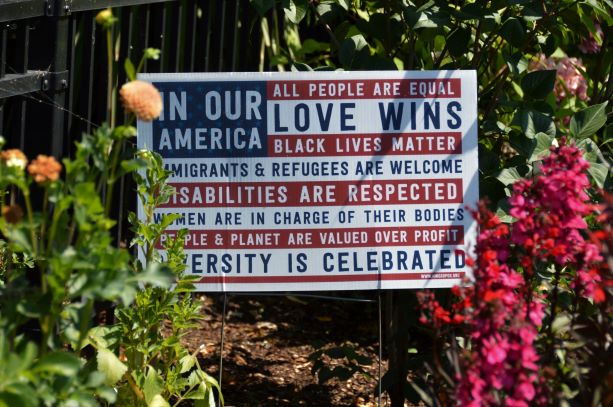
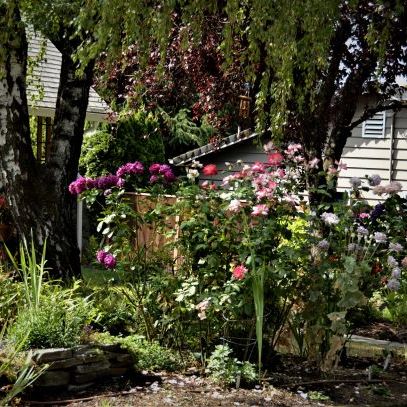
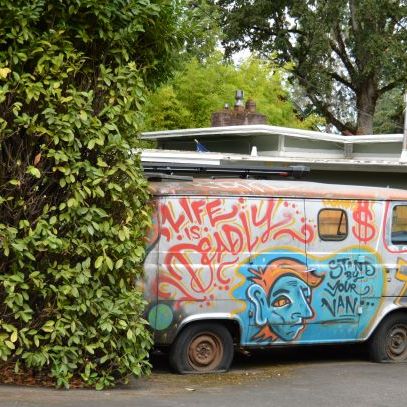
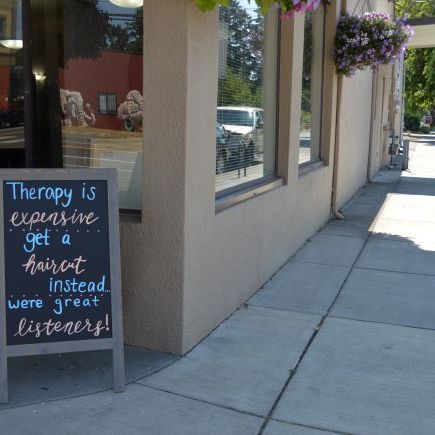
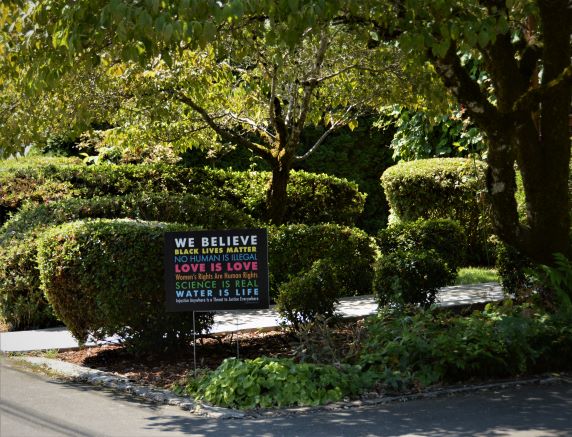
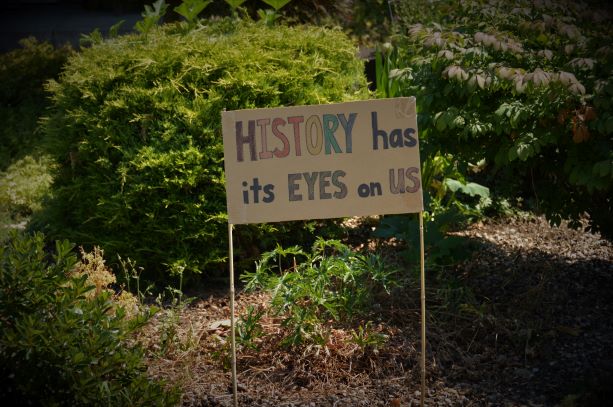
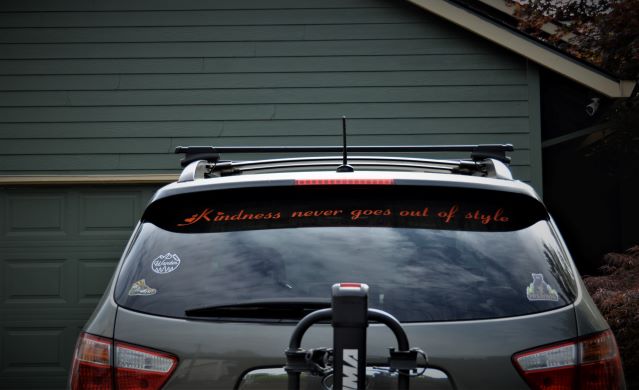
For the past month I’ve been fast walking around the neighborhood and haven’t carried my camera. Each day I vary my course to increase distance and speed. As I zipped through my environs, my peripheral vision witnessed the changes time and weather have made. What had bloomed in the spring had gone to seed, and now leafy green trees and brightly colored flowers dotted the landscape. Along with the flowers, signs had also popped up. Recently, I took a slower walk with the camera and capture some of the sights I’ve noticed along the way.
I live near downtown Portland, Oregon. This city has been in the news quite a bit lately. Some news sources make it sound as if Portland was burned to the ground. Yes, there has been over two months of protests that have come about, not only in the U. S., but also around the world, in support of the Black Lives Matter movement. Yes, there has been some violence and destruction of property in the form of graffiti, trash burning, and setting off firecrackers, much of the damage done by forces outside the BLM movement. This activity was limited to a two block area. The rest of the city is fine, and groups of citizens have worked to clean up messes and graffiti. When federal officers were deployed to this city, things changed. Their actions were aggressive and perceived as military occupation. Some protesters were seriously injured by these men.
The unofficial motto of this city is Keep Portland Weird, and it is weird in the kookiest of ways. First a Wall of Moms in yellow shirts showed up to protect protesters who now came out in greater numbers. When the federal officers were brutally aggressive to the Wall of Moms, they were followed up by a Wall of Dads carrying leaf blowers to blow the tear gas and pepper spray back in the direction of the federal agents. Next came a Wall of Grandmas and a Wall of Vets to protect the Moms, Dads, and Grandmas.
Governor Kate Brown negotiated to have the federal agents withdrawn. Now that they’re gone, protests continue more peacefully. Progress is being made with all parties in discussion to make lasting changes in the community for a safer, better place for all to live and work.
Where I live, less than ten miles from Portland, the neighborhood shows its support.














 The Write Mind of a Lefthander