This is a different sort of journey that I’ve recently taken. Eight years ago I was told that I needed knee replacement surgery. Because the procedure is so invasive, I sought alternatives to deal with pain: Synovisc injections, a knee brace, and physical therapy. They all worked well enough for a while.
On my trip to Calabria I found that there was always another path to explore, a few more steps that I could have taken had I not been limited by what my knees could bear. The time had come to do something about it.
In pre-dawn darkness I enter the hospital and walk into a dimly lit room. Connie, the attending nurse, washes me with antiseptic soap and dresses me in a hospital gown. On the bed she covers me with blankets that have been warmed. We talk about our mutual connection, growing up in Italian families on the East coast.
Connie expertly inserts an IV into my arm and hangs a bag of fluids with electrolytes and antibiotics from the stand beside the bed.
Craig, the nurse anesthetist, adds another bag to the IV. “What’s that?” I want to know. “Fluids,” he says. He unlocks the brakes on the bed and rolls me down the shadowy corridor into a brightly lit room. People dressed in blue scrubs and shower caps bustle around. I see one person in a veiled hat. I ask, “Who’s the beekeeper?”
I open my eyes. I’m in a different room filled with people, all looking at me, someone asks, “What’s your name? Do you know where you are?”
I’m vaguely aware of my granddaughter, Lauren, in the periphery of my vision. She’s dressed in a black shirt. My mother is standing beside her. My father is at the foot of the bed. I wonder if I’ve died and she’s in mourning. The room is full of people I know, I can’t see them, but I feel their presence: my grandmothers, my dear friends, Jacquie and Trini, more dearly beloved, and people whose names I don’t know, but who are familiar.
People come and go, wake me, give me injections, give me pills to swallow, ask me questions. Someone says I need to stand up. She lowers the bed and lifts my legs over the side. My feet touch the floor. She has me hold on to her arms to help me stand. Ow. Ow.
Oh wow. I’m standing. Left foot forward; right foot together. Another tentative step, and then another. I can walk.
It’s dark. Shift change. “Brendan will be your night nurse,” swing shift nurse says. “Brennan, no d,” night nurse Brennan says. He and I have a conversation. He doesn’t understand what I say. I need to explain in a variety of ways until he does.
Nate appears beside my bed. He’s smiling, golden bearded. “How can I help you?” I tell him that my hands are cold. “Let’s see what we can do about that.” He returns with hospital socks cut off at the toes and heels. He slips them on my hands, fingers and thumbs exposed. They warm my hands and I fall asleep. I wear the gloves for three days, but I don’t see Nate again.
Day shift rushes into the room bringing wake up energy. They open the curtains. The window looks out on a tree studded hillside. There are questions to answer, more medications to take. They leave a phone and menu to order breakfast. I want a steaming cup of strong coffee. I receive a lukewarm cup of weak coffee served with non dairy creamer.
My phone is full of text messages. I answer them and then call my sister, Kathy. “I’m alive,” I say. She knows. She says I called her last night. It seems it was a humorous conversation. I don’t remember the conversation, no less calling her.
Kym, a physical therapist, comes in. She massages my legs and helps me slide my feet to bend the knees. They are stiff and difficult to move. She helps me to stand and I take a few steps. When she leaves I drift in and out of sleep.
I open my eyes and there is a dark haired woman sitting at the edge of my bed. She is well dressed with a shawl wrapped around her shoulders. She is made up and wears red lipstick, gold hoops dangle from her ears. In her hand she has Lifesavers with only a few left in the roll. The rainbow colors of the wrapper are alive. She asks if I would like one. The Lifesaver she offers me is dark, emerald green. I hope it isn’t lime. Now I see that the woman is my friend, Jacquie. Trini stands beside her. I open my mouth for her to give me the Lifesaver. A hand reaches out of a golden white light and places a Eucharist on my tongue.
Brennan with no d comes in with a young nurse. “Julie is training with me,” he says. Julie is a beautiful young woman with short blonde hair in waves and a nice smile. She looks like an angel. Julie gives me my meds. She says that she recently graduated from nursing school and this is her first job. She is self assured in all that she does, and has an extra element that isn’t learned from books, gentle kindness. I fall asleep comforted, knowing that she is on the other side of the door.
The room is bright with sunlight. There are visits from administrators, papers to sign. A social worker asks me when I plan to leave. I have no idea. How would I manage at home alone? I can’t move without assistance.
I need to ask for a bowl of water to wash up and brush my teeth. I am red and itchy all over. A nurse gives me Benadryl and I fall asleep. The room is full of people; shadows in the corners, beside my bed. Hands reach out to caress me; I reach out to them and wake up, my hands flailing in the air.
The man in the next room throws something at the wall. He shouts, “Help!” I hear the sound of feet running. The man is loud, querulous, until he is calmed.
My grandchildren, Lauren and Alex, visit. I’m happy to see their beautiful faces. Lauren says when I came out of recovery I kept asking, “Is it snowing?” We laugh, but I sense that it frightened her to see me incoherent, on the border of here and there.
When night shift comes on, Julie is there to help me. While she gives me meds and a shot, she tells me about the trip to New York she has planned with her friends. I feel cared for, not managed.
It is the fourth day since surgery. Again, I need to ask for water to wash up. A nice looking man comes in the room. He’s wearing jeans and a sweater. “Who are you?” I ask. He’s my surgeon’s partner. It’s his weekend to visit patients. “You’re doing great,” he says.
Kym comes in and asks if I’d like to go for a walk. Getting out of bed is still an ordeal. I can’t move my legs, and getting to a standing position is painful, but once I take a few steps, motion becomes easier with each step. I walk to the door. “Can you walk in the hallway a few steps?” Kym asks. I take one step, and then another, and another until I’ve walked the length of the hall. It feels good to walk.
Another social worker comes in telling me how it’s going to be when I’m released. I don’t like her attitude. She leaves. A little while later another social worker, Jesse, comes in. She asks me where I want to go when I leave. I tell her the name of the facility. It has beautiful gardens and is near my home. I want to be near home so my friends can visit. “I will advocate for you,” Jesse says.
My grandson, Alex, arrives with a bag of fresh, organic fruit. We talk about his plans for his future. Another social worker comes in to say that arrangements have been made and I will be leaving. I will be going to a skilled nursing facility that I haven’t visited, in a part of town I am unfamiliar with, far from my home. My grandson is rushed from the room. I am dressed and within half an hour I am in a wheel chair in an ambulette, on my way to who knows where.
I clutch the bag of fruit Alex gave me. My knees are painful as I watch the streets we drive past, trying to figure out where I am.
I am put in a beige room. Someone helps me change into pajamas and into bed. The loud tic, tic, tic of the clock irritates me. “Please take it away,” I beg. There are papers to sign, meds to take. Thuy, the nurse, tells me to press the red button if I need anything and asks if I’d like dinner. I order veggie stir fry with brown rice. This is what I am served.
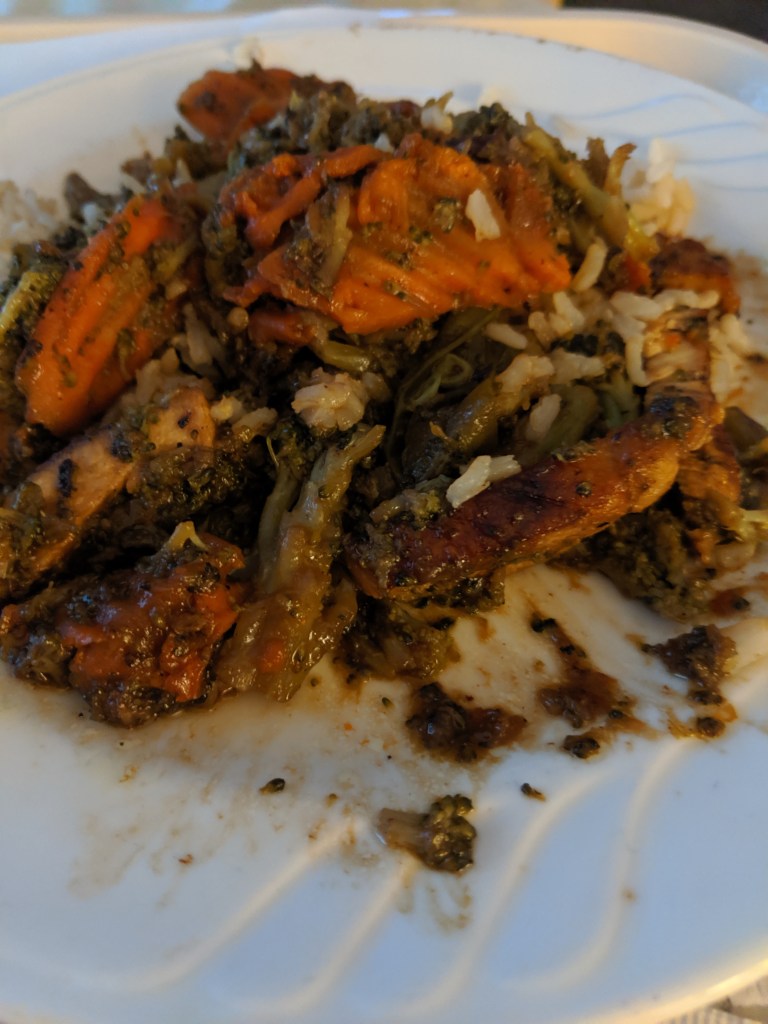
Unable to eat it, I turn on the Emmy’s and eat the fresh fruit salad Alex brought me. I start to cry. I wanted Maisie Williams to win the Emmy for her role as Arya Stark. I don’t want to be here, so far from home. I don’t like feeling vulnerable, not in control of my body, my life. The tart pieces of pineapple and sweet pop of blueberries are seasoned with salt from my tears.
All night long I watch the waning moon glide through the sky until it slips below the horizon.
Gloria Halleluiah Gloria
It’s seven o’clock in the morning, and she is smiling at me. She says her name is Gloria and she is my CNA. I wonder if I am dreaming because she looks like Trini. “How are you feeling today?” I can’t move my legs. I ache all over. My body isn’t functioning as it should. “Would you like a shower? You’ll feel better.”
Gloria moves my legs over the edge of the bed so I can stand and helps me into the wheelchair. In the bathroom I am overcome with pain. Gloria massages my back until it passes. She helps me into the shower and sprays my body with warm water. While I wash my hair, she washes my back, and legs. Her touch is gentle, her voice soothing. She rinses the soap off, wrings the excess water out of my hair. I wrap a towel around it. Gloria dries my body, and then wraps me in a dry towel. The warm water and her soothing massages make it easier to stand, and then sit in the wheel chair.
She pushes me up to the sink, in front of the mirror. I use toner all over my face, then eye cream and moisturizer, foundation, blush, mascara, and lipstick. I look in the mirror and see myself emerging from a fog.
Gloria helps me dress. She says, “Chad is your nurse. He’s a good one.”
“That’s Chadd with two d’s.” He has a cup of water and another filled with medications in his hands. His eyes sparkle. I wonder if he got the extra d that Brennan didn’t want. He doesn’t leave until I’ve taken each pill, explaining what each is and why I’m taking it. “If you need anything, press the red button. I’ll check in on you to see how you’re doing from time to time.” He keeps his promise
There’s a knock at the door. A tall, young man comes in. “I’m Matthew, your physical therapist. I’m here to do an evaluation.” Matthew is warm and soft spoken. We talk about the program I will follow over the next few weeks. “Let’s go for a walk,” he says. He doesn’t move to help me out of bed. He watches as I struggle to move my legs, and makes suggestions on which muscles to utilize to swing my legs over the side of the bed. He tells me how to place my feet on the floor in order to stand. Once I’m standing, I’m fine. I push the walker up the hall and back to my room. Matthew says I’m doing great.
The anesthesia and other drugs they pumped into me for surgery wear off, but there is still need of drugs for pain management that are given at specific intervals. Between those times, there is ice to alleviate the pain and swelling. Annie, the swing shift CNA, puts on the Kryo-cuffs filled with ice water that wrap around the knee. They are so cold that I’m chilled to the bones. When she removes the cuffs I ask for more blankets and fall into a restless sleep.
Wonder Drug
I wake in a sweat, my feet on fire, aching all over. I press the red button and Janet, the night CNA, comes in. I ask her to please remove my socks. She lifts the blankets, “You have no socks on,” she says. She massages my burning feet with her cool hands. From lying flat on my back for days, my hips hurt. She rolls me to one side and places a pillow under that hip and does the same on the other side. An hour passes. Restless and unable to sleep, I press the red button again. “Janet, I’m sorry to bother you, but I’m still hot and I ache all over.” It is two hours before I can have more pain meds. She smiles, “I have what you need.”
Janet returns with a scoop of chocolate ice cream. She raises the head of the bed and puts the tray in front of me. I take the first bite. Mmmmm. I savor the taste of creamy chocolate melting in my mouth. I take small bites, wanting it to last. I feel my body cool down. When it is done, I move the tray aside and fall asleep for the rest of the night.
“Let food be thy medicine…” Hippocrates
The head nurse visits. It is her administrative duty to visit each new patient and make an evaluation. She asks how I’m feeling and if there is anything I need.
I show Ms. Head Nurse the picture of the veggie stir fry I was served the night I arrived, explaining that I feel nutrition from properly prepared food is essential to healing. “If you don’t like what we offer, you can have food delivered.” Her words and tone are dismissive and insulting. Our conversation comes to an unpleasant end and she leaves.
For dinner I eat the Honeycrisp apple my grandson brought me. I enjoy every juicy bite.
Morgan, the Dietary Manager, visits. Thuy told her that I wasn’t happy with the food. I showed her the photo of the stir fry I was served. She asks, “What’s that?” Morgan says that I’m not the only one who is unhappy with the food and asks what she can do to improve it. I say the same thing I said to Head Nurse, that nutrition is essential to healing, and over cooked food loses its nutrition. She promises me that she will work with the cooks to improve the fare. Even though she visits me a few more times, the quality of the food does not improve.
For the remainder of my stay I eat salad and lentil soup. The lentil soup is Gloria’s suggestion; it is edible, even if at times it’s watery and unseasoned. To vary the basic green salad I go to the dining room for the salad bar at lunch. Sometimes there are thin slices of red cabbage, or diced celery, or shredded carrots to add color and crunch. The few times I try a daily special I’m disappointed. The oven baked chicken is so over cooked it’s the consistency of jerky, and the turkey pot pie contains pieces of uncooked turkey.
Food Glorious Food
My friend Shauna visits. She stopped at my house to pick up the mail and some extra clothing. She brings books and a brightly colored paper sunburst that cheers the bleak beige room I’m confined to, and lunch from Laurelhurst Market.
I open the container of tomato, vegetable, and chickpea soup. The aroma rouses my senses. The chickpeas are creamy when I chew them. I can taste the flavor of each piece of carrot, broccoli, and cauliflower. There’s a hint of cayenne in the broth, just enough to pique the taste buds, but not overwhelm them.
There is also half a sandwich. The bread is from Grand Central Bakery, smeared with mayonnaise, filled with arugula, fresh roasted turkey and pickled onions. The bread is firm and chewy, the pickled onion a sweet counterpoint to the bitter arugula. And there is a surprise, the crunch of a slice of salty bacon. I don’t normally eat bacon, but at this moment I accept its luscious addition. I chew slowly, taking delight in every flavor and texture in that bite.
Sated, I save the remainder of the sandwich and salad for dinner. The salad is mixed greens with thinly sliced radishes and pickled onion. The dressing is olive oil and fresh lemon juice. For the first time in a week I feel nourished.
My neighbor, David, visits with bagels from Henry Higgins, and my daughter in law, Eva, brings food from a Mediterranean food cart. My cousin Teresa sends cookies from an Italian Pasticceria in Brooklyn. A pignoli cookie in the morning makes the coffee palatable. Shauna visits every week and brings Thai food, or walks with me to Ozzie’s Greek Deli in the hospital across the street.
Motion is Lotion
I have physical therapy five days a week. I work with Mandy, or Matthew or Rachel on her days off. They are all supportive and helpful, but firm in their expectations of how to progress. I pedal on a recumbent bike to warm up. There are exercises for balance, and eventually, I practice walking up and down stairs; up with the strong leg, down with the leg that’s not as strong. Once a week, Mandy massages the areas around the knees and helps me bend them as far as they will go. I think of the song, Hurts So Good, but sometimes it hurts so much. She gives me bed and chair exercises to do on my own. The exercises seem simple, but each one is challenging, designed to prevent scar tissue, and aid flexion and extension.
Walking is encouraged. I love to walk. It is pain free. Until I’m cleared to walk on my own, I need to wait until a CNA is available to accompany me.
Kelly, the occupational therapist, teaches me how to be safe on my own around the house, and what to do if I fall. She shows me adaptive equipment to use, everything from a long handled shoe horn, to a shower chair.
Depth of Field
As I settle in, learn how to manage pain, and become mobile, life around me comes into focus. There are two couples in my wing who touch my heart.
A woman comes every day to visit her husband. She helps him into the wheelchair, and pushes him into the lounge. She reads to him and feeds him his meals. While she is attentive to her husband, I see that she is heavy with sadness.
There is a woman in the room across from mine. Her husband comes first thing every morning and leaves after he puts her to bed at night. Because of the proximity of our rooms, I see them often. He is cheerful and friendly. She smiles and nods, but doesn’t speak. He says they’ve been married fifty-two years and she is still his sweetheart. One evening as I walk the hallway he leaves. He waves to me and turns his head to hide the tears in his eyes.
Caregivers
When I arrive at the skilled nursing facility I need help to do almost everything. My basic needs are tended to by the CNAs; the nurses oversee their activities and dispense medications. All the nurses are efficient and meet whatever needs I may have, but Chadd, Jordan, and Peter relate to me as a person. They check in from time to time to ask how I’m doing.
Chadd remembers to cut the large pills into smaller pieces to make them easier to swallow, that I prefer to drink water that is room temperature, and that I like peppermint tea. He’s cheerful and likes to joke. He’s serious when I have concerns and resolves any issues I have.
Jordan walks the hall with me when a CNA isn’t available. He tells me about his Romanian grandmother who told him the original Grimm’s fairy tales. He recounts how Cinderella’s stepmother convinces her daughters to cut off their toes so that the glass slipper will fit one of them. “You won’t need your toes if you marry the Prince,” he giggles, “We’ll have servants to do the work.”
Peter is calm and composed. He tells me about his year old son who sleeps with him and his wife. We talk about the joys and challenges of the family bed, about books and movies. Peter supports me when I decide to stop taking Oxycodone before going home. He suggests that I start taking smaller doses and stretch out the time between. I stop completely three days before I go home. It isn’t as difficult as I thought it would be, and Peter is there if I need help.
I’ve come to the conclusion that CNA stands for Caring Nurturing Angels. I love and appreciate each of them, not only for how they care for me, but how I observe them care for others.
A patient wheels herself to the end of the hallway. She shakes the handle of the exit door and bangs on it. Brooke hears the commotion and quickly walks to the door. She kneels next to the wheelchair, puts her arm around the woman and talks quietly with her. When the woman is calm, she wheels her back to her room.
When I need anything, the CNAs are kind and helpful. They make me feel as if I am the only person they are caring for, even though I know they are responsible for at least twelve people on my wing. Over the three weeks I spend at the facility, I get to know each of them a little, but it is with Gloria that I feel a bond.
Gloria takes me for walks outside. It’s nice to be out in the sunshine and fresh air, to see kids play soccer on the school field next door. I enjoy her cheerful presence. I ask her how long she’s been a CNA. She says that she moved to Portland from Southern California with her boyfriend when she graduated high school twenty years ago.
“I really needed a job, any job. One day I got on the MAX. I didn’t know where I was going, but I prayed, “Dear God, I need a job, please help me.’ A woman got on the train at the next stop and sat next to me. We started to talk and I told her I was looking for a job. She said she knew of a place that was hiring CNAs, and she would take me there. After a few stops we got off and she walked me to the nursing facility. They said I need a credential to be a CNA, but they hired me to work in the kitchen and sponsored me to take the CNA course. I took all the classes and I’ve been a CNA ever since. I love my job. When I go to bed at night I sleep well. I know that I did my best and that I did good.”
Nurses and CNAs are on their feet for their entire shift. The nurses stand in the hallway at a locked cabinet from which they dispense medications, in front of a computer to monitor each patient. The CNA’s work is physically demanding. They take care of a person’s most basic needs. They lift and move and wash and clean and soothe each patient. They are on the go for their entire shift. Their pay is low for the work they do.
HOME
My son, Luke, had a short leave from his military duties the weekend prior to my return home. Before coming to visit me, he and Eva went to my house to move the furniture, and remove trip hazards so that I could move around safely. They brought a recliner for me to sit with my legs elevated and stocked the refrigerator with easy to prepare food.
It was wonderful to be in my own space, to sleep in my own bed, and to have Alexa play my favorite music, but I was still dependent on other people. Having an independent nature, it was difficult for me to ask for help. When I did, I was overwhelmed with the kindness of people willing to help in big and small ways.
My neighbors were caring and helpful. Dianna picked me up at rehab and drove me home with stops at the pharmacy and library. She also took me to appointments with the physical therapist and grocery shopping.
David dropped by from time to time to make sure I was okay. He put together adaptive equipment that made things, such as taking a shower, safe and easy. He’d tell me stories about his life that he laughed as hard at as I did.
My dear friend, Shauna, has been my life line through all of this. She watered my plants and brought my mail when she visited me. For ten weeks she gave one of her days off from work to help me with whatever needed to be done.
There aren’t enough words to express how welcome cards, texts, phone calls, and Facebook posts are. The hours are long when alone and any communication is uplifting. Thanks to Alice Olsen for her daily links to her music and special works of art via messenger, to Pamela and Jamie for spending time with me at home, and Bunny for driving me to the hospital the day of surgery
The healing continues. I’ve made great progress working with Duncan Mitchell at Mitchell Physical Therapy. He encourages me, and makes me work hard. While I’m warming up on the recumbent bike we talk about the progress and limitations I experience in daily life and work on what will help increase flexibility.
Every day motion feels more fluid, and I am able to sit at my desk for longer periods of time. Walking is easiest to do, and as long as it isn’t raining, I enjoy walks around the neighborhood. Since I’ve been able to drive again I am self sufficient, and feeling stronger.
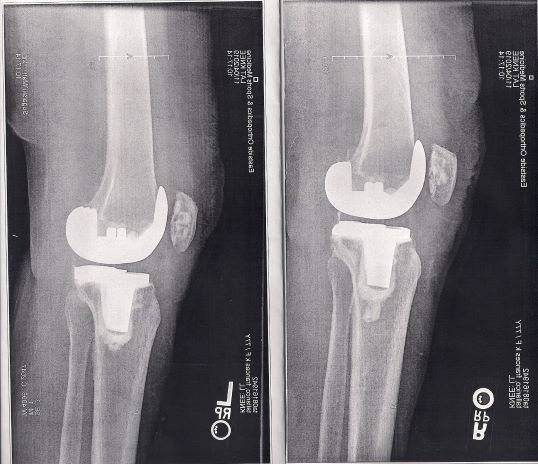
Dr. Matthew Sugalski did a wonderful job replacing my knees, and his staff at Eastside Orthopedics took good care of me pre and post surgery. X-rays were taken during my last visit to his office. He beamed at his handiwork when he showed me my new knees.
 The Write Mind of a Lefthander