Three years ago, I became aware that I had arrived at a stage in my life where I had no duties or obligations to hold me down. I no longer had a job. My children were adults with children of their own. Two of my grandchildren were young adults pursuing their own paths. It was time for me to pursue mine.
There have been many changes since then, physically, mentally, emotionally, and spiritually. My birthday is in August and I love celebrating the joy of being alive. This year I decide to observe it differently, to contemplate my life, where I’ve been and how I got here; where I want to go, and how to get there. I find the perfect place for silent reflection, the Benedictine Monastery of Christ in the Desert in Abiquiu, New Mexico.
Freedom’s navigation system routes me along country roads. Driving is pleasant and unhurried. Along the way, I see vibrant canyons, their faces etched by time, and wild sunflowers growing beside fast running rivers that skirt imposing mountains. There are small, old towns strung out like beads between long stretches of ranchland where I need to stop from time to time while cattle cross the road.
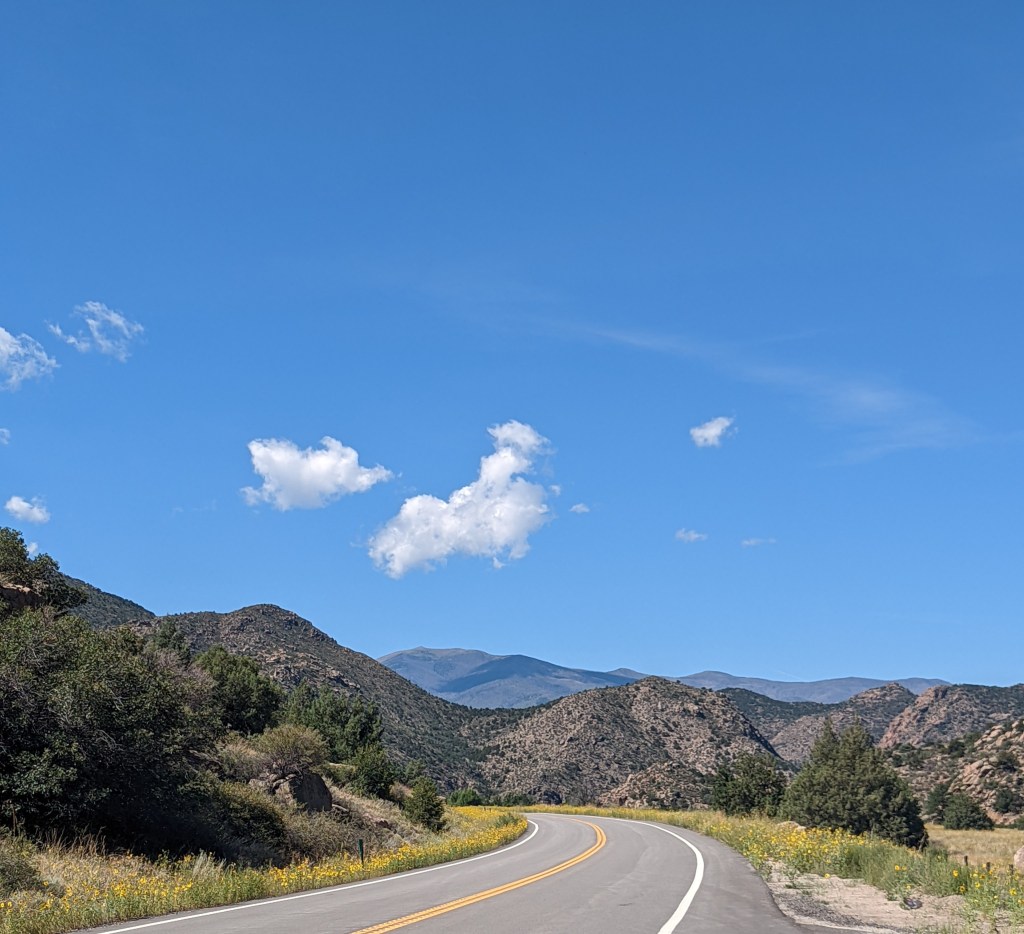
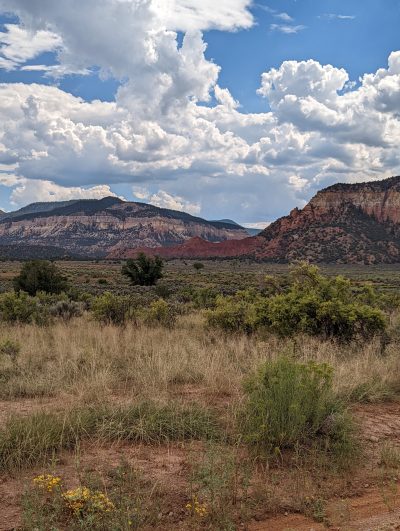
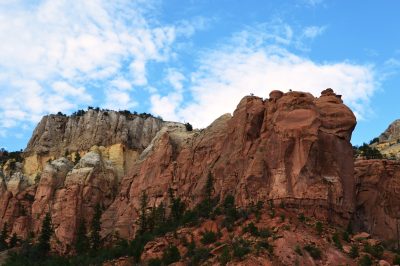
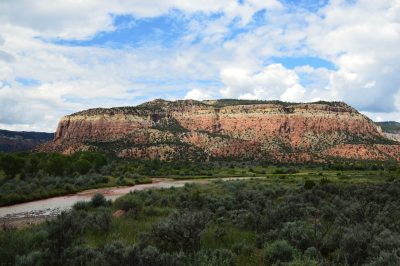
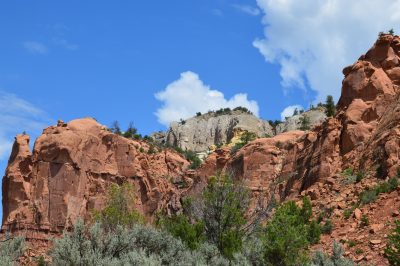
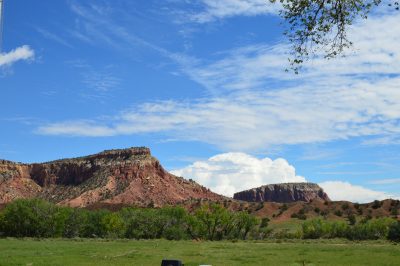
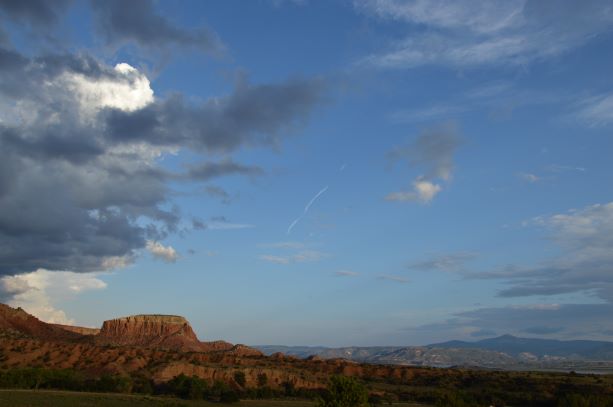
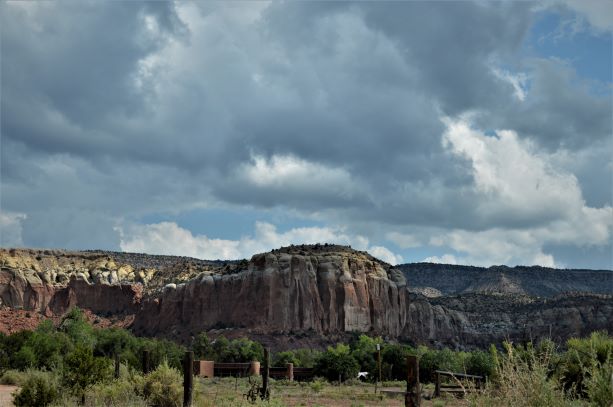
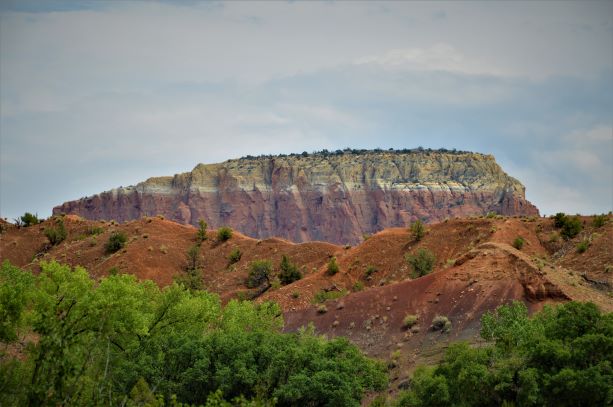
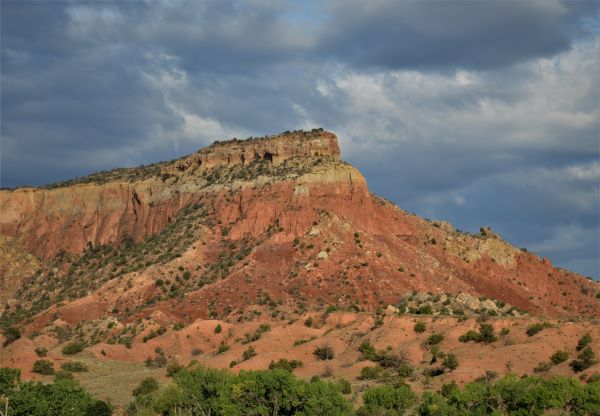
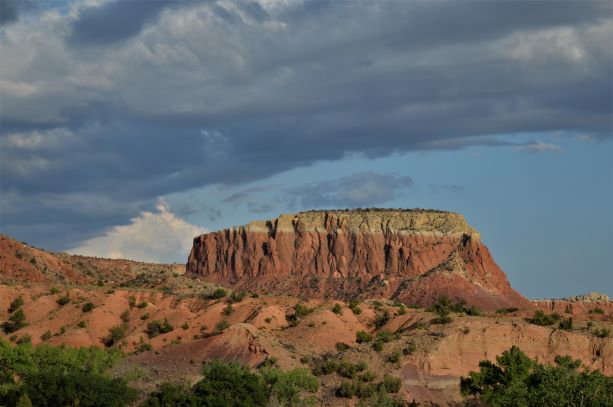
I drive through Chama, and down pine covered mountains. I don’t need a sign to tell me when I’m in Abiquiu. I see it in the grandly shaped and striated rock formations composed of volcanic debris from eighteen to twenty-seven million years ago. Tuffaceous sandstone, pebbly sandstone, siltstone, gravel beds, and mudstone in gorgeous shades of color from white to light grey, buff to ochre, red-orange to magenta. I fell in love with Abiquiu last summer and I’m happy to be back in this beautiful place.
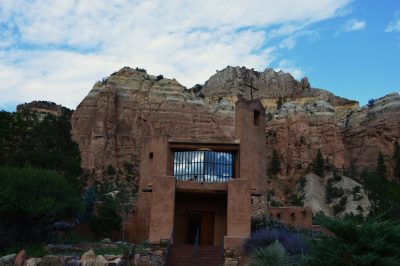
From the highway, it’s a thirteen mile drive to the monastery over a sometimes gravel covered, deeply rutted, bumpy, red dirt road. It takes forty minutes to get to the guest house. I have enough time to unload my car, make the bed in the simple room I’m staying in, and walk to the chapel for Nones. As I enter, the monks are chanting, “May you live to see your children’s children…”
Dinner is in the Guest Dining Room. Meals are taken in silence, but there are quiet introductions among the guests. Afterwards, I walk around the grounds and back to the guest house. In the courtyard I relax into the peaceful surroundings. The sun is about to set. The changing light creates more definition in every crevice of the rock formations. It’s magical.



I wait for darkness to see a star filled sky, but clouds roll in and draw a shade over them. I go to my room. When I lay my head on the pillow, I fall into a deep sleep.
In the middle of the night, I’m jolted awake by a car alarm going off in the guest parking lot. It seems like an eternity before the alarm stops. My body adjusts to the adrenaline coursing through it and just as I’m falling asleep, the alarm goes off again. This happens several times. Now I’m awake waiting for the next alarm. It doesn’t happen again, but there is the noise of my mind wondering about this and that, making comments on every speculation.
Silence is something I’ve always longed for. It’s quiet here, even the whip, whip, tweet of a bird, the chattering of crickets, and the howling and yipping of coyotes that echo throughout the canyon are sounds that do not intrude on the tranquility of this remote place. In “civilization” there is always noise, even at night: motors for refrigerators, heaters and air conditioners going on and off, the drone of traffic in the distance. I conclude that there is no such thing as silence, but there is quiet. Now that I’ve weighed and measured the difference between silence and quiet, noise and sound, I’m wide awake.
It’s my birthday. I get up, dress, and go outside to look at the heavens. I’m greeted by a half-moon and Jupiter brightening the pre-dawn sky. I was so excited by this sight that the photo is blurry from not holding the phone steady enough.

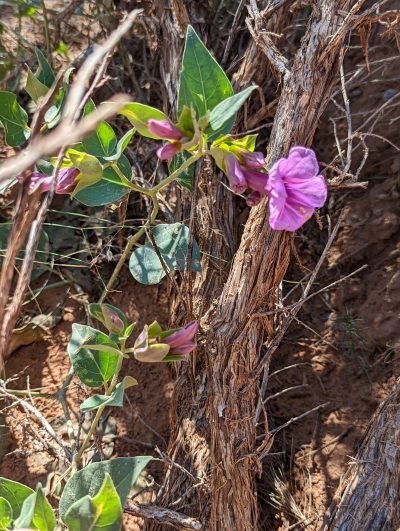
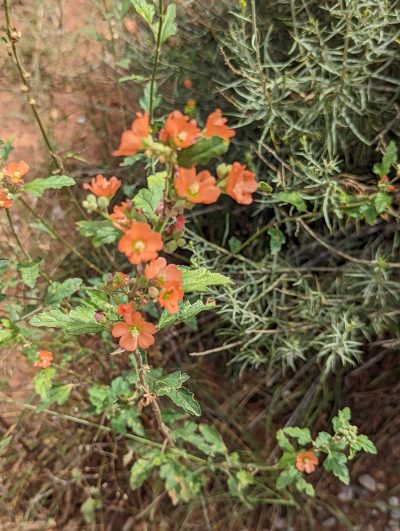
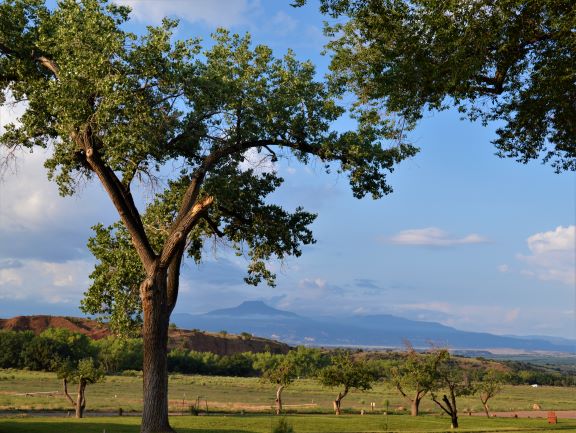
It’s been rainier than usual in this part of the southwest, making the landscape astonishingly green with a profusion of wildflowers in bloom. I find a spot to sit in the midst of all this splendor and send love and blessings to my family and friends, on this plane of existence or beyond the veil, who have walked life’s seasons with me, through joys and sorrows, and the hard lessons that created growth. I think of those who walked with me briefly, sometimes only moments, who had a great influence on my life, changing its course by pointing a way to go when I couldn’t see one. I’m filled with gratitude for the life I’ve had and for the good health that allows me to continue to experience it to the fullest. I ask the Divine Spirit how to be a better person, and what more can I do to help bring nature and humanity into balance?
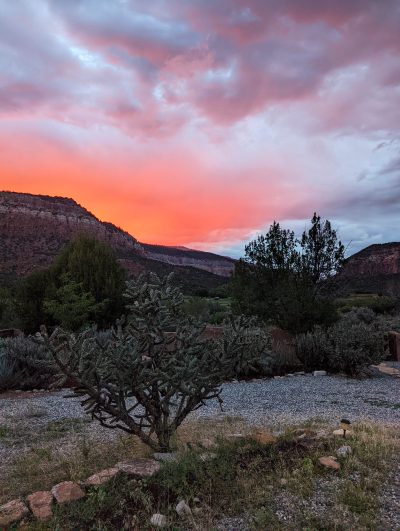
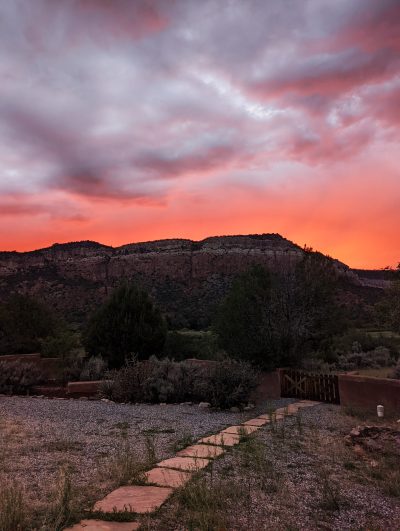
During Vespers, as the monks chant, thunder booms and rolls. Puffy white clouds gather and turn gray. The thunder grows more frequent, like the drumming of Grandfather, the Native American name for the Great Spirit. It rains hard for five minutes and stops as abruptly as it began. The sky remains cloudy, but at sunset it turns a brilliant shade of rose. The camera doesn’t capture the true color. The rain starts again, and continues all night, the booming of Grandfather’s drum speaking to me.
Everyone here is seeking solitude. Some do not speak at all, their days spent reading and in contemplation. Others observe the quiet, but are open to conversation. Mira Nakashima-Yarnall and her husband, Jon, are warm and friendly. We talk in the courtyard of the guest house. Mira’s father, George Nakashima, is the architect who designed the monastery chapel.
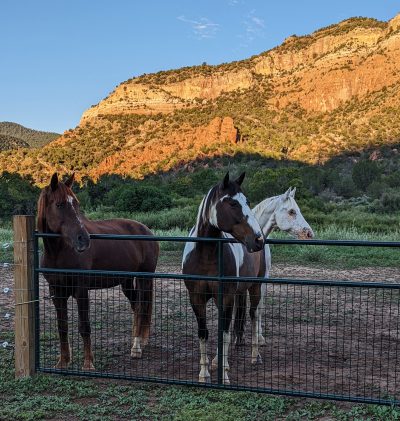
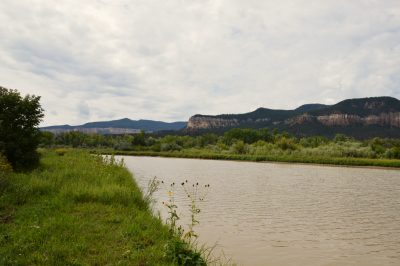
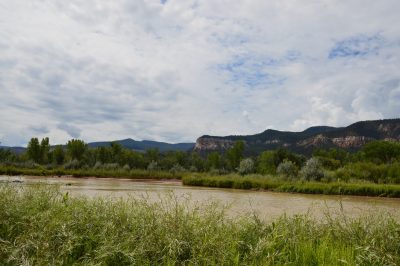
In the morning, Mira and I go for a walk. We cross the field that leads to the horse corral. The path is a red mire from the heavy rain overnight. The Rio Chama was low when I first arrived, but it’s full to its banks and runs fast and muddy. I enjoy being in Mira’s presence. She exudes peace and kindness. She’s the President and Creative Director of George Nakashima Woodworkers in New Hope, PA. Mira narrates the documentary A History of George Nakashima on You Tube, about his life and evolution from architect to furniture maker. It’s an interesting video and worth watching, as is a visit to the website: https://nakashimawoodworkers.com
Later in the day, I walk down the road and see a van with Ojai on the license plate. A man is sitting behind the wheel. I say, “Oh, hi. Are you from Ojai?” He looks up. “Yes. Do you know it?” I say that I’ve been there many times to hike and sit in the hot springs.
His name if Jeff. He just drove down from the Benedictine Abbey at Snowmass, CO and hopes to speak with a monk here about Father Keating and the Centering Prayer. I’d never heard of the prayer. Jeff explains that it is a way to quiet the mind, to get to mindlessness through a self-selected mantra. I say it sounds similar to Transcendental Meditation. We talk about the difference between mindlessness and mindfulness, about Eastern philosophies, mysticism, and the many roads that lead to inner peace, self-realization, Divine Spirit, the All Oneness.
He drives me to the guest house and gives me a tour of his van, outfitted for overlanding. There’s a solar panel on the hood to run an extra battery for the refrigerator, a satellite GPS, and many other features to accommodate self-sufficient travel in remote places.
We walk to the chapel and I introduce him to Brother Andre, the Guest Master who takes Jeff to speak with another monk about the Centering Prayer.
It rains all night again. After breakfast Jeff follows me down to the highway to make sure I have no problems on the muddy road. We wish each other well on our journeys. Jeff turns to the mountains, and I towards Ghost Ranch.


Ghost Ranch
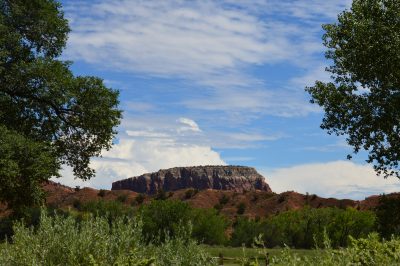
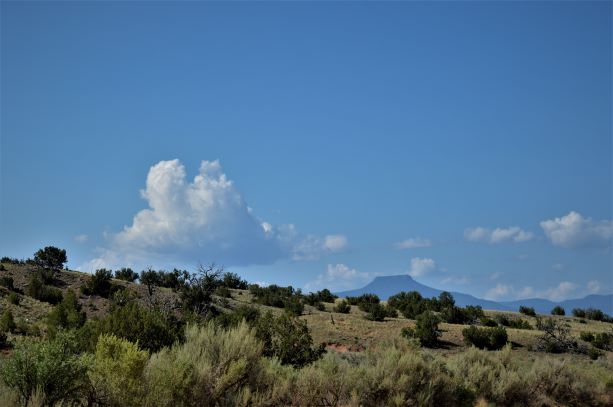
Ghost Ranch is lush with grasses and colorful wildflowers, hardly the desert xeriscape I saw a little over a year ago. In this time of severe drought throughout most of the western part of the United States, it’s a bold reminder of the life giving function of water.
After I check in at the Welcome Center, I go to the campground, choose a space and plug Freedom into the electrical outlet. I realize that I forgot to pack a mallet. I walk to the maintenance building and borrow a hammer from the foreman. He drives me back to the campsite in his golf cart. He says that in the spring the local water company sent the ranch a letter that there would be severe water restrictions because of the drought. Thankfully, the rains began on June second.
While I set up the tent, I realize that if there hadn’t been this stream of rain all summer, I might not be here now. I think of the pervading problem of drought in some parts of the world that lead to severe wildfires, and extremes of rain causing floods in other parts. I worry over how we human beings will solve the environmental crisis we are living through, and how much we are willing to forego as individuals to live in harmony with Nature.
The tent pops up easily and the soft ground yields to the hammer as I pound in the stakes. I roll out the mattress and sleeping bag, and situate a flashlight and the book I’m reading next to it. I wander around the grounds the rest of the afternoon, taking in the beauty.
It’s a lovely evening. Instead of eating in the dining hall, I find a table outside. A gentleman sits at the next table. He says his name is Dave Mitchell and we talk about our travels. The conversation turns to ecology and we learn that not only are we concerned about it, but we are seeking ways to help solve the environmental crisis. Dave is a contributor to Eco-Radio on KKFI.org, Kansas City, MO. We talk for a long time, and then walk together to the campground.
The night sky is once again shrouded with clouds. I intend to read a while, but it’s so cozy inside the sleeping bag that I close my eyes and drift into sleep.
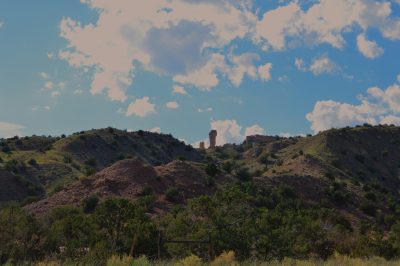
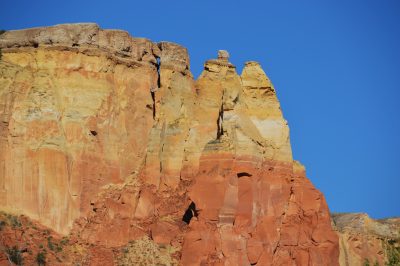
The tent is bright. Have I slept the morning away? I get up and look outside. The waxing moon lights the pre-dawn sky, a scattering of stars shine dimly around her. I dress for the day and sit at the camp table and read, waiting for the sun to rise.
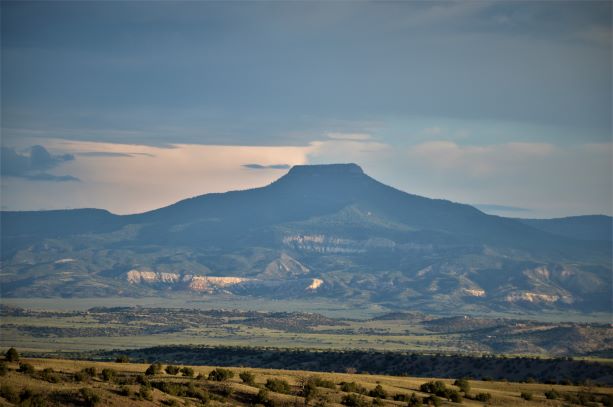
I walk down the road with the marker to Georgia O’Keeffe’s house. It’s private property, owned by the Georgia O’Keeffe Museum, but I hope that just one person ambling by might go unnoticed, and I can stand on a spot where she stood and see what she looked at. Past the horse corrals, there’s a gate covered with wire and a “No Entry” sign. I walk up a hill that overlooks the road. This is as close as I get to her house.

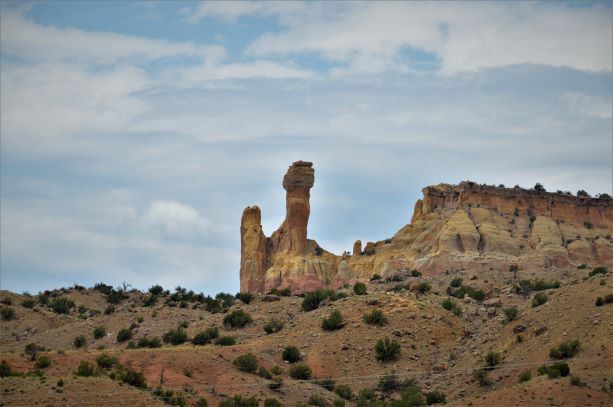
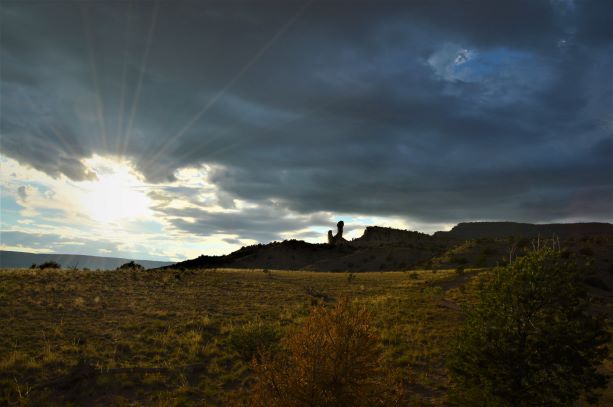
Later in the afternoon, Dave and I meet up and hike the trail to Chimney Peak. We stop from time to time to enjoy the views and take photos.
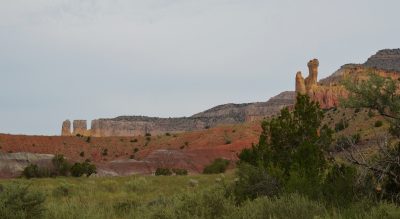

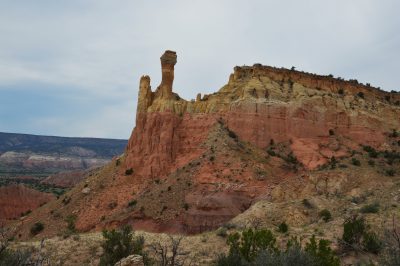
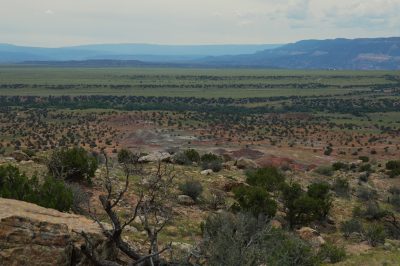
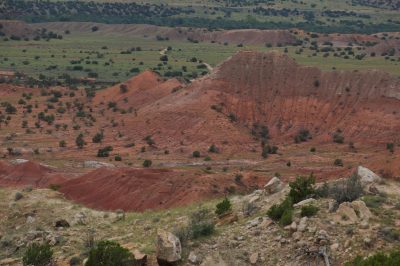
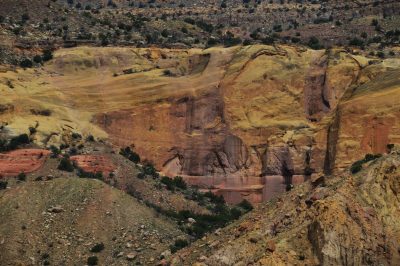
When I return to the campground, I realize that my phone is out of charge; the charger is in the car and I can’t access the car without the phone. Max Re, who works at the Trading Post, says he has a charger that will fit my phone. After dinner we walk to his van and plug my phone into the charger. We talk about where he attended school and his changing path in life. Max is a writer, and our conversation flows between what kind of books we like to read, psychology and philosophy, and quantum physics. After a while Dave joins us and ecology becomes part of the conversation. When there is enough charge on the phone, Max heads off for a gathering with co-workers and Dave and I talk for a while longer.
At the Welcome Center there’d been talk of rain tomorrow, a river of it according to some accounts. I hope it will wait until I leave, but as a precaution I pack the car.
I’m awakened by the sound of drips and splats on the tent. I peek outside and see misty drizzle. I get dressed, roll up the mattress, stuff the sleeping bag into its sack, put them in the trunk, and walk to the dining hall to meet Dave for breakfast. It takes two people to fold the tent. I ask Dave for help and he graciously says yes.
It’s raining steadily as we walk back to the campsite. I pull the stakes out of the ground; we fold up the tent like a taco and twist. It’s covered with mud and doesn’t want to stay folded, and we’re getting wet. Dave suggests that we move the tent under the bathhouse portico. We fold and twist numerous times, but the tent prefers to pop up, or folds into a circle twice the size of the trunk. Finally, we unload the trunk, put everything in the back seat of the car, and stuff the tent in the trunk. I imagine getting home, opening the trunk and the tent popping out like a Jack in the box.
Dave and I exchange email addresses and say farewell. I’m grateful for his patient help and camaraderie the past few days. My water repellant jacket is dripping wet and my shoes are caked with red mud. I take the jacket off as I slip into the front seat of the car and drape it over the passenger seat. I’m glad I had the forethought to put my sneakers there and change into them. Dry and cozy in my car, I drive into the rain and up the mountains surrounding Taos.

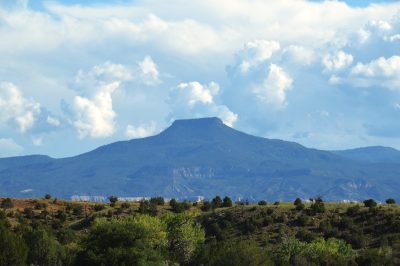
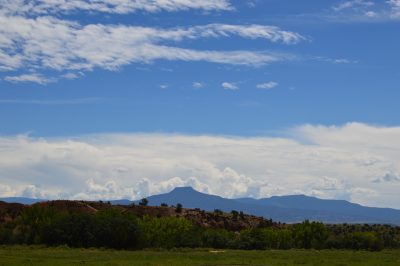
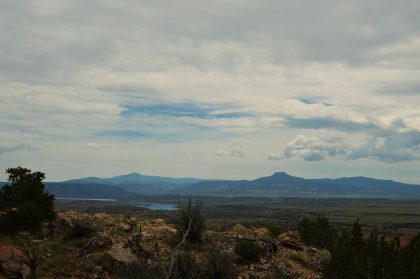
The ride home is in and out of squalls, along roads curving through pine forests. I think about what I learned this week. I’d gone away for quiet and solitude, and while I did have plenty of both, the Cosmos surprised me with an array of interesting people and thoughtful conversations. Nature embraced me with her beauty, and I realize that my wish to save Her is wrongly placed. Nature always comes back after fire or flood or humanity’s abuse, more beautiful than before. It is humanity that needs to be saved. Meeting people who are seeking a higher standard in their lives, looking to live in peaceful harmony with neighbor and nature, living with concern over the environmental crisis and working towards solutions, made me feel my prayers were heard. Grandfather’s drum replied, “There is hope, keep spreading the word.”
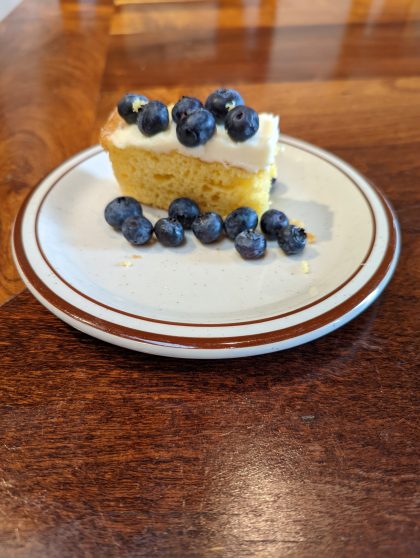
And after dinner on my birthday, the Cosmos supplied a slice of cake to celebrate.
To read more about the history Ghost Ranch and Georgia O’Keeffe, read my blog, The Best Place on Earth.


 The Write Mind of a Lefthander