It took six days to drive nearly three thousand miles from Missoula, Montana to Yaphank, Long Island. I spent two weeks visiting my siblings and cousin Teresa who was recovering from surgery. I stayed at her condo and visited her every day at the assisted living facility where she is convalescing. Most evenings I had dinner with my sister Kathy and brother-in-law Bob who live nearby. One night we made a traditional Italian dish usually made with baccalà (dried salted cod.) It would have taken days to soak the cod to remove the salt. Instead, we bought fresh cod at a nearby fish market. I haven’t been to a market with such a variety of fresh seafood in many years. We baked the cod with potatoes, onions, peppers, capers, olives, and crushed tomatoes sprinkled with oregano and drizzled with olive oil. It was delicious.
Sometimes we’d sit on the patio overlooking the pond. As the sky faded to dusk, little flickers of light danced in the grass, and then guided me on my walk home. It was magical. It brought back memories from my childhood, of summer evenings at my grandparents’ home in Huntington where I tried to catch fireflies in a jar to watch their lights glimmer, wishing I could fly among them.
Fireflies thrive in leaf litter and tall grasses in forests and fields, in humid environments and moist conditions. They are a threatened species because of diminishing habitat, pesticide use, light pollution, and climate change. Fireflies are thriving this summer in the Northeast and Midwest thanks to a warm, wet spring. If we stopped using pesticides, turned off the lights at night, and conserved wildlands, fireflies would make a comeback and children of generations to come will delight in Mother Nature’s summer evening spectacle.
My sister Sandy and I spent a day wandering around Stony Brook, a charming Colonial hamlet, and brother-in-law Fred made sure I had sfogliatelle, my favorite Italian pastry.
My brother and sister-in-law, Nick and Cathè Ann, are equine vets. They brought me to an event hosted by Manda Kalimian. A lifelong Hippophile and Equestrienne, Manda was shocked when she learned of the fate of old or unwanted horses, as well as the wild horses that are rounded up by the Bureau of Land Management (BLM) penned and sold at auction. She created The Cana Foundation, a non-profit organization to promote initiatives for returning wild horses into the ecosystem. Manda is working with Native tribes to release these majestic animals onto Reservation land for environmental conservation, integrating traditional indigenous knowledge with modern scientific research.
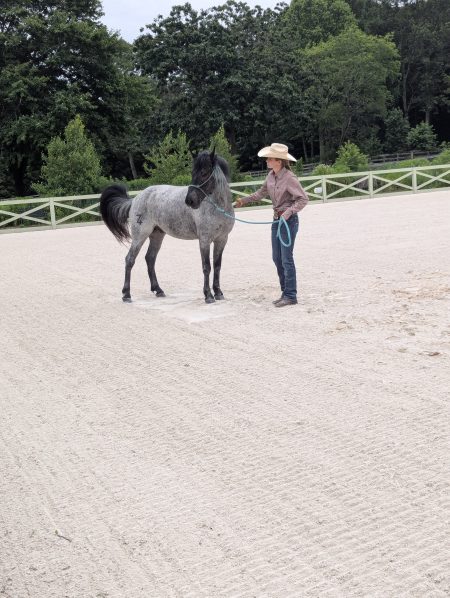
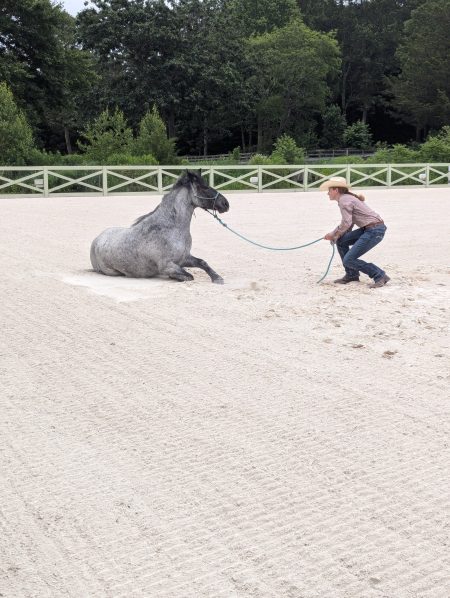
It was a beautiful summer evening at Manda’s stables where she showed two horses saved from auction. Because they’d lived in captivity before Manda rescued them, they’d lost their natural herd instinct, the ingrained social behavior of wild horses to live in groups. The younger horse, Luke, had many physical problems when Manda rescued him. She asked Nick and Cathé Ann to save him, and they did. Below are some photos of Luke and his trainer, Brooklyn.
You can read about Manda Kalimian’s path from horse lover to activist in her book Born to Rewild.

I left Long Island early on Sunday morning at the end of the July Fourth weekend. Traffic was steady on the Long Island Expressway to Queens where it grew heavier but was still moving. The approach to the George Washington Bridge was as stressful as the Holland Tunnel’s with multiple lanes merging from different directions. Once on the bridge, traffic moved at a steady pace.
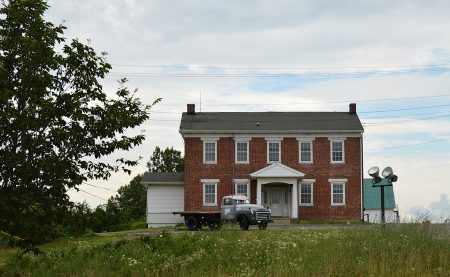
After several hours on I-70, I took the Lincoln Highway (U.S. Route 30.) Again, I was delighted by the beauty of Pennsylvania, on winding, hilly roads filled with farms and barns decorated with Hex signs, the folk art of stars and flowers. The area is steeped in history and it is reflected in the buildings such as the stately Toll House Number Two. The Pennsylvania Dutch architecture of brick or stone buildings are beautiful in their timelessness. Some towns have rows of abandoned homes and I wondered if they could be restored. With so many jobs being done remotely, wouldn’t it be lovely to live in small cities, close to nature with fresh food grown nearby, instead of making further incursions into nature for development.
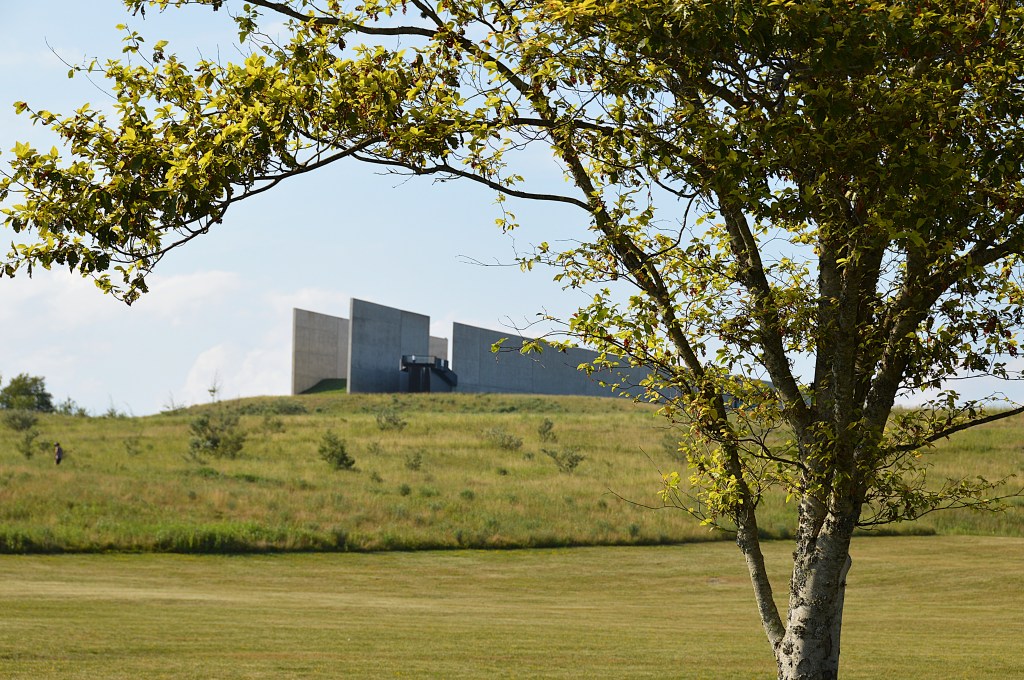
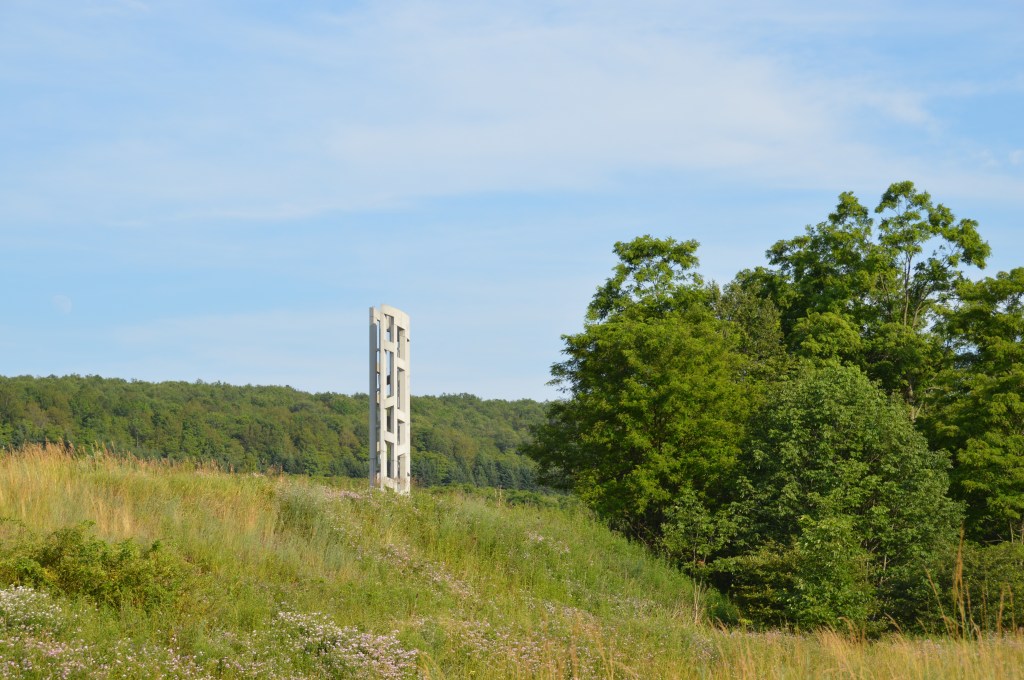
It was late afternoon when I arrived at the Flt. 93 Memorial. The site is stark in its commemoration of the events of September 11, 2001. I was deeply moved by my visit there. You can read more about it in my blog: Flt 93 Memorial.
When I planned my route, I knew the Memorial was off path, but it didn’t seem far. I needed to retrace my course over hills and around curves as the sun was setting. My destination was Somerset, but when I arrived in Bedford, I’d had enough driving for the day. My reservation for the night was at a Hampton Inn and when I saw one on the side of the road, I detoured and pulled into the driveway. I told the woman at the desk that I didn’t think I could make it to the Hampton Inn in Somerset. She said, “Don’t worry, I’ll take care of you.” When she said her name is Laura, I knew everything would be all right. Laura was my mother’s name. She called her affiliate, cancelled my reservation, and gave me a nice room on the first floor. There was no hassle and no additional fee. I asked if there was a good place to eat nearby. When she recommended Hoss’s Steak and Sea House, it didn’t sound like my kind of fare, but I was hungry and it was nearby. Hoss’s had a soup and salad bar that was excellent. The soups were made in house, as well as the salad dressings, potato salad, and coleslaw, and the salad components were fresh. It was one of the best meals I had on the road.
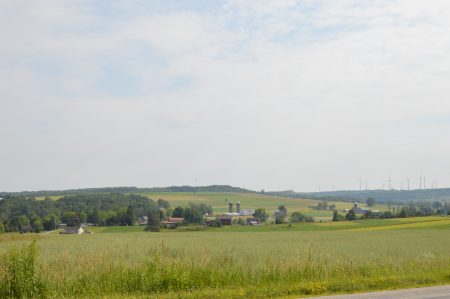
In the morning I continued on the Lincoln Highway to Huckleberry Highway and then to “Shortcut Road.” I passed four horses pulling a cart followed by a vintage grain drill. It was driven by a boy who looked about twelve or thirteen years old. The farms grew corn and the hillsides were lined with wind turbines generating electricity, a picture of the past and present coexisting.
When I stopped in Triadelphia, W. VA to charge Freedom, a man came to me and asked for help. He was elegant, dressed in yellow linen pants, a crisp white shirt, a vest, and a pale blue tie with tiny yellow daisies. He was transporting a Mustang EV and needed to use a charger but didn’t know which way to park so that the hose would reach the Mustang’s port. Another couple came over and together we helped resolve the problem. I wish I’d had the presence of mind to ask the man, whose name is Michael, if I could take his picture. He was splendid!
As I drove on towards Columbus, OH, the horizon was a dark wall rolling in the direction I was driving. Soon there were streaks of lightning, booms of thunder, and a burst of rain that came down in sheets. It was raining so hard that I couldn’t see past that deluge of water coming from the sky. Traffic slowed to five miles an hour. The road was now a river. Driving was sheer terror for what seemed forever and a day but may have been only ten minutes. The rain ended as abruptly as it began.
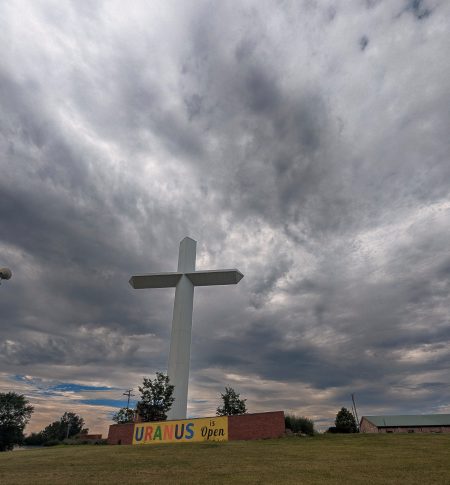
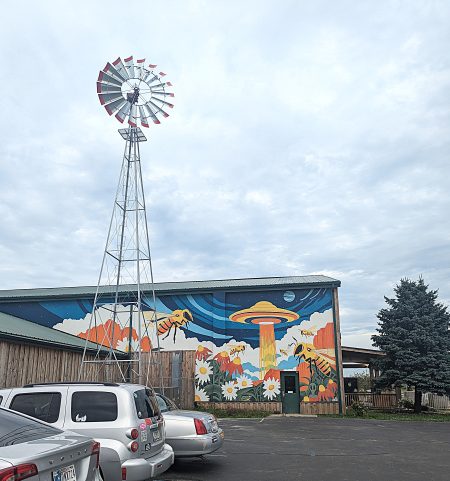
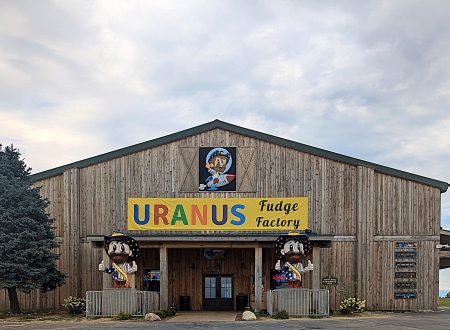
As I neared my destination, Richmond, Indiana, there were billboards advertising Uranus Fudge Factory. The ads were humorous and took the edge off the panic I felt driving through that tempest. When I exited I-70, there it was, Uranus Fudge Factory beside a one hundred foot tall cross. Of course, I had to stop to investigate it. The steel frame cross was erected by New Creations Ministries to “provide hope, direction, and light to travelers.” The site was a church, Bible college, and camp for troubled teens. Struggling with debt, the property was sold in 2016 to Uranus Fudge Factory. I bought some fudge and spoke with the young man who worked there. He said there are plans for developing the fifty acre property into some sort of amusement park.
Late afternoon the next day, I stopped to charge Freedom just outside of St. Louis when it started to rain. I returned to I-70 and after a few minutes on the road, it was as dark as midnight, flashes of lightning filled the sky, thunder rumbled in the distance. The rain came down as heavily as the storm the day before. I saw a sign indicating a hospital nearby and got off to wait out the storm in the hospital’s parking lot. The lightning and thunder passed and the rain subsided half an hour later, and I was on my way again. By the time I arrived in Columbia, Missouri, I was exhausted and ready to sleep.
I scheduled a short drive for my fourth day on the road so that I could spend time in Abilene, Kansas. It was a pleasant ride, the blue sky filled with cumulus clouds. One of those clouds broke up into little clouds that formed a school of hungry fishes swimming open mouthed in the sky ocean. It seemed appropriate. The air is so heavy with humidity in the East and Midwest that I felt as if I was underwater while I was there.
Farther along a white plane painted yellow under its wings was flying across the freeway performing roll maneuvers, turning and making touch and go landings on the farm on the other side of the freeway. It was like watching a butterfly at play.
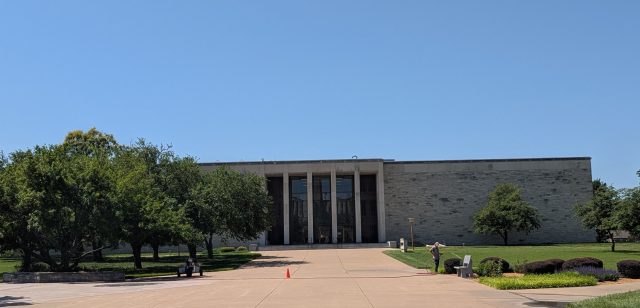
I spent the afternoon at the Eisenhower Museum and Library in Abilene, Kansas. President Eisenhower was an extraordinary human being. I loved learning more about him and wanted to cry thinking about everything that President Eisenhower did for our country and the world, and what the current administration is doing to it. My next blog will be about my visit to the Museum.
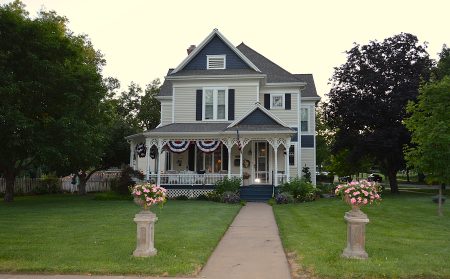
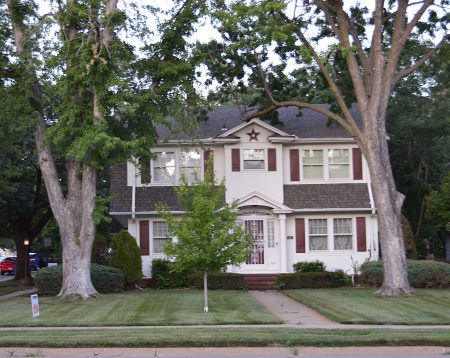
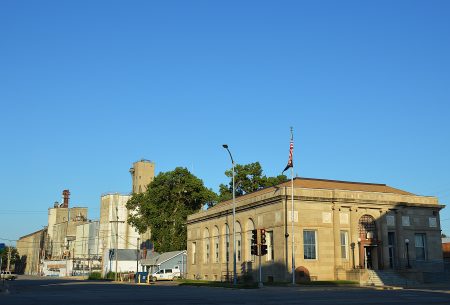
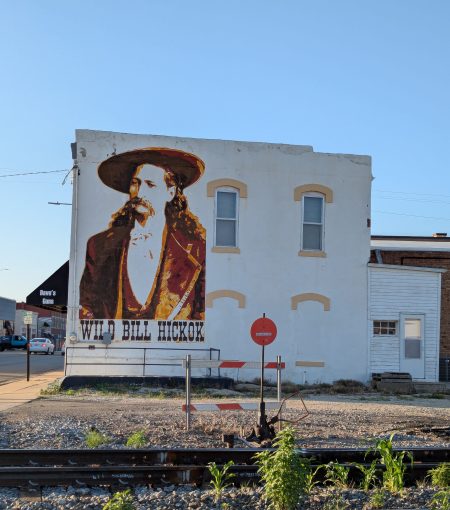
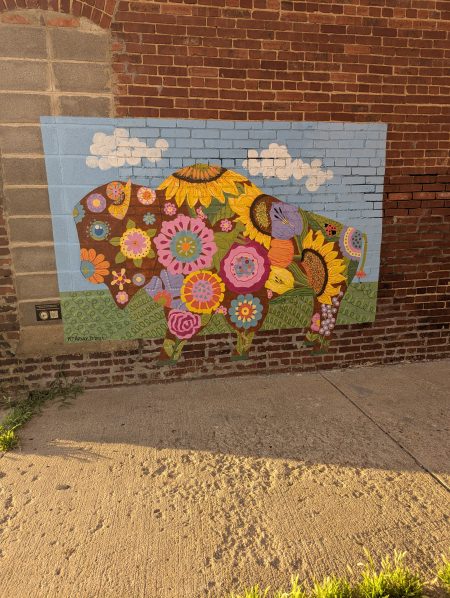
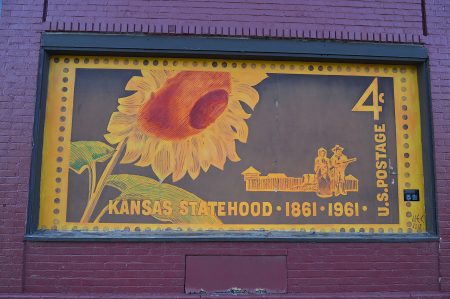
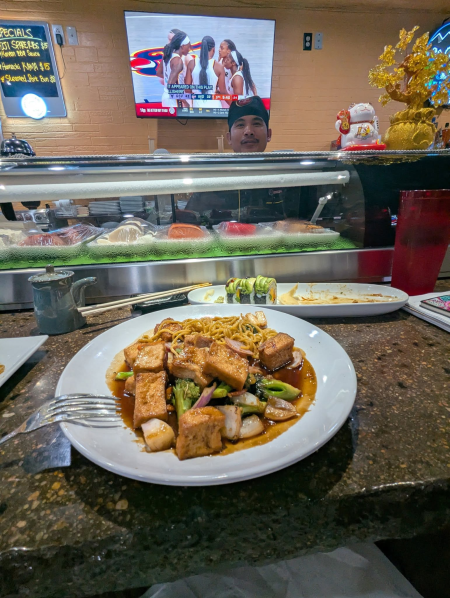
I was charmed by Abilene, its rich history, and Heritage Houses. I had dinner at Fuji Asian Kitchen. It was fabulous. I was famished and ordered more food than I could eat. Everything was delicious. I had veggie roll with mango, and tofu and vegetables with lo Mein noodles.

This is Mo, Sushi maker extraordinnaire.
As I drove the next day, classical music flowed in and out and among my thoughts: violins, cellos, pianos, clarinets, flutes, and the occasional emphasis of trumpets as I reflected on my experiences over the past few weeks. It seemed that everywhere I looked corn was growing, ninety million acres of it throughout the Heartland of America, the majority of it used for livestock feed and ethanol fuel production.
I stopped in Hays, Kansas to charge Freedom and went for a quick walk before returning to I-70, known as the Dwight D. Eisenhower Highway through Kansas, also called “The Ike” for the beloved President who created the interstate highway system. I sent a blessing to his memory and prayed for a new Ike to lead our country.
The wind picked up, blowing dust across the highway. In the distance a citylike mirage appeared on the horizon. Drawing closer, I saw that it wasn’t a city but a cluster of silos of seven to ten stories high. I wondered how many of these are needed to store ninety million acres of corn.
Just as I was beginning to think there would be no end to the wind, the dust, cornfields, and silos I saw the exit for Highway 86. The terrain changed as soon as I was on this country road. It was gently rolling and green, still agricultural, but now there were cattle ranches. Before long, I was in Castle Rock. I spent the weekend there and in Colorado Springs visiting family and friends.
Monday morning I headed north on I-25. I was surprised and delighted that there was little traffic going through Denver and I made good time up to Johnstown where I charged Freedom. Soon I was driving on I-287, a beautiful drive that made me appreciate Wyoming even more.
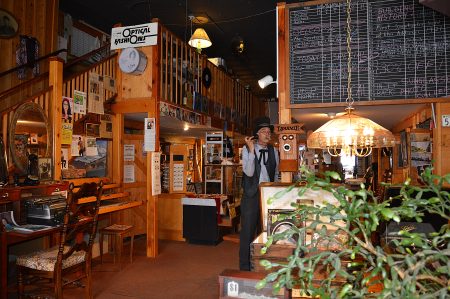
I arrived in Laramie, Wyoming too early to check into the hotel, so I spent the afternoon in the historic Old Town. I walked into The Spectacle Emporium because it looked like a museum. I felt as if I had entered a time warp; there were lenses for eyes and cameras spanning decades and centuries. Soon a tall, thin man in slacks, vest, western bowtie, and top hat emerged from the depths of the store. Steve Grabowski, the proprietor and optician, plays the part. He makes period glasses for individuals as well as for movies and TV shows. He also makes house calls. I spent a half hour in the store talking with Steve and listening to his stories. He is witty and I enjoyed a healthy dose of laughter.
Next door is the Wyoming Women’s History House. There are exhibits of how women lived and kept house and family when Wyoming was being settled, and they proudly show the role women played in politics. In 1869 when it was still a territory, Wyoming gave women the right to vote and hold public office. On September 6, 1870, Louisa Swain was the first woman to vote in Wyoming. In 1890 when Wyoming prepared for statehood, they chose to include women’s suffrage in the state constitution. When the U.S. Congress opposed this measure, Wyoming’s legislature replied, “We will remain out of the union one hundred years rather than come in without our women.”
In January, 1925, Nellie Tayloe Ross became the first woman Governor of Wyoming and in the United States.
Their motto is, “It ain’t braggin’ if ya done it!”

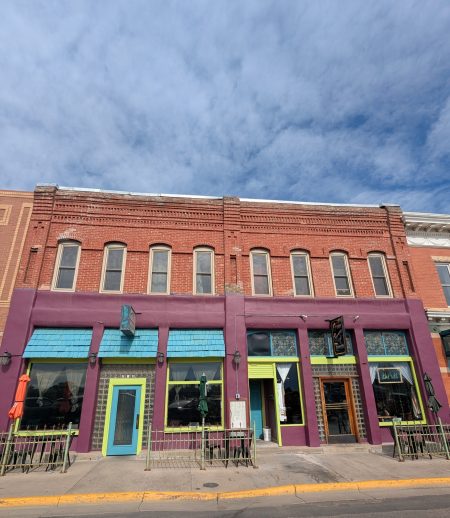
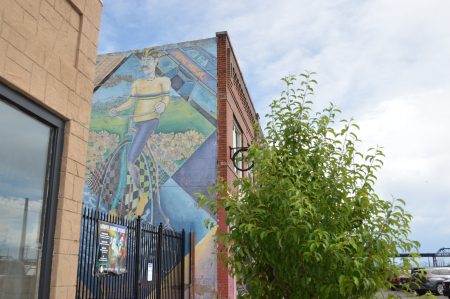
I spent the rest of the afternoon ambling around Old Town admiring the architecture and murals. I visited a bookstore that had once been a brothel. Up the street is The Chocolate Cellar where you can find fine chocolates and confections, as well as books and home decor. I had a pleasant conversation with Carrie Hansen, the owner. She recommended a stop at The Mercantile on my drive through Wyoming.
I spent a wonderful afternoon and evening in Laramie, Wyoming. Honestly, I think I fell in love with this city.
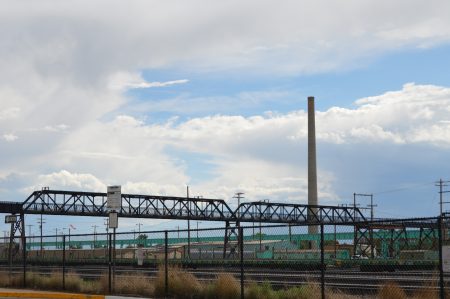
The next morning I passed the rolling foothills of Medicine Bow-Routt National Forest. Soon, the terrain changed to rocky flatlands with nothing to buffer the strong winds. Someone I spoke with in Laramie said that “they” were planning to line the hills with wind turbines and the views would be ruined. It seemed that everywhere I drove on this journey, I saw wind turbines, not only on hillsides, but also components being trucked to the sites where they’ll harness the energy of the wind.
There is concern about birds being killed as they fly into wind turbines. However, the largest cause of bird deaths is collision with buildings and windows. Pet and stray cats kill more birds than wind turbines, and far more birds are killed by habitat loss and pesticides than by cats and wind turbines.
As I was thinking this, I smelled it, the stench of hydrogen sulfide. Up ahead, in a depression in the flatlands sat a monstrous building wrapped in contorted pipes spewing vapors of stinky steam. A gas refinery. I wanted to cry. Not from the smell, but from the thought that there are people who still think pollution ridden energy is preferable to clean energy.
And now I learn that the current administration has opened thirteen million acres of federal land (your land and my land) for coal mining, as well as providing six hundred twenty-five million dollars to recommission or modernize coal-fired power plants that not only pollute the air, but also our waterways from tons of toxic waste dumped into them, all to meet the rising demand for power from growth in data centers (euphemistically called “the cloud”) and collection of information for artificial intelligence.

Photo by Leslie E Brady
I was ready for a stop at The Mercantile in Farson, Wyoming. In an area of arid high plains rangeland, it is one of only a few buildings on the crossroad of US 191 and WY 28. You will find gifts and local comestibles, but they pride themselves on being “The Home of the Big Cone.” And they’re not kidding. As much as I enjoy ice cream, I thought the double and triple scoops I saw other people eating would be a bit too much for me, so I ordered a baby scoop of Rocky Road. The beautiful young lady serving me filled the cone with a scoop as large as a regular scoop in other ice cream stores. I asked if that was a baby scoop. “Not yet, I have to put some more on.” I thanked her and said that what was already on the cone was sufficient for me.
I settled at a table and relished every lick of that delicious homemade ice cream. It was the best ice cream I’ve eaten in a long time. Also, the young ladies scooping the ice cream were cheerful. It adds to the enjoyment to be served by happy employees.
It was less than an hour drive to Pinedale where I spent the night. I went for a long walk and enjoyed the fresh, pine scented mountain air. In the morning I had breakfast at a garden café. As I sipped coffee and wrote in my journal, a little boy who looked about three years old stood next to me holding a toy truck in his hands. I smiled at him and said, “That’s a nice truck.” He nodded and ran off. He came back with a Matchbox car in his hands. I admired that as well. This time he smiled before running off. His parents apologized and hoped he wasn’t being a nuisance. I said that I was enjoying him and that I felt honored that he wanted to show me his cars. We chatted a while and Dad went to pack the camper. He likes to fish. Mom says, “Gather you cars, Jaden, it’s time to go.” He put two cars in the bag his Mom held open. “Where’s
the truck?” she asked. Jaden says he can’t find it. Mom gets up to look in the bushes for the truck. It’s time for me to get on the road. I say farewell to Mom. I bend down and ask Jaden if I could have a hug. He looks at the ground, considering, and then throws his arms around me for a quick hug. “Wow,” Mom says. He never does that.” I drove away with a full heart because a three year old shared his toys and a hug with me.
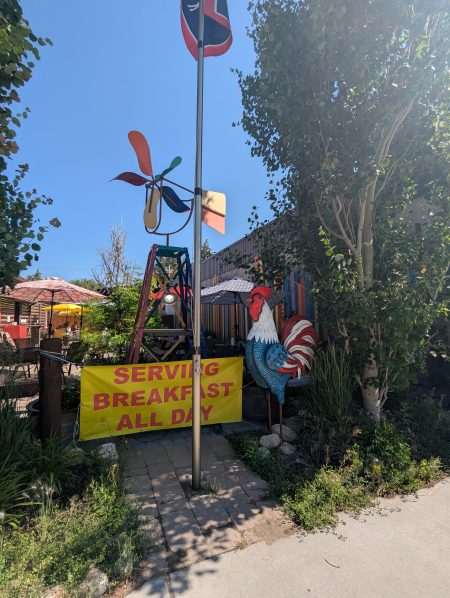
As I passed through Jackson, WY I had several glimpses of the Grand Tetons and regretted not planning a stop there. Another time.
I arrived in W. Yellowstone late in the afternoon. Ruby checked me in to the motel and gave me a map of Yellowstone Park. She suggested sites to see and that I get to the park by 7:00 AM to avoid long lines at the entrance.
With three hours of daylight left, I decided to go the park. The crowds were gone when I entered the park. I stopped at the Fountain Paint Pots to view the otherworldly landscape. I read interesting information about cone and fountain geysers, mud pots, and fumaroles, which are vents in the surface of the earth through which volcanic gases and vapors are released. However, I failed to research Old Faithful. I thought its name meant that its faithful spout was continuous, but its faithfulness comes in its two hour cycle. Having just missed its most recent show, I left. I didn’t want to wait until 9:30 for the next one and then drive back to the motel in the dark.
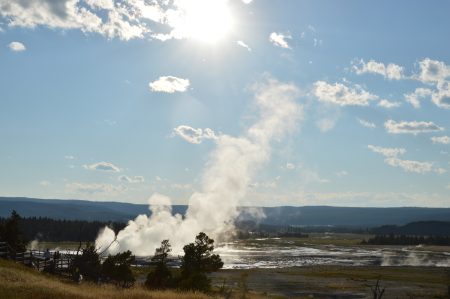
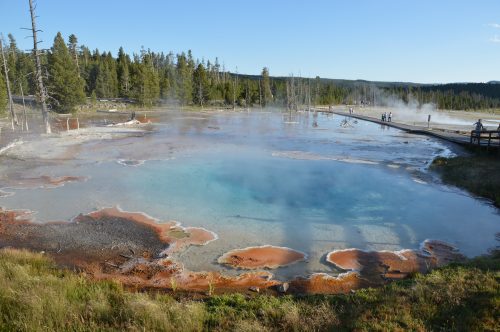
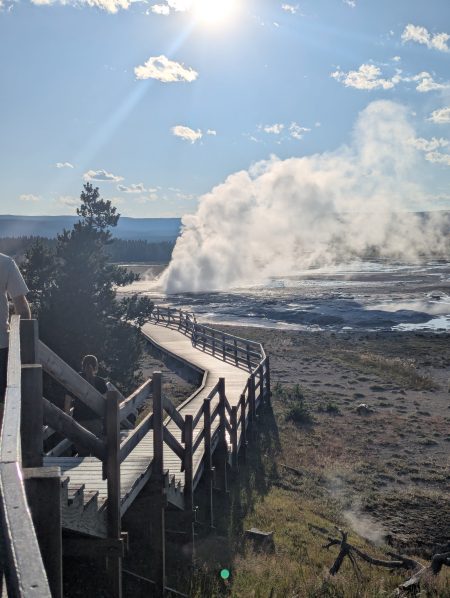
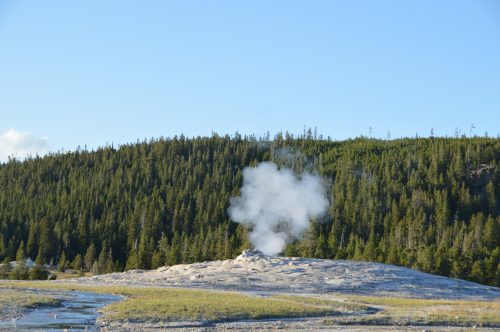
Old Faithful
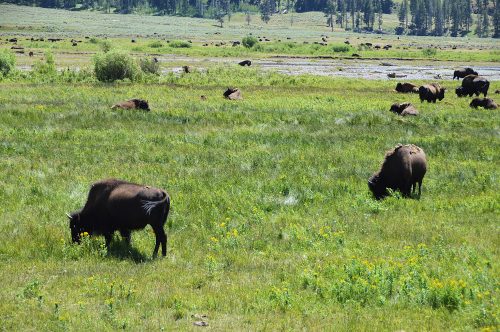
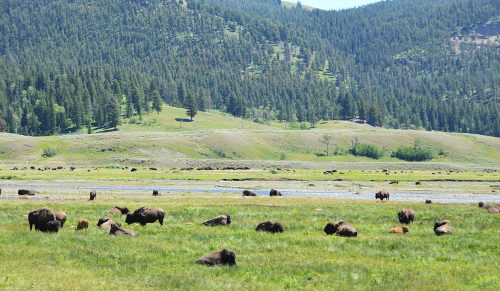
There was little traffic when I entered the park at 11:00 o’clock the next morning. Along the way to Lamar Valley there were more geysers, long ascents up winding roads with magnificent views of rivers threading their way around and through the landscape covered with wildflowers. Herds of Bison grazed throughout Lamar Valley. The red dogs (bison calves) stayed close to the cows, and the bulls wandered in groups.
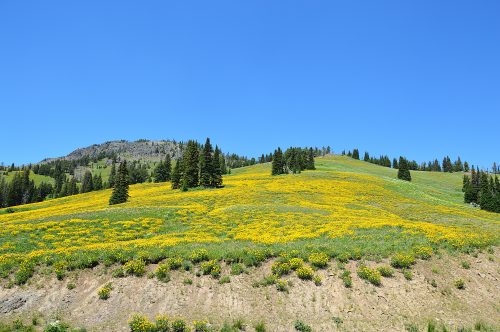
The road began to rise again and I was driving through forest. Up ahead I saw cars parked along the road and people staring at the hillside. As I passed, a gentleman pointed, “Bear,” he said. I looked up and sure enough, there was a bear hightailing it out of there.
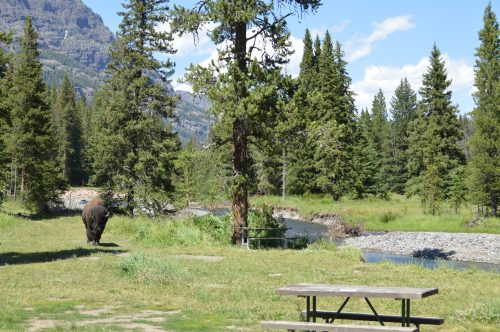
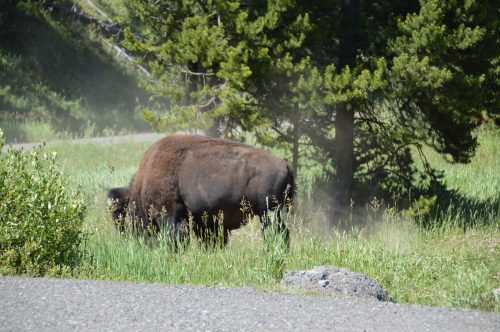
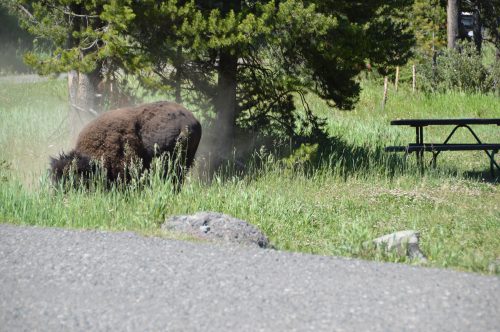
I realized that I’d been driving for three and a half hours. I turned around and stopped at Soda Butte Creek to stretch and breathe the fresh air before the long drive back to the motel. The creek sparkled in the sunlight and the sound of water splashing on rocks was soothing. I saw a man casting his line and sat on a bench to watch the motion of his rod flick the line through the air. I heard a man shout, “There’s a buffalo coming in your direction about fifty yards away.” I turned to see an SUV in the road and a man pointing to a path in the trees. I’m not an expert at judging distance, but there was a bison headed in the direction of the campsite and he was closer than seemed safe. People ran from picnic benches and the creek to the parking lot, ready to capture this magnificent creature on camera, or run if necessary.
That bull sauntered to the edge of the tree line as if he owned the place, kicked up some dust, and then rolled around in it with utter pleasure.
The next morning I went to a little café for breakfast and ordered a cheese omelet. When It was served to me, the cheese, though melted, was still wrapped in paper. Something broke inside me. For the two nights I’d been at this motel the people in the room to the right of me had the TV blaring from first thing in the morning until late at night. When they had a conversation, they needed to yell to hear each other. Someone in the room the left of mine snored all night. I was tired. Tired of eating in restaurants. Tired of being on the road. I went back to the motel, checked out, and packed the car. On the way out of town, I saw a lone bison walking on the road. He looked tired, too.
As I drove, seeing all the beauty around me lifted my spirit. I scanned the foothills of the Tobacco Root Mountains from the vast expanse of the valley floor dotted with remote cabins and thought of the places I visited on my journey. The splendor of nature throughout this country delighted me. I was gratified with the pleasant interactions I had with people, but I was perplexed. People are nice on a one-on-one basis, so why is there such division and discord in our country? We all want the same thing, a roof over our head, good food to eat, loving companionship of friends and family, and to live in harmony with our neighbors. The specifics are different for all of us. Nature is abundant and there is plenty for each of us to have what we want and need. Sadly, there is an ethos of greed right now where some want not only what they already have, and also want more, to the detriment of those who have less. Throughout the centuries philosophers have taught moderation and treating others as we wished to be treated, from the “Golden Rule” as taught by Confucius and Jesus, to the Stoics’ philosophy to live in accordance with nature and to practice moderation, to Aristotle’s “Golden Mean,” even Ben Franklin, one of our Founding Fathers advocated a philosophy of moderation. I like the way George Harrison said it best, “All the world is a birthday cake, so take a piece but not too much.”
When I turned onto I-90 heading west, excitement grew within me with every turn of Freedom’s wheels, and I felt joyful when I arrived in Missoula. Home.
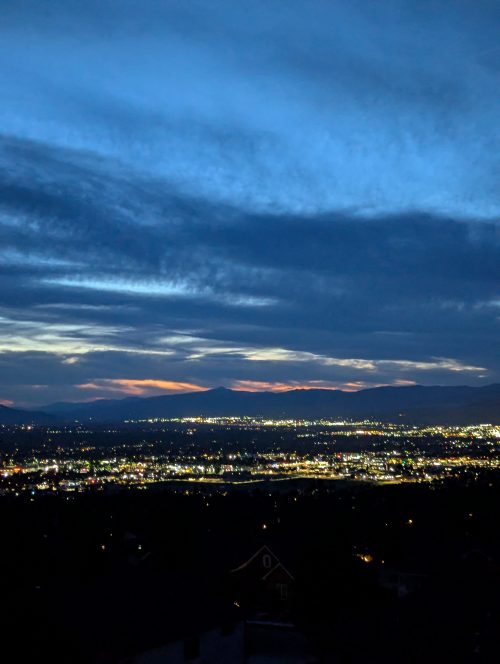
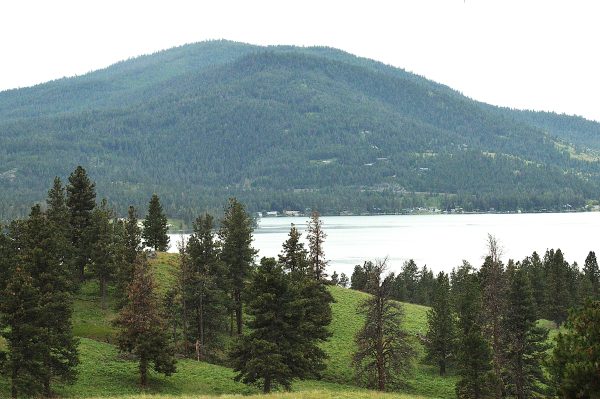
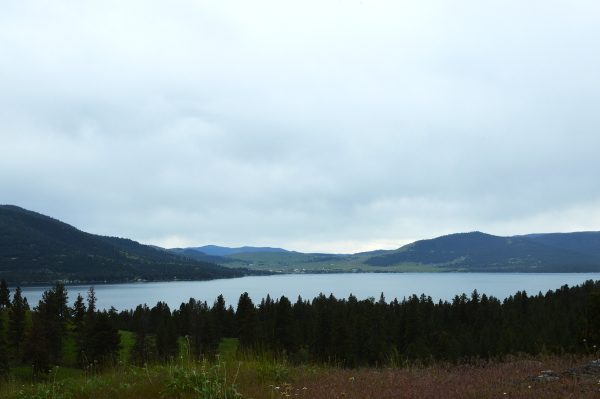
Missoula viewed from Stone Mountain






 The Write Mind of a Lefthander