“Oh give me a home, where the buffalo roam
Where the deer and the antelope play,
Where seldom is heard, a discouraging word
And the skies are not cloudy all day.” Dr. Brewster Higley
The Confederated Salish and Kootenai Tribes Bison Range is in Charlo, Montana on the Flathead Reservation. Three hundred fifty bison roam the 18,766-acre range that is also home to black bear, elk, mule deer, white tailed deer, coyote, cougar, big horn sheep, pronghorn antelope, mountain cottontail, chipmunk, and badger. Excited to see these animals, I began the nineteen-mile-long drive on Red Sleep Mountain Road, up into the open rolling hills.
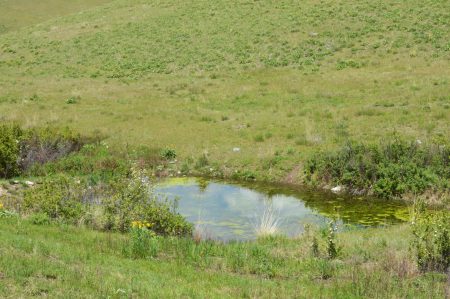
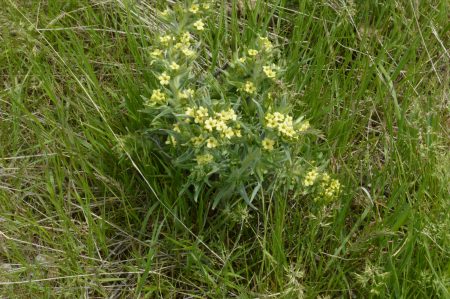
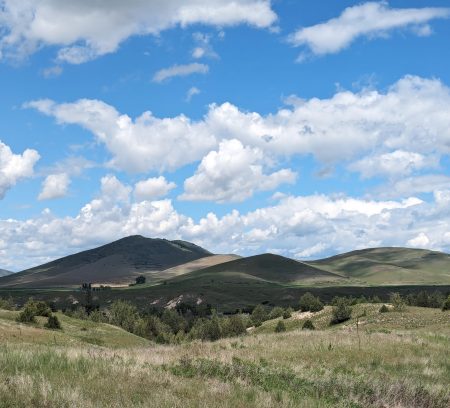
The road is narrow and unpaved. I’m happy to drive slowly to take in the surrounding beauty. There are few other visitor vehicles, and every so often I pullover to allow a trailing car to pass. The lower grasslands are comprised of bunchgrasses and forbs, herbaceous broadleaf plants that are not grasslike.
A little higher, Pauline Creek supplies water for streamside thickets. I hear a sweet and lilting birdsong that is new to me, but see no birds. Wildflowers are in bloom, as well as a stand of Saskatoon Serviceberry. Although I stop frequently and scan the hillsides, I haven’t glimpsed bear, elk, bison, or any other wildlife.
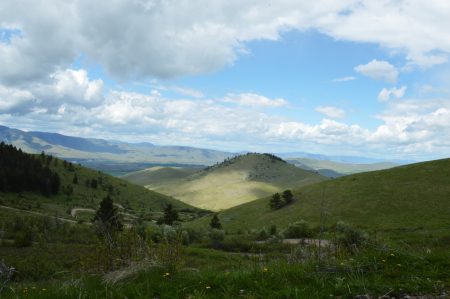

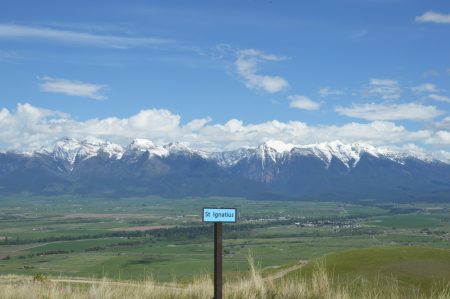
There is space for about five cars to park at the Bitterroot Trailhead. It’s a quarter mile walk along a ridge. The vistas are breathtaking: the Mission Mountains to the East, and below the ridge, the gently winding Flathead River looks like a turquoise silk ribbon.
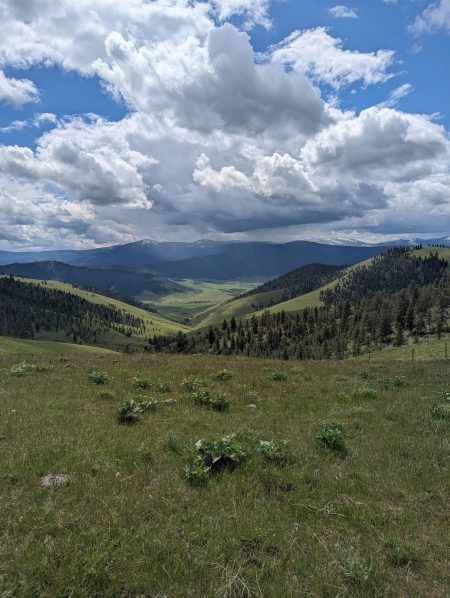
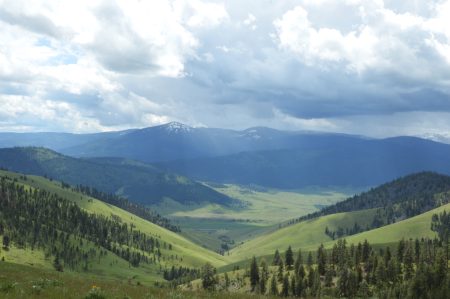

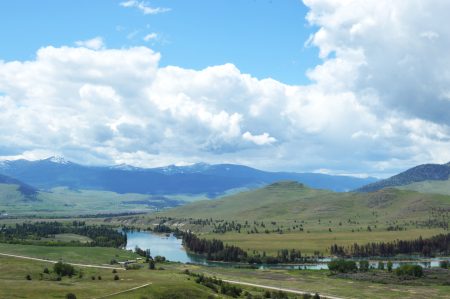
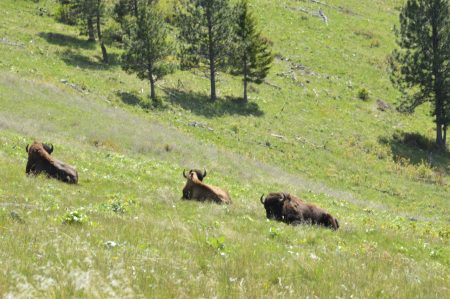
The trail is shorter at High Point. There’s more parking and restrooms. At 4,885 feet, it is the highest point on the drive. Here I see four bison resting on the hillside. On the other side of the ridge is a view of the Mission mountains.
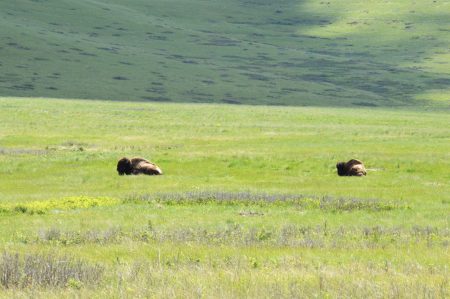
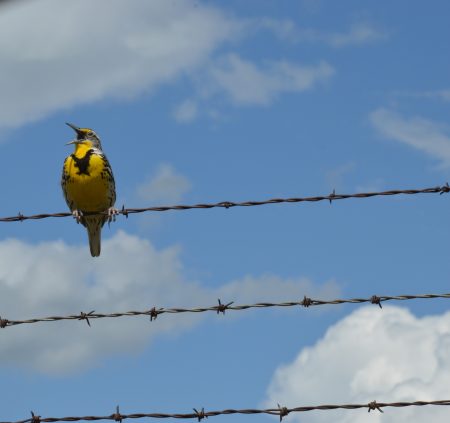
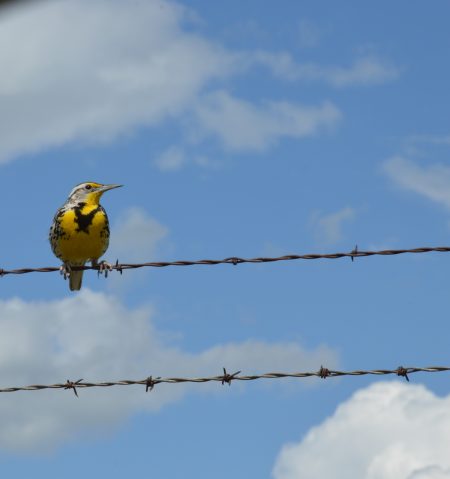
Driving down Antelope Ridge, there’s not an antelope in sight. As I passed Jon’s creek, I heard the same birdsong I’d heard at the beginning of the drive and glimpsed a bird sitting on the barbed wire fence. I put Freedom in reverse and slowly backed up, hoping that the bird would not fly away. To my joy, he sat there, singing his song, and posing for me, Mr. Western Meadowlark, the Montana State bird. Isn’t he beautiful?
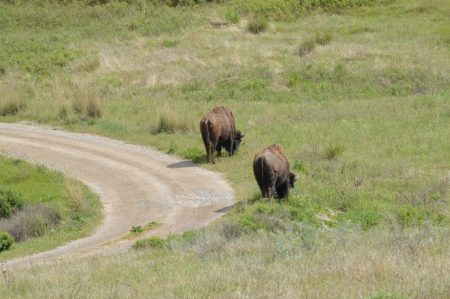
I entered the Western Loop and drove around the curve. On the road is a bison. I’m beside myself with excitement. He looks at me and I can almost hear him think, “Oh, another Lookie-Lou.” He takes his time crossing the road. I sit in utter wonderment at his enormity, and then take his picture. I continued on and encountered two more bison. After taking a few more photos, I exited the Bison Range feeling as if it was Christmas morning, and I’d gotten everything I wished for.
It took me two and a half hours to drive Red Sleep Mountain Road and West Loop Road. Inside the Range, there is a Visitor Center and Museum. There is a picnic area outside the entrance. It’s a wonderful way to spend a day.
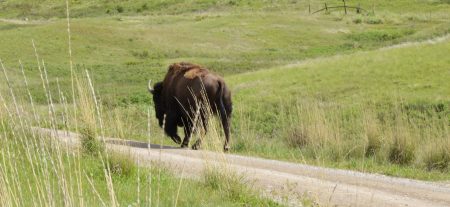
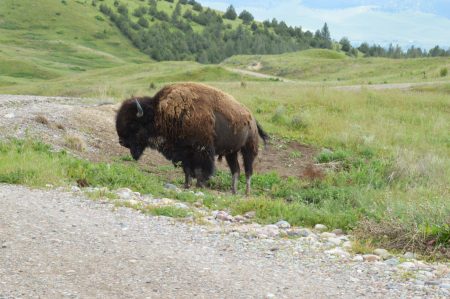
You are probably wondering why I refer to them as bison when they are buffalo. Aren’t they? Bison and Buffalo are in the Bovidae family, but they are different animals. Buffaloes are native to Africa and Asia. They are more docile and easily domesticated, but can be found in the wild. Bison are found in North America and Europe. Bison have massive heads and thick muscles on their neck and shoulders that allow them to survive and thrive in the bitter cold prairie winters, using their heads as plows to sweep away snow drifts to find food: grasses, sedges, and other grass-like plants.
So, Bison is the scientific name and buffalo is the culturally accepted common name. The names have come to be used interchangeably; call them what you wish.
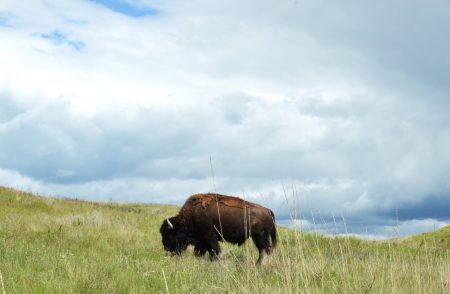
There was a time an estimated thirty to sixty million bison roamed North America like a great furry carpet, from the Appalachian Mountains in the East to the Rocky Mountains in the west, from northern Canada to northern Mexico, mostly in the Great Plains.
Bison provided not only food for Native Americans, but also clothing and tipis made from the hides. Also, soap was made from the fat, rope was made from hair, tools were made from the bones, cups, ladles, and other utensils were made from the horns. Bladders were used for storage, stomachs were used to boil water, tails were used as fly swatters, teeth and toe bones for games, sinew to bind things, and a hodge-podge of parts to make glue. Dry bison dung was used for fuel. Because Bison provided so much of itself for their survival, Native Americans also had a spiritual connection with them. They were honored as relatives and paid tribute through songs, dance, and prayers.
As European settlers arrived and Manifest Destiny surged westward, the mass destruction of Bison began, first for “parts,” such as hides and tongues, that were marketable in cities in the East, leaving bison bodies to rot in the Plains. Because bison were so important to the lives of Native Americans, annihilation of the Bison became part of the plan to subjugate them. In 1870, two million plains bison were killed in one year. Between 1874 and 1876, 5.4 million were killed, but it was the completion of the Transcontinental Railroad that accelerated the slaughter of the Bison, and by the late 1880s it is estimated that out of the millions that once roamed the American West, only 541 bison remained.
In the 1860s, when the Bison were on the brink of extinction, a tribal member, Atatice, asked the tribal chiefs if he could bring some Bison to the Flathead reservation. The chiefs could not reach a consensus, and Atatice abandoned his vision. While on a buffalo hunt, his son, Latati, brought some orphaned calves across the Continental Divide to the Flathead Reservation and fulfilled his father’s vision. A small herd began to flourish, and in 1884 Latati’s stepfather, Walking Coyote sold the herd of thirteen bison to Michel Pablo and Charles Allard without Latati’s consent.
Pablo’s mother was Blackfoot and Allard’s mother was Cree. Both married into the Confederated Salish Tribes and ranched on the Flathead Reservation, where they turned the bison loose to roam and wander over an area of fifty square miles. Protected from annihilation, the bison propagated freely, and the herd grew.
Shortly after graduating Yale University in 1870 with a degree in Zoology, George Bird Grinnell joined an expedition by the Peabody Museum to collect vertebrate fossils in the West. He spent many years studying the natural history of the region. In 1875 he was invited to serve as a naturalist and mineralogist on an expedition to Montana and the newly founded Yellowstone Park. During the winter of 1874-75 he documented the poaching of no less than three thousand buffalo, deer, elk, and antelope for their hides.
Grinnell was editor and contributor to Forest and Stream Magazine and his articles became the catalyst for the conservation movement. His expertise on western natural history helped form a friendship with Theodore Roosevelt. They launched the Boone and Crockett Club in 1887 to stop the profligate hunting of large mammals that could lead to their extinction, and worked together on legislation to preserve Yellowstone’s wildlife.
By the time Charles Allard died in 1896, the Allard- Pablo herd had grown to three hundred twenty bison. The herd was divided, and Allard’s wife received fifty-four bison that she sold to Charles Conrad. His two daughters received twenty-seven. When that herd grew to sixty-five, eighteen were sold to Yellowstone Park whose bison herd had diminished to twenty-two. In 1906, Pablo sold his herd of 700 Bison to Canada.
In 1908, The U.S. Government seized 18,524 acres of the Flathead Reservation to establish the National Bison Range. Thirty-six bison were purchased from the Conrad family for the initial herd. They were the direct descendants of the Allard-Pablo herd. Although the Range was on the Flathead Reservation, tribal members were prohibited from working there.
The Bison Range was returned to the stewardship of the Confederated Salish and Kootenai Tribes in 2020 by Congress by Public Law. The Tribes take pride in their relationship and history with these Bison, and hold an ongoing sense of responsibility for their well-being.
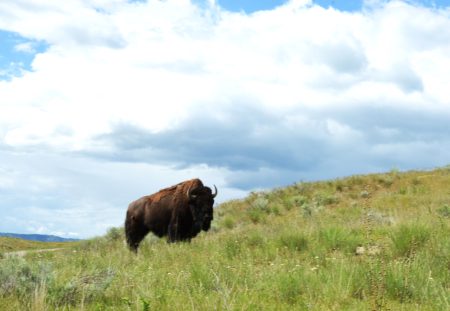
Yellowstone National Park is the only place in the United States where Bison have lived continuously since prehistoric times and represent the best example for preservation of wild plains Bison. Approximately five thousand bison roam Yellowstone and some nearby areas in Montana. They congregate during the breeding season to compete for mates, as well as migrate to new habitat areas. Allowing these natural behaviors has enabled the successful return of a species that was on the brink of extinction just over a century ago, although Bison are considered “ecologically extinct” as a wild species.

The North American Bison was named the national mammal of the United States on May 9, 2016.
 The Write Mind of a Lefthander